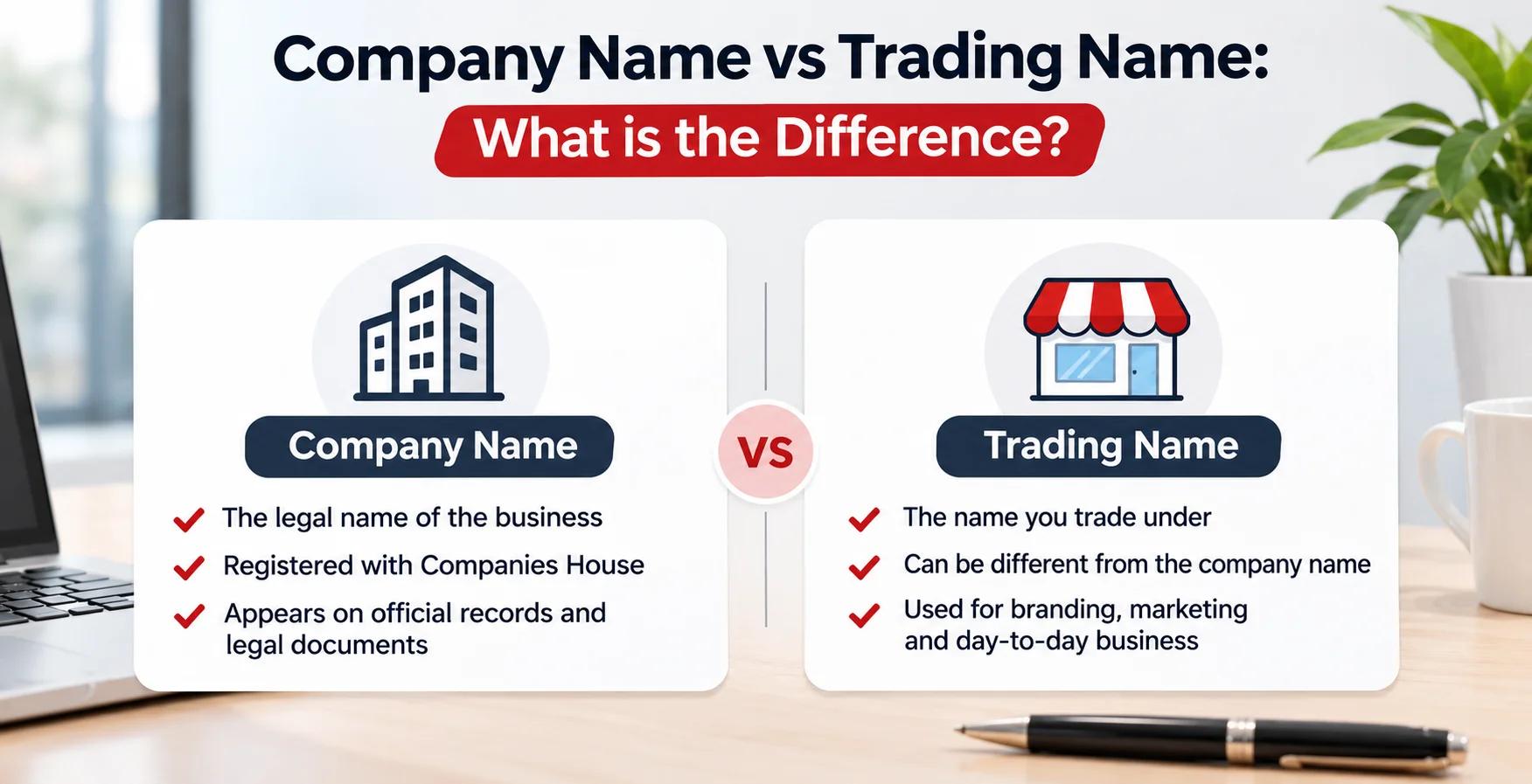
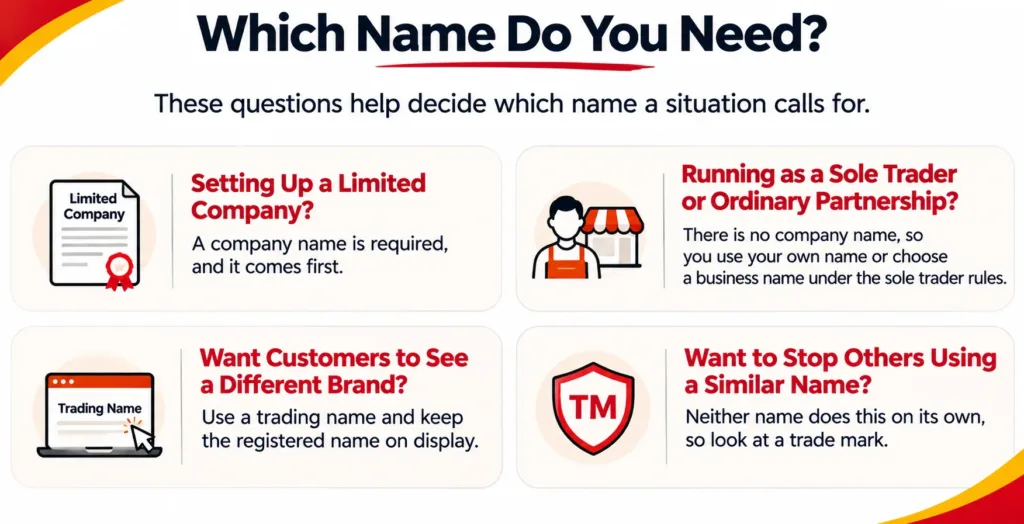
Company name vs trading name comes down to legal status. A company name is the legal name a business is registered under at Companies House, while a trading name is a different name it uses with customers, and you do not need to register it. A private limited company name usually ends in “Limited” or “Ltd” and cannot match another registered name.
Trading name vs company name also changes what you put on invoices, letters and websites, because a limited company must still show its full registered name on invoices, and its registered number and registered office address on letters and websites. A trading name, which the UK government calls a business name, needs no filing. Sole traders and partnerships have no company name, so they trade under their own name or a business name, and neither needs registering. Neither name gives automatic trade mark protection, so a business that wants it should register a trade mark.
What is a Company Name?
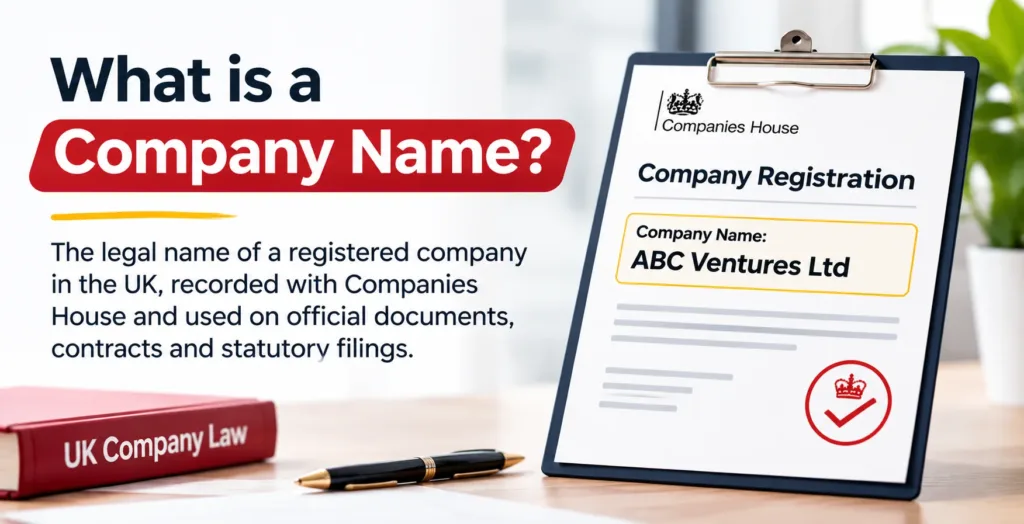
A company name is the legal name a business is registered under at Companies House. A private limited company name must usually end in “Limited” or “Ltd”, and it cannot be the same as the name of another registered company. Companies House records the name on the certificate of incorporation it issues when the company is registered. The same name appears on the public register, which anyone can search online to find the company’s registered number, registered office address and filing history. That name is the one the company uses on its annual accounts, confirmation statements and contracts, so it stays the same when the business trades under something different.
The rules come from the Companies Act 2006 and are applied by Companies House, which checks every proposed name against the following points.
- “Same As” Names: A name cannot be the “same as” an existing one. Names count as the same when the only difference
s are certain punctuation, special characters, words that look or mean much the same, or words that are very common in UK company names. The UK government’s example is that “Hands UK Ltd” and “Hand’s Ltd” are treated as the same as “Hands Ltd”. A “same as” name is only allowed if the companies belong to the same group, or the other company confirms in writing that it has no objection. - “Too Like” Names: A name can be challenged as “too like” another one. If someone complains and Companies House agrees that the name is too like one registered earlier, the company may have to change it, and Companies House contacts the company to explain what to do.
- Offensive Names: A company name cannot be offensive.
- Sensitive Words: A name cannot contain a sensitive word or expression, or suggest a link with government or local authorities, unless the company gets permission from the relevant government department. The UK government gives “Accredited” as one example, and publishes the list of words that need approval.
Before choosing a name, search the Companies House company name availability checker to see what is already on the register. A clear result is a good start but not a guarantee, because the UK government warns that a name too similar to another company’s name or to a registered trade mark may still have to change after a complaint.
What is a Trading Name?
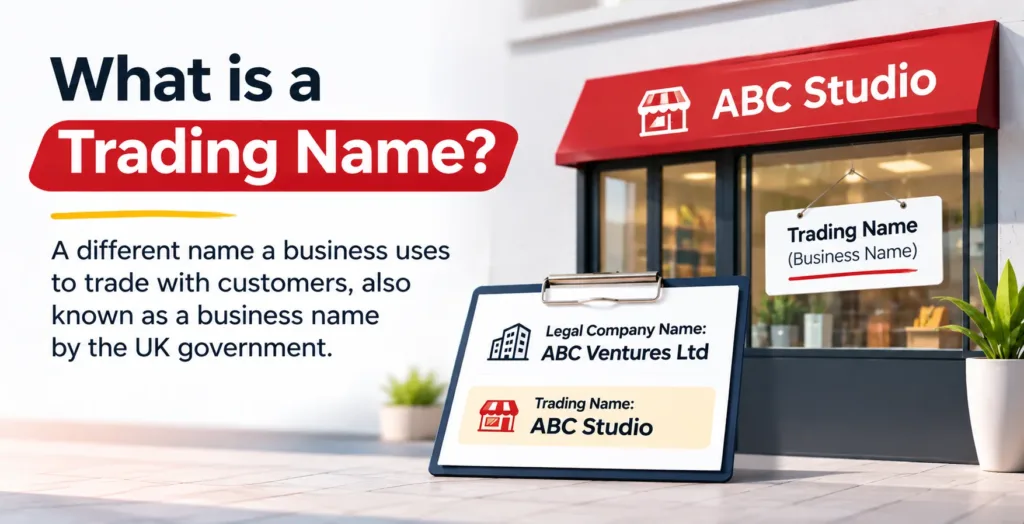
A trading name is the name a business uses with its customers when that name differs from its registered company name or, for a sole trader, from their own name. It is not registered anywhere, so nothing needs filing. The UK government calls it a business name, and some people also say trade name.
Trading names usually appear as “trading as”, often shortened to “t/a”. A company called ABC Ventures Ltd, for example, might trade as ABC Studio, with the registered name first and the customer-facing name second. The company remains the legal body behind the business, and the trading name is simply the label it uses day to day.
There is no register of trading names, but rules still apply. According to the UK government’s business name rules, a business name must not include “limited”, “Ltd”, “limited liability partnership”, “LLP”, “public limited company” or “plc”. It also cannot contain a sensitive word or expression without permission, a point covered in the company name section. If the name is too similar to another business’s trade mark, it may have to change after a complaint.
Can a Sole Trader or Partnership Use a Trading Name?
Yes, a sole trader or partnership can use a trading name. A sole trader, meaning a self-employed individual who has not formed a company, can trade under their own name or choose another business name, and neither needs to be registered. Ordinary business partnerships have the same choice, using the partners’ own names or a different name.
The same ban on company-type endings applies to sole trader names, which also must not be offensive or too similar to a trade mark, according to the UK government’s sole trader business name rules. Choosing a name is also a separate step from registering as a sole trader with HMRC, so a sole trader business name never needs its own registration.
Invoices, letters and other official paperwork must show the sole trader’s own name alongside the business name, if there is one. A sole trader called Sam Reed running a business named Reed Joinery would put both on an invoice. Partnerships follow a similar rule, showing all the partners’ names plus the business name.
What is the Difference Between a Company Name and a Trading Name?
The difference between a company name and a trading name is that a company name is the registered legal name of a company and must usually end in “Limited” or “Ltd”, while a trading name is the name the business uses with customers instead, which needs no registration and gives no automatic protection.
A limited company always has a company name and may add trading names on top, while sole traders and ordinary partnerships have no company name at all.
The table below compares them point by point, using the UK government’s company name rules.
| Feature | Company Name | Trading Name |
|---|---|---|
| Legal status | Legal name of a registered company | Different name used with customers, called a business name by the UK government |
| Where it is recorded | Companies House register and certificate of incorporation | Not recorded, as there is no register of trading names |
| Must it end in Ltd or Limited | Usually, for a private limited company | No, and it must not include limited, Ltd, limited liability partnership, LLP, public limited company or plc |
| Uniqueness check | Cannot be the same as another registered name | No registry check, but it may have to change after a complaint if too similar to a trade mark |
| Legal protection | Registration alone gives no trade mark protection | None automatically, and a registered trade mark is the route |
| Must it be displayed | Yes, on signs, letters, order forms and websites, with the registered number, registered office address and place of registration | Optional to use, but the registered name must still appear, and sole traders must show their own name alongside it |
| Who can use it | Registered companies, not sole traders or ordinary partnerships | Limited companies, sole traders and partnerships |
| How it is changed | Filing with Companies House, which issues a new certificate | Start using the new name, with no filing |
| Example | ABC Ventures Ltd | ABC Studio |
The display row follows the UK government’s rules on what to display on company stationery.
What is the Difference Between a Trading Name and a Business Name?
There is no practical difference between a trading name and a business name, because in everyday UK use they mean the same thing. The UK government uses “business name” for the name a company or sole trader trades under, so guidance written for one applies equally to the other. The rules for that name are the ones set out above, which means the comparison between a business name and a company name is the one in the table above.
What are the Benefits of Company and Trading Names?
The main benefit of a company name is a registered legal name that no other registered company can share, while the main benefit of a trading name is that a business can run several brands or change its brand without changing its registered name. The trade-off is that a trading name carries no automatic protection, and the registered name must still appear beside it on invoices, letters, and websites.
A company name gives a limited company these benefits:
- A Name No Other Registered Company Can Share: The name cannot be the same as another registered company’s name, so the company has a unique name on the register.
- A Fixed Legal Identity: The registered name stays the same on annual accounts, confirmation statements and contracts, even when the business trades under something different.
- Proof of Incorporation: The certificate of incorporation records the company’s full name, registration number and date of incorporation, so the name is documented from the day the company is registered.
A trading name gives a business these benefits:
- Several Brands Under One Company: One company can trade under more than one name, so separate services or locations can have their own branding without forming new companies.
- Rebranding Without a Legal Name Change: Changing a registered name means filing with Companies House and paying a fee (£20 online at the time of writing), whereas a new trading name needs no filing, so the brand can change while the company stays as it is.
- A Shorter, More Marketable Name: A long or formal registered name can give way to something easier for customers to say and spell.
- Keeping an Established Name After an Acquisition: A business that has been taken over can keep trading under the name customers already know.
- Open to Sole Traders and Partnerships: Businesses with no company can also use a trading name, which the UK government calls a business name, so these benefits are not limited to limited companies.
Does a Company Name Need to Have Limited or Ltd?
Yes, a private limited company’s name must end in “Limited” or “Ltd”. The ending forms part of the registered name, and some companies limited by guarantee, such as certain charities and professional bodies, are exempt when their articles of association meet set conditions.
The UK government says a registered charity or a company limited by guarantee can drop the ending if its articles of association say the company meets all three conditions below.
- Purpose: The company promotes or regulates commerce, art, science, education, religion, charity or any profession.
- No Payouts to Shareholders: The company cannot pay its shareholders, for example through dividends.
- Contribution on Winding Up: Each shareholder must contribute to the company assets if it is wound up during their membership, or within a year of them stopping being a shareholder.
Once you know the name suffix rules, the practical questions are about using a trading name.
Is There a Difference Between Limited and LTD?
No, there is no difference between “Limited” and “Ltd” in a company name. “Ltd” is the short form of “Limited”, and the UK government treats either as an acceptable ending for a private limited company. The company should still use its name exactly as shown on its certificate of incorporation, because the UK government requires the full company name as it appears there on invoices.
How Do You Add a Trading Name to a Company?
You add a trading name to a company by simply starting to use it, because there is no filing and trading names are not recorded anywhere. The name must follow the restrictions below, and the company must keep its registered details visible wherever the name appears.
- Check the Rules: Test the name against the restrictions in the section below.
- Search the Registers: Look for similar names on the Companies House register and the trade mark register.
- Update Your Records: Change the website, invoices, email signatures and bank details.
- Keep Registered Details Visible: Show them beside the trading name.
On business letters, order forms and websites, the UK government requires the registered number, the registered office address, the part of the UK where the company is registered and the fact that it is a limited company, usually shown through the full name including “Limited” or “Ltd”. A copy-ready line looks like this.
ABC Ventures Ltd, trading as ABC Studio. Registered in England and Wales No. [number]. Registered office: [address].
Do I Need to Tell HMRC My Trading Name?
Yes, you generally need to tell HMRC your trading name if it is new or has changed. According to HMRC’s guidance on how to update your business details, you must tell them if you change your name, business name, or trading address. VAT changes must be reported within 30 days.
HMRC asks businesses to update their details for every tax and scheme they are registered for, which can include Corporation Tax, Self Assessment, PAYE and VAT. Construction Industry Scheme details are reported separately.
Are There Any Restrictions on Using a Trading Name?
Yes, there are restrictions on using a trading name, even though trading names are not recorded on any register. Three restrictions apply to any business name, covering company-type endings, sensitive words and trade marks, and sole traders face a fourth on offensive names. Breaking them can force a name change, though the trade mark rule applies only after a complaint.
- Company-Type Endings: The name cannot include “limited”, “Ltd”, “limited liability partnership”, “LLP”, “public limited company” or “plc”.
- Sensitive Words: The name cannot contain a sensitive word or expression without permission from the relevant government department.
- Trade Mark Similarity: The name may have to change if it is too similar to another company’s trade mark and someone makes a complaint.
- Offensive Names (Sole Traders): A sole trader’s name also cannot be offensive.
Can You Change a Trading Name Later?
Yes, you can change a trading name later, at any time and with no Companies House filing, as long as the new name follows the same restrictions. Changing the registered company name is different, because it is a formal filing. After switching, update everything that carries the old name, including the website, invoices, email signatures and bank details, and tell HMRC as described above. A registered name change takes more steps, because the company must tell Companies House before it tells HMRC. At the time of writing, Companies House charges £20 to change a company name online and £85 for the same-day service, as set out in the UK government’s Companies House fees list. Our guide on how to change a limited company name explains the process, and Xact + Accountants Company Name Change Service can handle it for you.
Should You Trademark a Company Name in the UK?
Yes, you should trademark a company name in the UK if the name matters to your business. A company name on its own does not protect your brand, and registering a company at Companies House gives no trade mark protection. A registered trade mark gives you the exclusive right to use the name for the goods (such as clothing, furniture or skincare) or services (such as accounting, plumbing or consultancy) it covers. It lets you take legal action if others use a similar name without permission.
Companies House registers companies, while the Intellectual Property Office (IPO), the government body that registers trade marks, handles the trade mark side, so the two are separate protections. A UK trade mark protects your brand in the UK and the Isle of Man only, and a business selling abroad would need to look at other countries separately. The application fee is also non-refundable, even if the application is not accepted, according to the IPO’s TM3 application form, which makes it sensible to check a name carefully before paying.
Companies House’s reply to a reader comment on its 2019 guide to company names, trading names and trade marks explains that “Oxford Kitchens” would be regarded as descriptive for a kitchen company based in Oxford, so a trade mark would be difficult to obtain. A name like “Wren” tells you nothing about kitchens and works well as a trade mark. The post dates from 2019, so it is useful for the principle only, and the IPO’s current guidance should be your guide for fees and rules.
A business without a registered trade mark may still have some protection under the common law of passing off, which protects a business’s reputation when another trader misleads customers. It is harder to prove than a registered right, and the other side may argue that a purely descriptive name lacks distinctiveness. A dispute of this kind is a matter for a solicitor or trade mark attorney rather than an accountant. Our guide to choosing a company name covers how trade marks fit into the naming process.
Is a Trade Name the Same as a Trademark?
No, a trade name is not the same as a trade mark. A trade name is the name a business uses to identify itself, while a trade mark is a sign, such as a name, logo, or slogan, that identifies particular goods or services and can be registered with the IPO. The two can use the same words, yet only the trade mark carries a registered right.
A trade mark is registered for named goods or services, so its protection reaches only as far as the application does. Using a trade name for years does not create the same registered right, which is why the two are treated separately.
Can You Trademark a Business Name?
Yes, you can trademark a business name if it is distinctive and not too similar to a mark already registered. The IPO’s free trade mark search shows which marks are already registered or applied for, so you can spot likely conflicts before paying any fee.
The IPO checks each application against existing marks, including ones that are similar rather than identical, so a search for close spellings and sounds as well as exact matches gives a fuller picture. For an important brand, a professional search by a solicitor or trade mark attorney is worth considering, because the free search is only a starting point.
The UK government says an application is published as soon as you apply, so others could use details from it, for example by buying the matching domain name. Securing the domain before applying reduces that risk.
How Much Does It Cost to Trademark a Company Name in the UK?
Since 1 April 2026, trademarking a company name in the UK costs £205 online for one class, and £60 for each extra class. A paper application costs £250, and renewal after 10 years costs £245. A class is a category of goods or services, so the total depends on how many your brand covers.
These figures come from the IPO’s trade mark forms and fees and its TM3 application form, which both reflect the changes that took effect on 1 April 2026. Older pages may still show the previous fees of £170 and £50, so do not rely on them. A trade mark usually takes around 3 to 4 months to be granted if there are no issues. Any issues the IPO raises have to be resolved first, so the time can be longer. The full process is set out in the UK government’s guide on how to register a trade mark.
Can I Register a Company Name Without Trading in the UK?
Yes, you can register a company name without trading in the UK by incorporating a company and keeping it dormant, meaning it is not trading. The company still has to file annual accounts and a confirmation statement with Companies House; it needs a UK registered office, and its directors must verify their identity.
A confirmation statement is a yearly check that the company’s details on the public register are correct, and at the time of writing, Companies House charges £50 to file one online. Which accounts a dormant company files depends on how Companies House classifies the company, as the UK government’s rules on dormant company accounts explain. Even the simpler version is required every year, so a dormant company suits a business planning to trade soon better than one that only wants to hold a name. Companies House has also suggested that a trade mark may be the better option when the only aim is to protect a name, and that professional advice is worth taking first.

How Do I Register a Company Name in the UK?
You register a company name by incorporating the company with Companies House. That means checking the name is available, choosing the company type, directors and shareholders, then filing the application. The digital fee has been £100 since 1 February 2026, and sole traders and ordinary partnerships have no business name registration at all.
The UK government’s step-by-step guide to setting up a limited company covers the order of the process. A company needs at least one director and at least one shareholder, who can be the same person, along with a registered office address and a SIC code, which describes what the company does. It must also identify any people with significant control, for example, anyone holding more than 25% of the shares or voting rights. Companies House’s current fee list shows paper applications at £124.
Identity verification has been mandatory for new directors and people with significant control (PSCs) since 18 November 2025, so a new director must verify before incorporating a company or being appointed. Existing directors confirm they have verified when their company files its next confirmation statement, during a 12-month transition that ends on 18 November 2026 at the time of writing. Companies House explains the rules in its identity verification announcement.
Xact + Accountants company formation and company name services can handle the application if you would rather not file it yourself.
Frequently Asked Questions
Can a Limited Company Have More Than One Trading Name?
Yes. A limited company can trade under more than one name, provided each follows the restrictions on trading names covered earlier. Check every name separately against the register and the trade mark search, because clearing one name says nothing about another.
Can Two Businesses Use the Same Trading Name?
Yes, in practice, because no register of trading names stops it. The risk comes from an earlier business with a reputation in the name, which can claim passing off, or from a trade mark owner, who can complain and force a name change.
Does a Trading Name Give Any Legal Protection?
Not by itself. A trading name carries no registered right, so protection comes from a registered trade mark or from passing off, which needs proof of reputation and customer confusion. A new or little-known name may have little reputation to prove.
What Happens If Someone Else Takes My Trading Name as Their Company Name?
You may be able to challenge it, depending on your rights. Companies House handles "too like" complaints about earlier registered company names, the Company Names Tribunal hears only opportunistic registrations, and a trade mark owner can take legal action. Take advice from a solicitor or trade mark attorney.
How Do I Check If a Company or Trading Name Is Already Taken?
Run four checks. Use the Companies House name availability checker and the IPO trade mark search, then look at domain names and social handles, and finish with a plain web search. Our guide to checking UK company name availability has more detail.
Can You Buy a Company Name?
Not directly, because a company name belongs to the company that holds it. You can buy a ready-made company and change its name, record a change of ownership of a registered trade mark with the IPO for £60 at the time of writing, or buy a domain from its owner.

About the Author: Ahmad Raza