
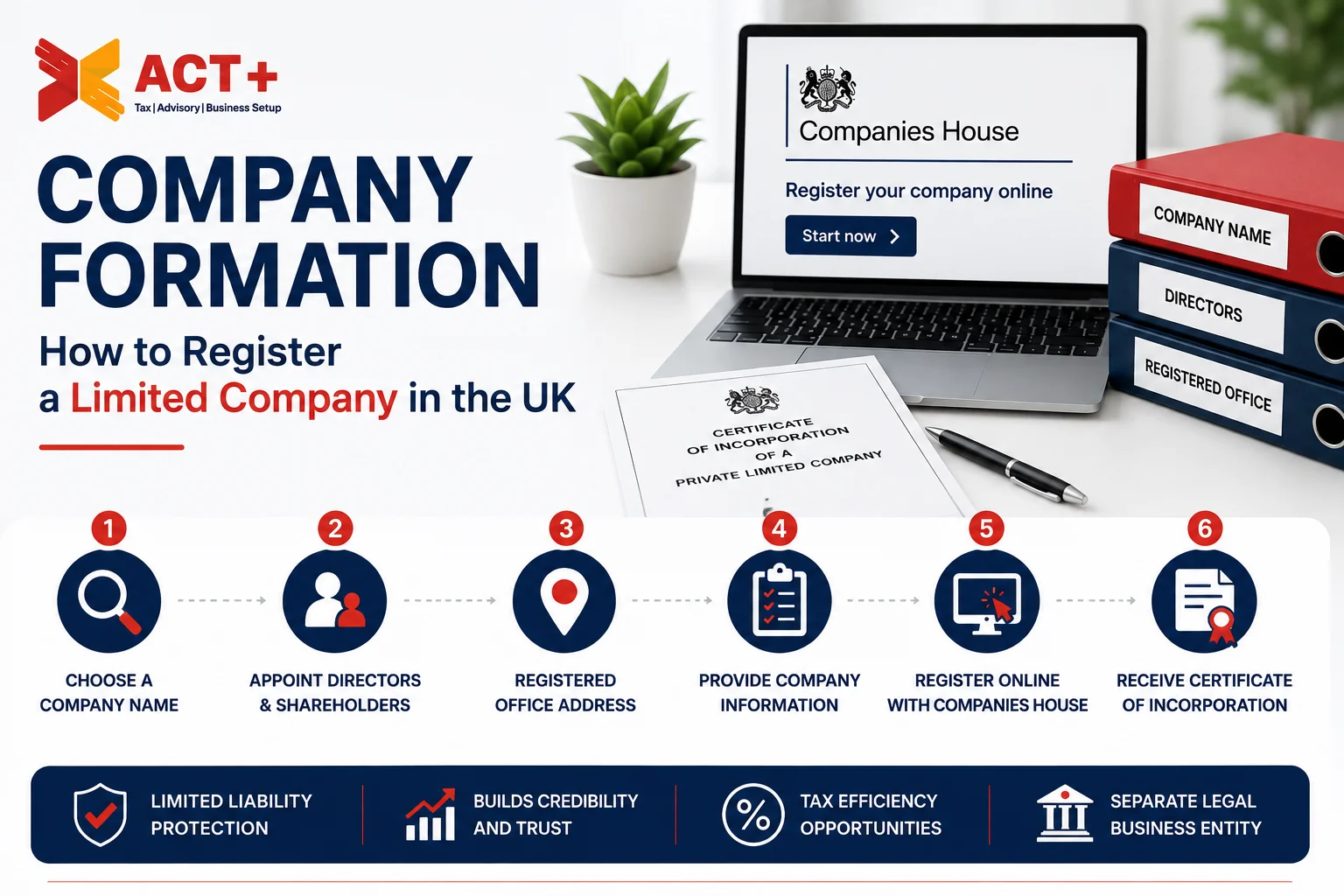
Company formation in the UK is the best way for many entrepreneurs to protect their personal assets, enhance business credibility, and create opportunities for future growth.
Understanding the UK company registration process can help you avoid delays and costly mistakes. Online company formation allows you to register a company with Companies House quickly and efficiently.
Successful limited company formation involves more than completing an online form. You must choose the correct company structure, appoint directors, issue shares, select a SIC code, and meet your legal responsibilities after incorporation.
What Is Company Formation?
Company formation is the legal process of creating a business that exists as a separate legal entity from its owners. Once incorporated, your business receives its own legal identity and becomes registered with Companies House.
A limited company can own assets, enter contracts, employ staff, and trade in its own name. The company’s finances also remain separate from the personal finances of its directors and shareholders.
Many entrepreneurs choose limited company formation because it provides limited liability protection. This means your personal assets are usually protected if the company experiences financial difficulties.
Businesses also choose company formation in the UK because it can:
- Improve business credibility
- Make it easier to raise investment
- Create tax planning opportunities
- Help win larger contracts
- Build long-term business value
Whether you plan to operate locally or internationally, completing your Companies House registration correctly is the foundation of a successful business.
What Types of Companies Can You Form?
The UK offers several legal structures depending on your business goals.
1. Private Limited Company (Ltd)
A private limited company is the most popular business structure in the UK. It offers limited liability, separate legal status, and flexibility for small and growing businesses. Most startups, consultants, e-commerce businesses, contractors, agencies, and family businesses choose this structure.
2. Public Limited Company (PLC)
A Public Limited Company can sell shares to the public. This structure suits larger businesses looking to raise investment through public markets. A PLC must meet higher capital and regulatory requirements than a private limited company.
3. Limited Liability Partnership (LLP)
An LLP combines features of a partnership and a limited company. Each partner enjoys limited liability while sharing responsibility for managing the business. Professional firms such as accountants, architects, and solicitors often choose this structure.
4. Community Interest Company (CIC)
A community interest company operates for social or community benefit rather than maximising profits. Many charities, social enterprises, and non-profit organisations choose this business model.
How Many People Are Required to Form a Limited Company?
You only need one person to start a private limited company in the UK.
That individual can act as the following:
- The company director
- The sole shareholder
This means a single person can own and manage the company. You can appoint multiple directors and shareholders if you plan to operate the business with partners or investors.
Every limited company must have at least the following:
- One director
- One shareholder
- One registered office address
- One person with significant control (PSC), where applicable
The director and shareholder can be the same person.

What Do You Need Before Forming a Company?
Preparing the correct information before submitting your application makes Companies House registration faster and helps prevent delays.
1. Registered Office Address
Every UK company must have a registered office address. This is the official address where Companies House and HMRC send legal correspondence.
The address must:
- Be located in the UK
- Match the country where the company is registered
- Be capable of receiving official mail
Many business owners use an accountant’s registered office service to protect their personal address.
2. Director Details
You must appoint at least one company director.
During company registration in the UK, Companies House requires information such as
- Full legal name
- Date of birth
- Nationality
- Occupation
- Service address
- Residential address (kept private in most cases)
A company director is legally responsible for managing the business and ensuring it meets its statutory obligations.
3. Shareholder Information
You must decide who owns the company before you form a company online.
For each shareholder, you should determine:
- Number of shares issued
- Share value
- Ownership percentage
- Voting rights, where applicable
Many new companies begin with one shareholder holding all issued shares.
4. SIC Code Selection
Every company must choose at least one Standard Industrial Classification (SIC) code. The SIC code tells Companies House what activities your business will carry out.
Examples include:
- Software development
- Retail sales
- Construction
- Property letting
- Consulting services
- Accounting and bookkeeping
Choosing the correct SIC code helps classify your business accurately.
5. Company Name
Choose a unique company name before submitting your application.
The name must:
- Be available on the Companies House register
- Not closely resemble an existing company
- Avoid restricted or sensitive words unless permission is obtained
- End with “Limited” or “Ltd” for private limited companies
A memorable company name also strengthens your brand and improves customer recognition.
6. Memorandum and Articles of Association
During limited company formation, Companies House requires two legal documents: the Memorandum of Association confirms that the founding shareholders agree to create the company.
Articles of Association explain how the company will be managed, including director powers, shareholder rights, voting procedures, and company rules. Most businesses use the standard model articles provided by Companies House, although bespoke articles are available for more complex company structures.
Who Can Form a Company in the UK?
Anyone can complete company formation in the UK, provided they meet the legal requirements set by Companies House. You do not need to be a UK citizen or UK resident to register a company in the UK.
UK Residents
UK residents can set up a company online in the UK by providing the required company and director information. Once incorporated, the company can begin trading immediately if all legal obligations are met. Many entrepreneurs choose online company formation because the process is simple, fast, and cost-effective.
Non-UK Residents
Non-UK residents can also form a company online in the UK. There is no legal requirement for directors or shareholders to live in the UK.
Every company must have:
- A registered office address in the UK
- At least one company director
- A suitable SIC code
- The required incorporation documents
Depending on your business activities, you may also need to register for corporation tax, VAT, or PAYE with HMRC.
Sole Traders Switching to a Limited Company
Many businesses begin as sole traders and later move to a limited company.
This often happens when:
- The business is growing quickly.
- Profits continue to increase.
- The owner wants limited liability.
- Customers prefer dealing with incorporated businesses.
- Tax planning opportunities become more important.
Changing from a sole trader to a limited company can improve credibility while separating personal and business finances.
How to Form a Company in the UK
If you have prepared your information, the company registration process in the UK is straightforward. Most applications can be completed online in less than an hour.
Step 1: Choose Your Company Name
Select a unique company name that complies with Companies House rules.
Before submitting your application:
- Check that the name is available.
- Avoid restricted words unless authorised.
- Ensure it reflects your business professionally.
A strong company name also helps build your brand.
Step 2: Decide Your Company Structure
Most businesses choose a private limited company.
You should also decide:
- Number of directors
- Number of shareholders
- Share allocation
- Voting rights
- Persons with Significant Control (PSC)
Choosing the correct company structure at the beginning reduces future administrative work.
Step 3: Select Your Registered Office Address
Every company must provide a registered office address located in the UK. This address appears on the public Companies House register and receives official correspondence from Companies House and HMRC. If you do not want your home address to appear publicly, you can use a professional registered office service.
Step 4: Choose Your SIC Code
Your SIC code describes your main business activity. Selecting the correct code helps Companies House classify your company correctly. If your business carries out more than one activity, you can choose multiple SIC codes where appropriate.
Step 5: Prepare Your Incorporation Documents
Before submitting your application, you will need:
- Memorandum of Association
- Articles of Association
- Director details
- Shareholder information
- Registered office address
- Company name
- SIC code
Step 6: Submit Your Companies House Registration
You can submit your Companies House registration online or by post. Online applications are usually processed much faster than paper applications. Companies House issues a Certificate of Incorporation confirming that your company legally exists.
Step 7: Register for Corporation Tax
HMRC normally registers your company for corporation tax using the information Companies House provides.
If required, you may also need to register for:
- VAT
- PAYE
- Construction Industry Scheme (CIS)
How Long Does It Take to Incorporate a Private Limited Company?
Most online applications are approved within 24 hours when all information is accurate. Companies House processes thousands of applications each day. Straightforward online applications often receive approval the same working day. Paper applications usually take several working days because they require manual processing.
Errors can delay incorporation. Common issues include:
- Incorrect director details
- Duplicate company names
- Missing shareholder information
- Incorrect SIC codes
- Invalid registered office addresses
Using an experienced company formation specialist helps reduce delays by checking every part of the application before submission.
What Documents Are Required for Company Formation?
Preparing the correct documents before applying makes the registration process much smoother.
You will normally need:
- Proposed company name
- Registered office address
- Director identification details
- Shareholder information
- Share capital details
- Persons with Significant Control (PSC)
- Memorandum of Association
- Articles of Association
- SIC code
- Contact details for official correspondence
Some businesses may also require additional documentation depending on their industry or regulatory requirements. Keeping these documents organized makes future Companies House filing much easier.
How Much Does Company Formation Cost?
The total cost depends on how you choose to register your company. If you submit the application directly to Companies House, you only pay the government incorporation fee. Many business owners also choose a professional company formation agent because they receive additional services, such as:
- Company registration
- Registered office address
- Digital incorporation documents
- Share certificates
- Ongoing compliance support
- HMRC registration guidance
Although using an accountant or formation agent costs more than registering yourself, it often saves time and reduces the risk of errors. For growing businesses, professional advice can be a worthwhile investment from the start.
How Long Does Company Formation Take?
The registration process itself is only one part of setting up a business.
A typical timeline looks like this:
What Happens After Company Formation?
Receiving your Certificate of Incorporation is only the beginning. Once your company has been registered, you should complete several important tasks.
Open a Business Bank Account
Keeping personal and business finances separate makes bookkeeping and tax reporting much easier.
Most UK banks require your Certificate of Incorporation and proof of identity before opening an account.
Register for VAT (if required)
You must register for VAT if your taxable turnover exceeds the current HMRC threshold or if voluntary registration benefits your business.
Set Up Payroll
If you plan to employ staff or pay directors through PAYE, you should register as an employer with HMRC and operate payroll correctly.
Maintain Accounting Records
Every limited company must keep accurate financial records.
These include:
- Sales invoices
- Purchase invoices
- Bank statements
- Payroll records
- Expense receipts
Good recordkeeping simplifies annual accounts preparation.
File Annual Accounts and Confirmation Statements
Every company must submit annual accounts and a confirmation statement to Companies House. Missing filing deadlines can result in financial penalties and may eventually lead to compulsory strike-off. Staying compliant protects your company’s reputation and ensures it remains legally active.
What Are Company Formation Agents in the UK?
A company formation agent is a professional or business that helps entrepreneurs register a company with Companies House. They simplify the incorporation process and ensure the application is completed correctly.
Although you can complete online company formation yourself, many business owners choose a formation agent to save time and reduce the risk of mistakes.
A company formation agent may provide services such as:
- Preparing and submitting your Companies House registration
- Checking your proposed company name
- Providing a registered office address
- Preparing the Memorandum and Articles of Association
- Issuing share certificates
- Advising on company structure
- Helping with Corporation Tax, VAT, and PAYE registration
- Providing ongoing compliance support
Using an experienced accountant or formation specialist is especially valuable if you are starting your first business or have more complex requirements.
What Are the Benefits of Company Formation?
Choosing limited company formation offers several advantages over trading as a sole trader.
Some of the key benefits include:
- Limited liability: Your personal assets are generally protected if the company experiences financial difficulties.
- Professional image: Many customers, suppliers, and lenders prefer dealing with limited companies.
- Separate legal identity: The company can own assets, enter contracts, and borrow money in its own name.
- Tax planning opportunities: Directors can often combine salary and dividends in a tax-efficient way, depending on their circumstances.
- Business continuity: A limited company can continue operating even if ownership changes.
- Easier investment: Companies can issue shares to attract investors or bring in new shareholders.
- Greater credibility: Incorporation can strengthen your reputation with clients, banks, and business partners.
What Mistakes Should You Avoid When Registering a Company in the UK?
Small mistakes during company registration in the UK can cause delays or create compliance issues later.
Some of the most common mistakes include:
- Choosing a company name that is already registered.
- Selecting the wrong SIC code.
- Using an incorrect or unsuitable registered office address.
- Entering inaccurate director or shareholder information.
- Issuing the wrong number of shares.
- Forgetting to register for Corporation Tax or VAT when required.
- Missing annual filing deadlines.
- Mixing personal and business finances.
- Failing to keep proper accounting records.
Taking time to prepare your application carefully helps you avoid unnecessary complications.
Can I Form a UK Company as a Non-UK Resident?
Yes, Non-UK residents can legally register a UK company without living in the country.
There is no requirement for directors or shareholders to be UK residents.
However, you will still need:
- A UK registered office address
- At least one company director
- A company name that meets Companies House rules
- A valid SIC code
- The required incorporation documents
Depending on your activities, you may also need to register for corporation tax, VAT, or PAYE. Many overseas entrepreneurs choose the UK because it offers a well-established legal system and a straightforward incorporation process.
What Happens If Companies House Rejects My Application?
Companies House may reject your application if it contains errors or missing information.
Common reasons include:
- The proposed company name is unavailable.
- Director details are incomplete or incorrect.
- The registered office address is invalid.
- Required documents are missing.
- The SIC code is incorrect.
- Shareholder information is incomplete.
If your application is rejected, Companies House usually explains the reason. You can correct the issue and submit a new application. Reviewing your information before submission significantly reduces the chance of rejection.
Do I Need to Tell HMRC When I Register a Company?
Yes, every limited company must meet its tax obligations.
After incorporation, HMRC will normally register your company for Corporation Tax using the information provided by Companies House.
Depending on your business activities, you may also need to:
- Register for VAT
- Register as an employer for PAYE
- Register for the Construction Industry Scheme (CIS), if applicable
Even if your company is not trading immediately, you should understand your reporting obligations and keep accurate records from the start.
What Is the Difference Between a Company Limited by Shares and a Company Limited by Guarantee?
Both are limited companies, but they serve different purposes.
Most businesses choose a company limited by shares, while charities and community organisations often choose a company limited by guarantee.
Which Is Better: Sole Trader or Limited Company?
The right structure depends on your goals, income, and level of business risk.
Sole Trader
A sole trader is the simplest business structure.
Advantages
- Easy to start
- Lower administrative requirements
- Full control of the business
- Simpler accounting
Disadvantages
- Unlimited personal liability
- Fewer tax planning opportunities
- Less credibility with some customers and lenders
Limited Company
A limited company is a separate legal entity.
Advantages
- Limited liability protection
- Greater business credibility
- Potential tax planning opportunities
- Easier to attract investors
- Better long-term growth potential
Disadvantages
- More reporting obligations
- Annual accounts and Confirmation Statements are required
- Additional administrative responsibilities
Many businesses begin as sole traders before changing to a limited company as they grow.
Which Is Better: A Trademark or a Registered Company?
A registered company and a trademark protect different aspects of your business. A registered company protects your legal business name within the Companies House register. A trademark protects your brand identity, including your business name, logo, slogan, or other distinctive marks used in trade. Registering a company does not automatically give you trademark protection. If your brand is valuable or you plan to expand, registering both your company and your trademark provides stronger legal protection.
What Is Better: An Ltd Company or a Sole Trader?
This is one of the most common questions asked by new business owners. If you want simplicity and have a small business with low risk, operating as a sole trader may be suitable. If you expect your business to grow, want limited liability, or require greater credibility, forming a limited company is often the better choice.
What Is the Difference Between Incorporation and Formation?
Incorporation and formation are often used interchangeably, but they have slightly different meanings.
In practice, they describe the same overall process.
- Company formation refers to creating a new company.
- Incorporation refers to the legal act of registering that company with Companies House.
Once incorporation is complete, the company becomes a separate legal entity.
Do You Need Professional Company Formation Services?
You can register a company yourself, but professional support often makes the process much easier.
A company formation specialist can:
- Ensure your application is accurate
- Help you choose the right company structure
- Advise on shares and ownership
- Register your company quickly
- Assist with Corporation Tax and VAT registration
- Explain your ongoing compliance responsibilities
- Support you with bookkeeping, payroll, annual accounts, and tax returns as your business grows
At Xact+ Accountants, we help entrepreneurs, contractors, consultants, landlords, start-ups, e-commerce businesses, and overseas investors complete their company formation in the UK quickly and correctly.

About the Author: Ahmad Raza