
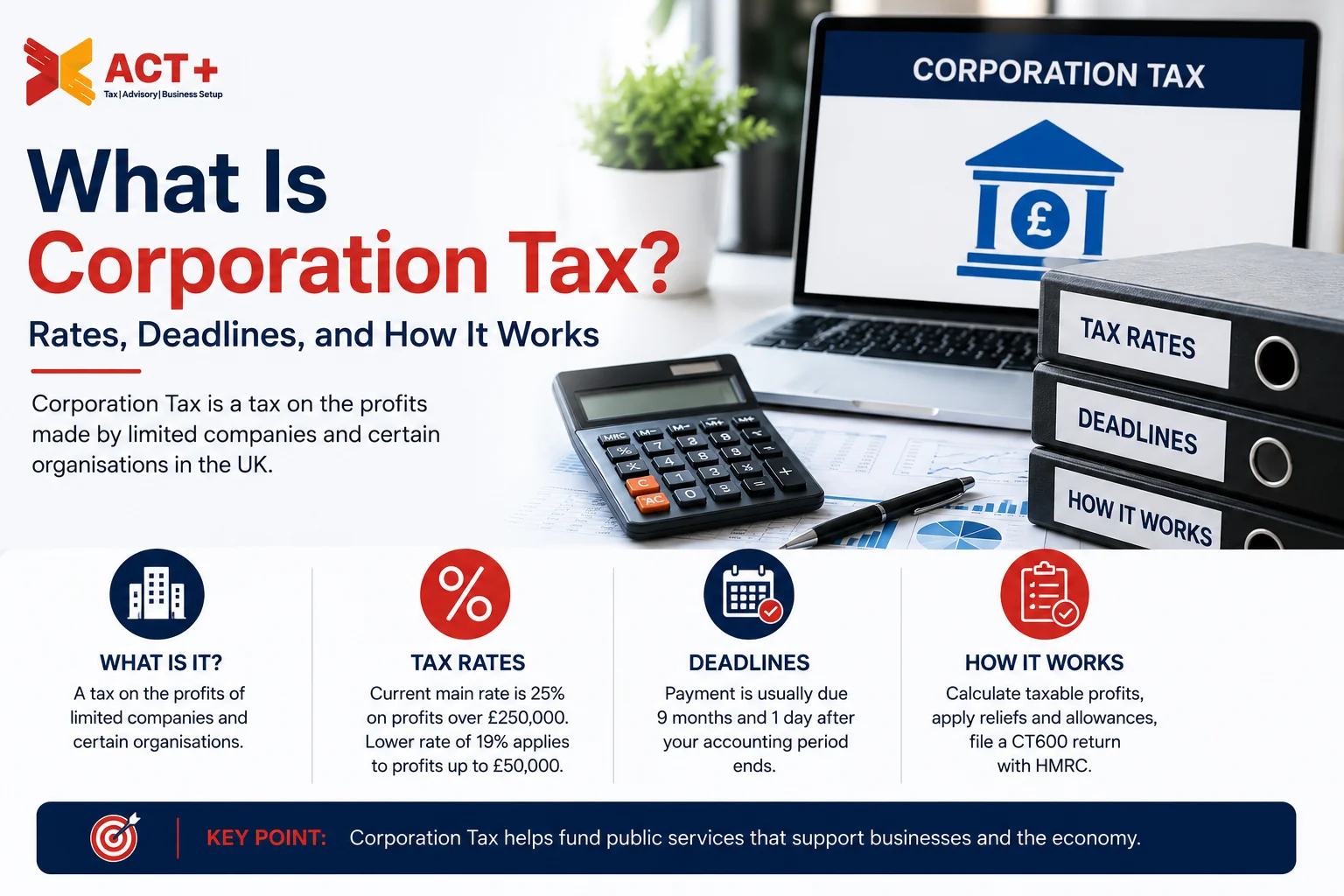
Corporation tax is a tax that companies and some organisations pay on their taxable profits. In the UK, it is collected by HM Revenue & Customs (HMRC). The amount a company pays depends on its taxable profit, the corporation tax rate that applies, and any tax reliefs it can claim.
For the financial year starting 1 April 2026, the main corporation tax rate is 25%. Companies with qualifying profits of £50,000 or less may pay the 19% small profits rate. If profits fall between £50,000 and £250,000, the company may be able to claim marginal relief, which can reduce its corporation tax bill.
Companies are responsible for working out how much corporation tax they owe, paying it on time, and sending a company tax return to HMRC. Keeping accurate records and understanding the main rules can help directors avoid late payment interest, penalties, and unexpected tax bills. This article explains what corporation tax is, the current rates, how it is calculated, important deadlines, payment rules, and common tax reliefs available to UK companies.
What Is Corporation Tax?
Corporation tax is charged on the taxable profits of companies and certain organisations. It can apply to trading income, investments, and chargeable gains from selling assets. A UK company normally calculates corporation tax for each accounting period.
The calculation starts with the company’s accounting records and accounts. Tax rules then adjust those figures to establish taxable profit. Corporation tax is separate from the tax paid personally by directors and shareholders. The company has its own tax obligations.
What Profits Are Subject to Corporation Tax?
Corporation tax can apply to trading profits, investment income, and chargeable gains. These amounts form part of the company’s taxable position. Trading profits come from normal business activities. A consultancy may earn fees from clients. A retailer may generate profit from selling products.
Investment income can arise from company investments. Chargeable gains can arise when a company disposes of certain assets at a gain. Accounting profit does not always equal taxable profit. Corporation tax rules require adjustments before the final liability can be calculated.

Is Corporation Tax the Same as Company Tax?
Company tax usually refers to corporation tax when people talk about the tax on a UK company’s profits. Corporation tax is the official term used by HMRC.
But corporation tax is not the only tax a company may need to deal with. Depending on its activities, a business may also have responsibilities for VAT, PAYE, and National Insurance contributions.
A company tax return is also different from paying corporation tax. The tax return reports the company’s income, expenses, taxable profits, and the corporation tax calculation. The corporation tax payment is the actual amount the company pays to settle its tax bill.
What Are the Corporation Tax Rates?
For the financial year starting 1 April 2026, the corporation tax rate a UK company pays depends mainly on the level of its taxable profits.
- 19% small profits rate applies to companies with taxable profits of £50,000 or less.
- 25% main rate applies when taxable profits are more than £250,000.
- Marginal Relief applies when profits are between £50,000 and £250,000. This provides a gradual increase in the amount of corporation tax due as profits rise.
For example, a company with taxable profits of £40,000 would normally pay corporation tax at 19%. A company with profits above £250,000 would normally pay the 25% main rate.
But these profit limits do not always stay at £50,000 and £250,000. They are reduced if the company has associated companies or if its accounting period is shorter than 12 months. This means a company should consider its own circumstances when working out which corporation tax rate applies, rather than looking at its taxable profit alone.
What Is Corporation Tax Marginal Relief?
Corporation Tax Marginal Relief can reduce the tax a company pays when its profits fall between £50,000 and £250,000. It provides a gradual move from the 19% small profits rate to the 25% main corporation tax rate. The standard marginal relief fraction is 3/200. The exact calculation can also depend on the company’s taxable total profits and augmented profits. For example, suppose a company has £100,000 of taxable profits and its augmented profits are also £100,000. It has no associated companies, and its accounting period is 12 months.
Corporation tax at 25% would be £25,000. The company can claim £2,250 of marginal relief, reducing its corporation tax bill to £22,750. This gives the company an effective corporation tax rate of 22.75%. This is a simple example. The actual calculation may be different if the company has associated companies, receives certain distributions, or has an accounting period shorter than 12 months.
What Is the Corporation Tax Rate for Profits Between £50,000 and £250,000?
Companies with profits between £50,000 and £250,000 are normally charged corporation tax at the 25% main rate before marginal relief is deducted. This means there is no single flat Corporation Tax rate for companies within this profit range. Instead, the company’s effective tax rate gradually increases as its profits move closer to £250,000. Within the standard marginal relief band, additional profits can effectively be taxed at a 26.5% marginal rate.
Still, this does not mean that all of the company’s profits are taxed at 26.5%. The 26.5% figure only describes the tax rate that can apply to each additional pound of profit earned within the marginal relief range. The company’s overall Corporation Tax rate will therefore remain below 25% until its profits reach the upper limit of the marginal relief band.
Do Associated Companies Affect Corporation Tax Rates?
Associated companies can reduce the £50,000 and £250,000 corporation tax profit limits. Companies are generally associated when one company controls another or when the same person or group of people controls both companies. Where associated companies exist, the normal corporation tax profit limits are divided by the total number of associated companies, including the company itself.
For example, if two companies are under common control, the standard £50,000 lower limit and £250,000 upper limit would normally be reduced to £25,000 and £125,000 for each company. This means a company may enter the marginal relief range or become subject to the 25% main corporation tax rate at a lower level of profit than a standalone company. The associated company rules should therefore be checked carefully when working out the corporation tax rate that applies.
Who Pays Corporation Tax?
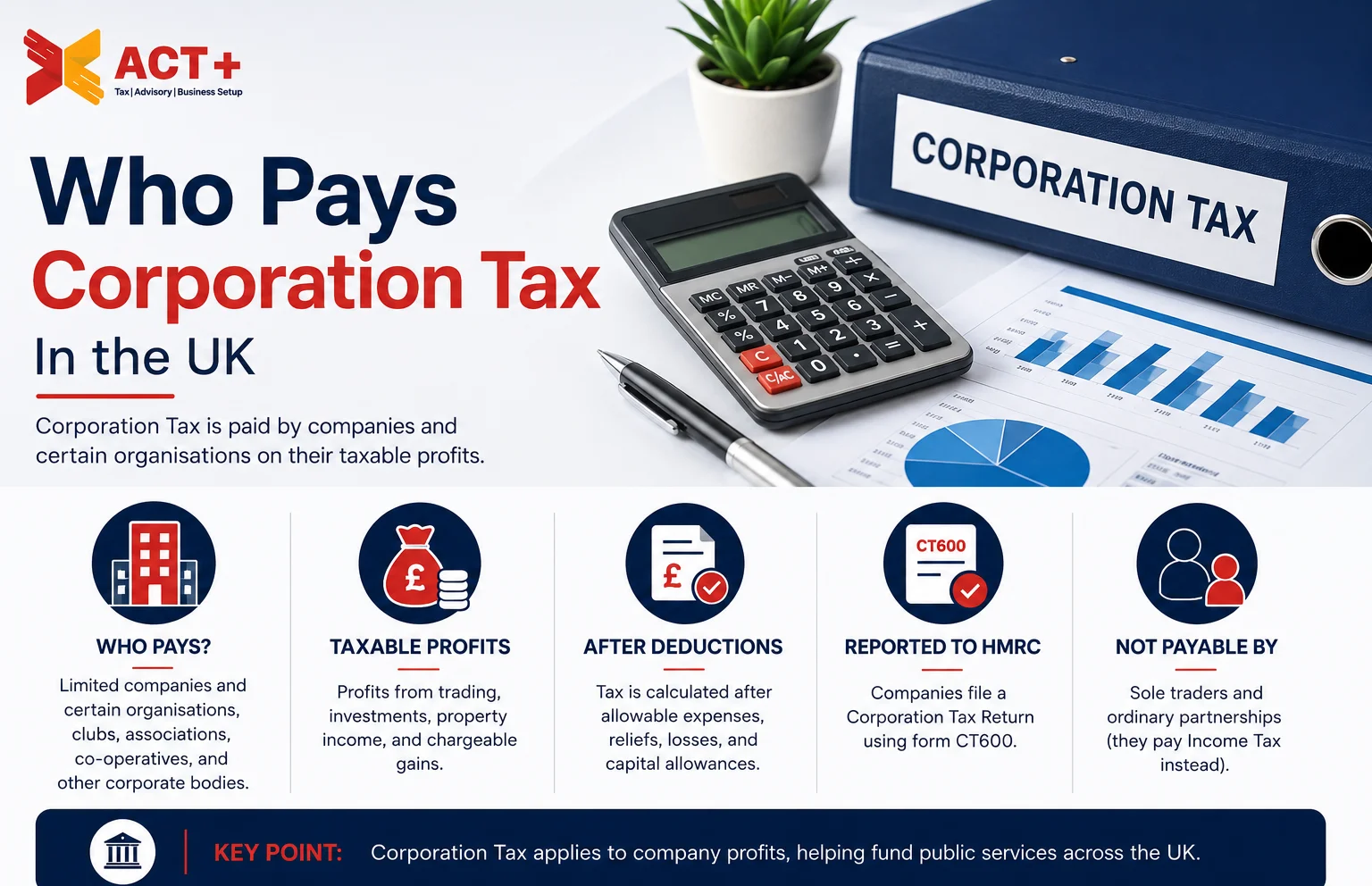
Corporation tax is mainly paid by companies and certain organisations on their taxable profits. In the UK, most limited companies must pay corporation tax when they make profits from trading, investments, or the sale of assets.
UK-resident companies are generally liable for corporation tax on profits earned in the UK and overseas. This includes private limited companies, public limited companies, and some other corporate bodies.
Certain organisations that are not registered as limited companies may also have to pay corporation tax. These can include clubs, societies, associations, housing associations, and some co-operatives when they carry out taxable activities.
A company may need to pay corporation tax on:
- Profits from selling goods or services.
- Investment income.
- Rental or property income.
- Chargeable gains from selling business assets.
Sole traders and ordinary business partnerships do not normally pay corporation tax. Instead, the individuals running these businesses usually pay income tax on their share of the profits through self-assessment.
Companies must calculate their taxable profits after considering allowable business expenses, capital allowances, losses, and available tax reliefs. The resulting corporation tax liability is reported to HM Revenue & Customs (HMRC) through the company’s corporation tax return, normally using the CT600 form.
Do Limited Companies Pay Corporation Tax?
Yes, UK limited companies normally pay corporation tax on their taxable profits. The company itself is responsible for paying corporation tax. Directors and shareholders do not normally pay the company’s corporation tax from their personal income. Directors may have their own income tax to pay on salaries, benefits, or other income they receive from the company. Shareholders may also need to pay tax on dividends paid to them.
This is because a limited company is treated as a separate legal and tax entity from its directors and shareholders. The company therefore has its own tax responsibilities, while the people connected with it may have separate personal tax obligations.
Do Sole Traders Pay Corporation Tax?
No, Sole traders do not pay corporation tax on their business profits. Instead, a sole trader normally reports their business income and expenses through self-assessment. They may then pay income tax and National Insurance based on the profits they earn.
This is different from a limited company, which is a separate legal entity and normally pays corporation tax on its taxable profits. Understanding this difference is important when comparing self-employment with running a limited company, as the tax rules and responsibilities are not the same.
Do Partnerships Pay Corporation Tax?
Ordinary partnerships generally do not pay corporation tax on their business profits. Rather, each partner normally pays tax on their share of the partnership’s taxable profits. Individual partners usually report this income through self-assessment and may need to pay income tax and National Insurance.
Different rules can apply if a limited company is a partner in the business. In that case, the company may have to pay corporation tax on its share of the partnership profits. This means the tax treatment depends on who the partners are and how the partnership is structured.
Do Charities, Clubs, and Associations Pay Corporation Tax?
Some clubs, societies, and unincorporated associations may need to pay corporation tax. This can depend on the activities they carry out and the type of income they receive. For example, tax may be due on trading profits, investment income, or gains made from selling certain assets.
An organisation does not always need to be a limited company to fall within the corporation tax system. If a club, society, or association carries out taxable activities, it may need to register with HMRC, calculate its taxable profits, and submit a company tax return.
Charities are treated differently in many cases. A registered charity may qualify for special tax exemptions and reliefs when its income and gains are used for charitable purposes. However, some types of trading or non-charitable income may still be taxable.
The exact tax position depends on how the organisation is set up, where its income comes from, and how the money is used. This means clubs, societies, associations, and charities should check their individual circumstances before deciding whether corporation tax is due.
Do Non-UK Companies Pay Corporation Tax in the UK?
A non-UK company may need to pay UK corporation tax if it carries out certain activities in the UK. Its tax position can depend on the type of UK business activity, property income or gains, and whether it has a taxable presence in the UK. For example, a non-UK company may fall within UK corporation tax rules if it trades through a UK permanent establishment or receives certain profits from UK property.
International double taxation agreements may also affect where profits are taxed and can help prevent the same income from being taxed twice. Non-UK companies should therefore review their UK activities, income, and business structure carefully. They should not assume that being registered overseas automatically means there is no UK corporation tax liability.
How Is Corporation Tax Calculated?
Corporation tax is worked out by adjusting a company’s accounting profit to arrive at its taxable profit. The accounting profit shown in the company’s accounts is usually the starting point. Certain amounts may then need to be added back or deducted under corporation tax rules. Allowable business expenses can reduce taxable profit, while costs that are not allowed for tax purposes may increase it.
The company may also be able to claim capital allowances, use available trading losses, or apply other tax reliefs. These adjustments help determine the final amount of profit that is subject to corporation tax. Once the taxable profit has been calculated, the correct corporation tax rate is applied to work out how much tax the company needs to pay.
What Is Taxable Profit for Corporation Tax?
Taxable profit is the amount of profit a company uses to calculate its corporation tax liability. It is not always the same as the profit shown in the company’s financial accounts.
A company usually starts with its accounting profit and then makes tax adjustments according to UK corporation tax rules. Some business expenses shown in the accounts may not be allowable for tax purposes. These expenses are added back when calculating taxable profit.
Examples of expenses that may be disallowed include certain client entertainment costs, fines, penalties, and some non-business expenses. Depreciation charged in the accounts is also normally added back because tax relief on qualifying assets is generally claimed through capital allowances instead.
Taxable profit may include:
- Trading profits from normal business activities.
- Income from investments or property.
- Chargeable gains from selling taxable business assets.
- Other taxable company income.
The company may then reduce its taxable profit by claiming available tax reliefs. These can include trading losses, capital allowances, qualifying charitable donations, and certain other corporation tax reliefs.
The final taxable profit is used with the applicable corporation tax rate to calculate how much corporation tax the company must pay to HMRC for the relevant accounting period.
Are Capital Expenses Deductible for Corporation Tax?
Capital expenditure is usually treated differently from normal day-to-day business expenses for Corporation Tax purposes. It normally relates to buying, improving, or creating assets that the business will use for a longer period.
A company may be able to claim capital allowances on qualifying assets such as machinery, equipment, and certain business vehicles. These allowances can reduce taxable profits by allowing some or all of the cost of qualifying assets to be deducted for tax purposes. This is why it is important to understand the difference between capital expenditure and revenue expenditure.
Does Depreciation Reduce Corporation Tax?
Accounting depreciation does not usually reduce a company’s corporation tax bill. Instead, tax relief is normally given through capital allowances on qualifying assets. A company may include depreciation as an expense in its profit and loss account. This amount is generally added back when calculating taxable profit because depreciation is not normally an allowable tax deduction.
The company can then claim any available capital allowances on qualifying assets, such as machinery, equipment, or certain vehicles. This is one reason why the profit shown in the company’s accounts can be different from its taxable profit for corporation tax purposes.
Can Losses Reduce Corporation Tax?
Company losses can sometimes reduce the amount of Corporation Tax a business has to pay. This depends on the type of loss and whether the company meets the relevant loss relief rules.
For example, trading losses may be used against taxable profits in the same accounting period. In some cases, losses can also be carried forward to reduce profits in future periods or carried back against earlier profits.
Certain companies within a qualifying group may also be able to use group relief, allowing losses from one company to reduce taxable profits in another group company.
The way losses are used depends on the type of loss, when it arose, and the company’s individual circumstances. Using the correct loss relief can therefore make an important difference to the final Corporation Tax bill.
Do Dividends Reduce Corporation Tax?
No, Dividends paid to shareholders do not reduce taxable profits for corporation tax. HMRC treats dividends as distributions of profits rather than costs incurred to earn those profits. Dividends and other distributions are therefore not deductible when computing company income.
For example, assume a company has £80,000 of taxable profit. Paying £30,000 of dividends does not reduce that taxable profit to £50,000. The company calculates corporation tax separately. It can then distribute available profits when company law permits.
How Do You Calculate Corporation Tax From Profit?
Corporation tax is calculated by working out the company’s taxable profit and applying the appropriate corporation tax rate. The calculation starts with the profit shown in the company accounts, but accounting profit may need several tax adjustments before the final tax liability is calculated.
A simple calculation follows these steps:
- Start with the company’s accounting profit.
- Add back expenses that are not allowable for corporation tax.
- Deduct allowable tax reliefs and capital allowances.
- Include any taxable income and chargeable gains.
- Deduct available losses or other qualifying reliefs.
- Apply the relevant corporation tax rate to the final taxable profit.
For the 2026/27 financial year, the small profits rate is 19% for qualifying companies with profits of £50,000 or less. The main rate is 25% for profits above £250,000. Companies with profits between these limits may qualify for marginal relief.
For example, if a qualifying company has taxable profits of £40,000, corporation tax at 19% would be:
£40,000 × 19% = £7,600 Corporation Tax. The £50,000 and £250,000 profit limits can be reduced where a company has associated companies or a shorter accounting period.
When Are Corporation Tax Deadlines?
Most companies have different deadlines for paying corporation tax and filing their Company Tax Return. For many companies, Corporation Tax is normally due 9 months and 1 day after the end of the accounting period. Different payment rules can apply to larger companies that pay Corporation Tax by instalments. The Corporation Tax Return is usually due 12 months after the end of the accounting period.
These deadlines are different from the deadline for filing annual accounts with Companies House, so companies should keep track of each date carefully. A corporation tax financial year is not always the same as a company’s accounting period.
The UK Corporation Tax financial year runs from 1 April to 31 March. A company’s accounting period is the period used to calculate its corporation tax. It will often follow the period covered by the company’s accounts, although there can be exceptions.
When Do You Have to Pay Corporation Tax?
Most companies must pay their corporation tax 9 months and 1 day after the end of their accounting period. For example, if a company’s accounting period ends on 31 March 2026, its normal corporation tax payment deadline will be 1 January 2027.
The company should therefore prepare its corporation tax calculation before the payment deadline so it knows how much tax is due. The deadline for filing the company tax return is usually later than the payment deadline. Waiting until the return is due before working out the tax could therefore lead to a late corporation tax payment and possible interest or penalties.
When Is a Company Tax Return Due?
A company tax return is normally due 12 months after the end of the company’s accounting period. For example, if the accounting period ends on 31 March 2026, the normal filing deadline will be 31 March 2027.
The corporation tax filing usually includes the company’s tax return, annual accounts, and supporting tax calculations where required. The CT600 is the main form used to report the company’s corporation tax position to HMRC. It shows key details such as taxable profits, tax reliefs, and the amount of corporation tax due.
Is Corporation Tax Due Before the Company Tax Return?
Yes. Corporation Tax is normally due before the company tax return filing deadline. Most companies must pay their corporation tax 9 months and 1 day after the end of the accounting period. The company tax return is usually due 12 months after the accounting period ends.
For example, if a company’s accounting period ends on 31 March 2026, the corporation tax payment is normally due on 1 January 2027. The company tax return is then normally due on 31 March 2027. Preparing the company accounts and tax calculation early helps the business know how much corporation tax it needs to pay before the payment deadline. This can also reduce the risk of late payment interest and other problems.
When Do Large Companies Pay Corporation Tax?
Companies with higher taxable profits may have to pay corporation tax through instalments. HMRC states that companies with taxable profits above the relevant £1.5 million threshold can fall within instalment payment rules.
Frequently Asked Questions About Corporation Tax
How do you pay Corporation Tax?
Can you pay Corporation Tax online?
What happens if you pay Corporation Tax late?
How do you register for Corporation Tax?
What are the Corporation Tax penalties?
What happens if you file your Company Tax Return late?
Is there a penalty if you have no Corporation Tax to pay?
What is the difference between Corporation Tax and Income Tax?
What is the difference between Corporation Tax and VAT?
What is the difference between Corporation Tax and PAYE?

About the Author: Ahmad Raza