
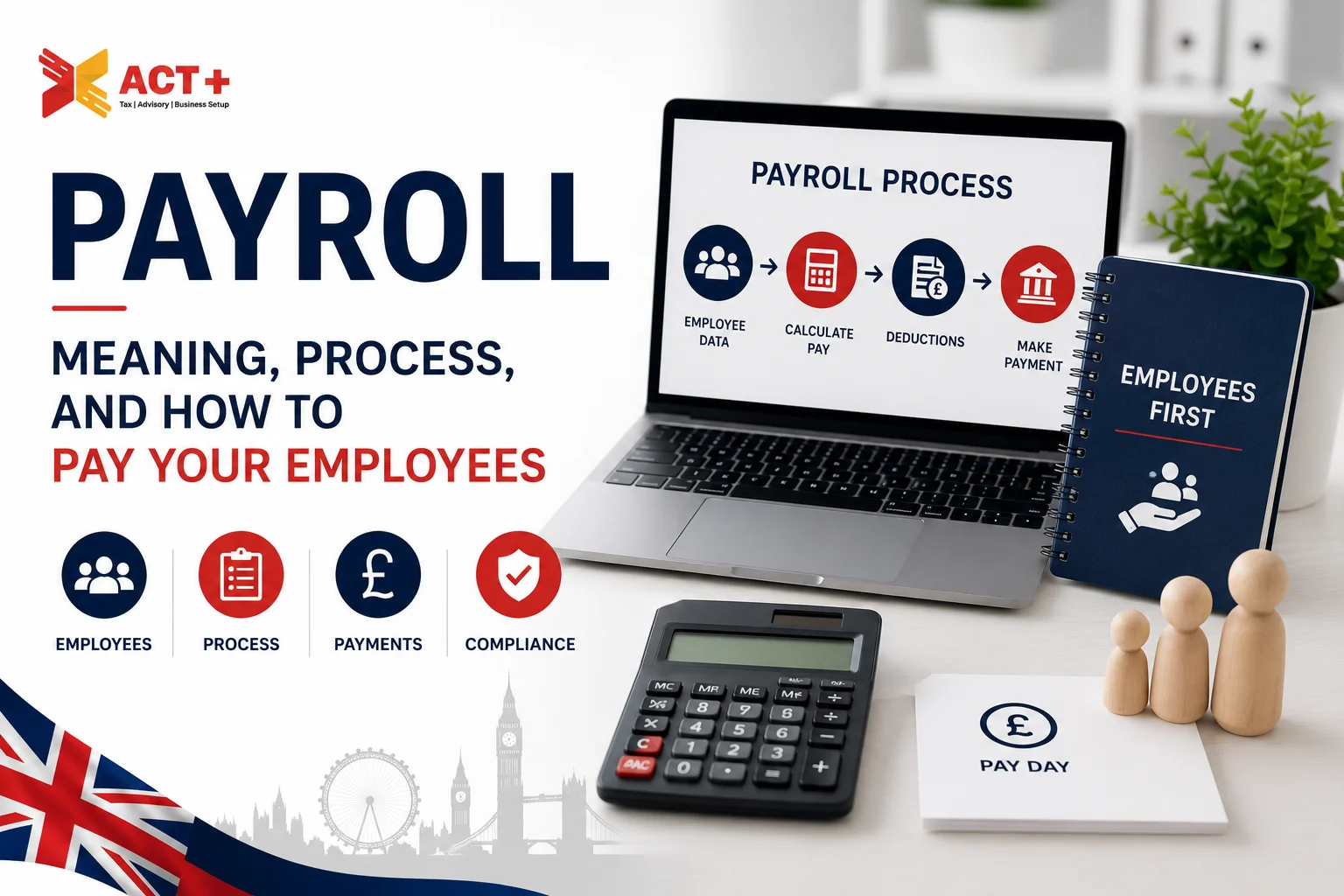
Payroll is one of the most important business functions in the UK. Every employer must calculate employee pay correctly, deduct the right taxes, report payroll information to HMRC, and pay employees on time. A reliable payroll process helps businesses comply with UK employment and tax laws while building trust with their workforce.
Many business owners search for what is payroll, how do I do payroll, payroll UK, running payroll, or payroll processing when employing staff for the first time. You may also see common misspellings such as psyroll, pay roll, pay role, payrol, and payrool. All of these searches refer to the same business process of calculating and paying employees correctly.

What is payroll?
Payroll is the process of calculating employee pay, deducting taxes and other contributions, reporting payroll information to HMRC, and paying employees accurately and on time. The definition of payroll covers every financial activity linked to employee wages. Payroll includes salary calculations, overtime, bonuses, tax deductions, National Insurance contributions, pension contributions, statutory payments, and employer reporting requirements.
Employers usually operate payroll through the Pay As You Earn (PAYE) system. PAYE allows employers to deduct income tax and National Insurance before employees receive their wages. Many people ask what payroll does. Payroll ensures employees receive the correct wages while employers meet their legal obligations to HMRC. Businesses can manage payroll internally, use payroll software such as Xero Payroll, or outsource payroll to specialist UK payroll service providers.
✓ Free consultation • Accurate & hassle-free payroll services
What Is Included in Payroll?
Payroll includes all financial details linked to employee pay, deductions, and employer contributions. Accurate payroll information allows a business to calculate wages correctly, meet HMRC reporting duties, issue payslips, and maintain a complete employment payment record for every employed worker.
Typical payroll information includes the following:
- Employee name
- Payroll number
- National Insurance number
- Tax code
- Gross salary
- Hourly wages
- Overtime payments
- Bonuses
- Commission
- Pension contributions
- Student loan deductions
- National Insurance deductions
- Income Tax deductions
- Statutory Sick Pay
- Statutory Maternity Pay
- Net employee pay
- Employer National Insurance contributions
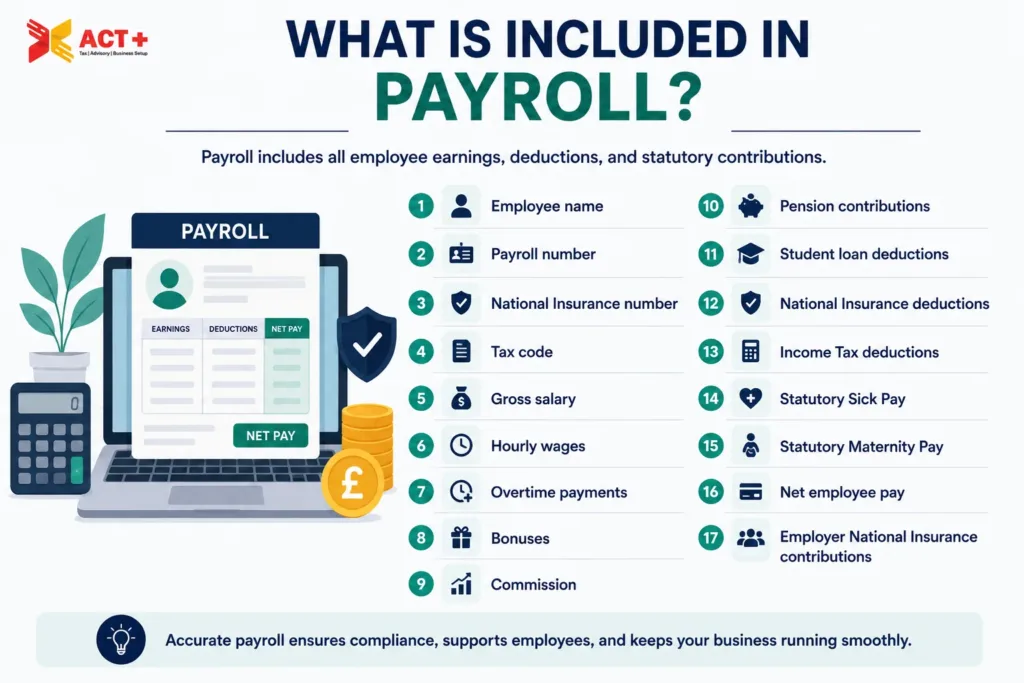
Each payroll record creates a complete history of every employee paid by the business. Maintaining accurate payroll information helps employers produce correct payslips, payroll reports, and year-end records.
How Does Payroll Work in the UK?
Payroll works in the UK through the PAYE system, which requires employers to calculate employee pay, deduct taxes, submit payroll information to HMRC through Real Time Information (RTI), and pay employees on the agreed-upon payday.
The UK payroll process follows several stages:
Collect employee details
Before employing staff, employers gather essential information to set up accurate payroll and employment records. This includes the employee’s full name, address, date of birth, National Insurance number, tax code, starter checklist or P45, bank details, and signed employment contract.
Calculate employee earnings
The employer calculates the employee’s basic salary, hourly wages, overtime, bonuses, commission, and holiday pay. These payments are added together to determine the employee’s total gross pay before tax and other deductions.
Calculate deductions
The payroll system automatically calculates deductions from the employee’s gross pay. These may include PAYE income tax, national insurance contributions, workplace pension payments, student loan repayments, and attachment of earnings orders.
Submit Real-Time Information (RTI)
UK employers must report payroll information to HMRC every time employees receive payment. This reporting system is called Real-Time Information (RTI). RTI helps HMRC keep tax records up to date throughout the year.
Pay employees
The employer transfers the employee’s net salary to their bank account. The employee also receives a payslip showing every payment and deduction.
Pay HMRC
The employer sends income tax, national insurance, and other deductions to HMRC before the relevant payment deadline.
✓ Free consultation • Accurate & hassle-free payroll services
What is payroll processing across the UK?
Payroll processing is the complete workflow that turns employee working hours and salary information into accurate wages, compliant tax reporting, and timely employee payments. Every business follows a structured payroll processing process, regardless of its size. A typical payroll process includes 8 stages.
1. Gather Employee Information
Before processing payroll, employers collect the information needed to create each employee’s payroll record. This includes personal details, tax code, payroll number, bank details, National Insurance number, and workplace pension information.
2. Record Working Time
Employers record each employee’s working time for the relevant pay period. This may include normal working hours, overtime, holiday leave, sick leave, maternity leave, paternity leave, and other forms of statutory leave.
3. Calculate Gross Pay
Gross pay is the total amount an employee earns before deductions. It may include basic salary, hourly wages, overtime payments, bonuses, commission, holiday pay, and other employment-related payments.
4. Calculate Payroll Deductions
The payroll system calculates statutory and voluntary deductions from the employee’s gross pay. These deductions may include PAYE income tax, national insurance contributions, workplace pension contributions, student loan repayments, and attachment of earnings orders.
5. Create Payslips
Employers must provide employees with a payslip for each pay period. The payslip explains the employee’s gross pay, individual deductions, tax code, National Insurance contributions, pension deductions, and final net pay.
6. Submit Payroll Information to HMRC
Employers submit payroll details to HMRC through real-time information. The Full Payment Submission normally reports employee pay, tax, and National Insurance information on or before the employee’s payday.
7. Pay Employees
After completing all payroll calculations and deductions, the employer transfers the employee’s net pay into their chosen bank account. Many UK businesses use BACS or another secure electronic payment method.
8. Keep Payroll Records
Employers must keep accurate payroll records for the required period. These records include employee details, payments, deductions, tax codes, leave payments, and reports submitted to HMRC. Good record keeping supports compliance and makes future payroll processing easier.
What is a payroll number?
A payroll number is a unique reference used to identify an employee within an employer’s payroll system. It helps employers organise payroll records, process employee pay accurately, and distinguish between employees with similar names. Many businesses assign payroll numbers automatically through payroll software. A payroll number often appears on payslips, payroll reports, employee records, P60 forms, and P45 forms.
Not every employer uses payroll numbers. This is acceptable when the business has another reliable employee identification system. The main purpose is to ensure that each employee’s payroll information, deductions, payments, and employment records remain accurate and properly organised.
How do you calculate the payroll?
Payroll calculations combine employee earnings with statutory and voluntary deductions to determine the final amount an employee receives.
A simple payroll calculation follows 5 steps.
Step 1. Calculate gross pay
Gross pay includes all earnings before deductions.
Gross pay may include:
- Basic salary
- Hourly wages
- Overtime
- Bonuses
- Commission
- Holiday pay
Step 2. Calculate Income Tax
The employer calculates income tax through the PAYE system using the employee’s tax code and taxable earnings. Payroll software normally performs this calculation automatically based on the relevant tax period and HMRC rules.
Step 3: Calculate National Insurance
National Insurance contributions depend on:
- Employee earnings
- National Insurance category
- Current HMRC thresholds
Step 4. Apply additional deductions
Additional deductions may include:
- Workplace pension
- Student loan repayments
- Attachment of earnings
- Salary sacrifice arrangements
Step 5. Calculate net pay
Net pay is the amount the employee receives after all deductions have been removed from gross pay. The employer transfers this final amount to the employee’s chosen bank account.
The basic payroll formula is:
Net pay = Gross pay − Income Tax − National Insurance − Other deductions
Modern payroll software performs these calculations automatically. Systems such as Xero Payroll reduce manual work, improve accuracy, and help businesses run payroll efficiently while meeting HMRC reporting requirements.
What Are the Four Types of Payroll Systems?
4 main types of payroll systems are listed below:
1. Manual Payroll
Manual payroll involves calculating wages, taxes, and deductions without dedicated payroll software. This method usually suits businesses with very few employees. However, it increases the risk of calculation errors and missed HMRC deadlines.
2. Payroll Software
Payroll software automates payroll calculations and HMRC reporting.
Popular payroll software includes:
- Xero Payroll
- BrightPay
- Sage Payroll
- QuickBooks Payroll
Most software automatically calculates the following:
- Employee pay
- PAYE Income Tax
- National Insurance
- Pension contributions
- Statutory payments
Many systems also submit Real-Time Information (RTI) directly to HMRC.
3. Outsourced Payroll
An outsourced payroll provider manages essential payroll duties on behalf of a business. This service helps employers calculate employee pay accurately, meet HMRC reporting requirements, manage pension obligations, and maintain reliable payroll records without handling the entire payroll process internally. An outsourced payroll provider typically handles the following:
- Payroll calculations
- Payslips
- HMRC submissions
- Pension reporting
- Year-end payroll reports
This option allows business owners to focus on running their company instead of processing payroll.
4. Cloud-Based Payroll
Cloud payroll combines automation with online accessibility. Business owners can access payroll information securely from any location with an internet connection. Cloud payroll systems often integrate with accounting software, time-tracking systems, and HR platforms.
Each system suits different business sizes, budgets, and operational needs. Choosing the right payroll method helps businesses pay employees accurately, comply with HMRC rules, and reduce administration.
Why Is Payroll Important for Businesses?
Payroll is important because it ensures every employee is paid accurately and on time. An effective payroll system calculates wages, salaries, bonuses, overtime, tax, National Insurance, pension contributions, and other deductions. Accurate payroll processing builds employee trust, improves staff satisfaction, and reduces disputes about employee pay.
Payroll also helps businesses meet their legal and financial responsibilities. Employers must report payroll information to HMRC, submit real-time information, produce payslips, and maintain accurate payroll records. Reliable payroll management supports cash flow planning, financial reporting, budgeting, and business compliance while reducing the risk of penalties and costly payroll errors.
What do I need to do before my business can run a payroll?
Your business must register as an employer, collect employee information, choose a payroll system, and set up PAYE before running payroll. Complete these steps before paying your first employee.
Register as an employer:
Register your business with HMRC before your first payday.HMRC issues a PAYE reference after registration.
Collect employee details:
Obtain accurate payroll information from every employee.
This includes:
- Full name
- Address
- Date of birth
- National Insurance number
- Tax code
- Bank details
- Starter Checklist or P45
Choose a payroll system:
Select a payroll method that suits your business.
You can choose:
- Payroll software
- Cloud payroll
- Outsourced payroll
- Manual payroll
Register for workplace pensions:
Most UK employers must provide a workplace pension. Check your pension duties before employing staff.
Decide your payroll schedule:
Choose how often employees will receive payment.
Common payroll frequencies include:
- Weekly
- Fortnightly
- Four-weekly
- Monthly
A consistent payroll schedule helps employees plan their finances.
What Are Payroll Deductions?
Payroll deductions reduce an employee’s gross pay to calculate their final net pay. These deductions may be mandatory under UK law or voluntary based on agreements between the employee and employer. Accurate deductions ensure employees receive the correct amount while businesses meet their payroll responsibilities.
Common payroll deductions include PAYE Income Tax, National Insurance, workplace pension contributions, student loan repayments, postgraduate loan repayments, attachment of earnings orders, salary sacrifice arrangements, and union subscriptions. Payroll software usually calculates these amounts automatically using current HMRC rules and the employee’s payroll information.
What Is PAYE in Payroll?
PAYE stands for Pay As You Earn. It is the UK system employers use to deduct income tax and national insurance from an employee’s wages before paying net pay. PAYE payroll helps ensure employees pay the correct tax throughout the tax year instead of paying one large amount later.
Employers calculate PAYE deductions using the employee’s tax code, earnings, pay period, and National Insurance category. They report payroll information to HMRC through Real Time Information on or before payday. Payroll software usually completes these calculations and helps businesses maintain accurate payroll records.
✓ Free consultation • Accurate & hassle-free payroll services
How to do payroll for employees in the UK?
First, register as an employer with HMRC and set up a PAYE scheme. Choose HMRC-recognised payroll software and collect each employee’s personal details, tax code, National Insurance category, bank information, and P45. You must also record their salary, working hours, overtime, bonuses, pension details, and student loan status.
Next, calculate each employee’s gross pay for the relevant pay period. Your payroll system should then calculate PAYE income tax, national insurance, workplace pension contributions, student loan repayments, and other deductions. Subtract these deductions from gross pay to calculate the employee’s net pay.
Create a payslip showing gross pay, deductions, and net employee pay. Submit a full payment submission to HMRC through Real Time Information on or before payday. You must then pay employees, pay the required deductions to HMRC, update payroll records, and complete annual payroll duties.
How to pay employees in a small business UK?
Small businesses usually pay employees through direct bank transfer after completing payroll calculations and HMRC reporting. Most small businesses use payroll software because it automates calculations and reduces errors.
Before paying employees:
- Complete payroll calculations.
- Submit the FPS to HMRC.
- Confirm the payment amount.
- Transfer the employee’s net pay.
- Issue a payslip.
Direct bank transfer using BACS is the most common payment method in the UK.
What does gross pay usually include?
Gross pay is the total amount an employee earns before payroll deductions. It includes all payments due for the relevant pay period, such as basic salary, hourly wages, overtime, bonuses, commission, holiday pay, statutory payments, and shift allowances.
Gross pay does not represent the amount an employee receives in their bank account. Employers deduct PAYE Income Tax, National Insurance, workplace pension contributions, and other applicable deductions from gross pay to calculate net employee pay.
What salary deductions should I be aware of?
Salary deductions reduce an employee’s gross pay to calculate net pay. They may include statutory amounts required by law and voluntary payments agreed with the employee. Accurate deduction records help employers process payroll correctly, meet HMRC duties, and prevent errors.
Common salary deductions include:
- PAYE Income Tax
- National Insurance
- Workplace pension contributions
- Student loan repayments
- Postgraduate loan repayments
- Attachment of earnings
- Salary sacrifice deductions
- Union membership fees
Understanding each deduction helps employers calculate accurate employee pay, produce correct payslips, and avoid mistakes during payroll processing.
Which payroll deductions are mandatory?
Most UK employers must make certain deductions from an employee’s gross pay before releasing their wages. These deductions help employees meet their tax, National Insurance, pension, and legal payment obligations through the payroll system.
Mandatory payroll deductions commonly include PAYE income tax, employee national insurance contributions, workplace pension contributions where automatic enrollment applies, and court-ordered attachment of earnings where required. Employers must calculate each deduction accurately to determine the employee’s correct net pay.
What Is the Difference Between Payroll and Payslip?
Payroll is the complete process of calculating and paying employee wages, while a payslip is the document that explains an individual employee’s pay and deductions. Payroll covers every employee in the business. A payslip only relates to one employee and one pay period.
| Payroll | Payslip |
|---|---|
| Calculates employee wages | Shows one employee's pay details |
| Includes tax calculations | Shows tax deducted |
| Produces HMRC reports | Helps employees understand their pay |
| Covers all employees | Covers one employee only |
Every employee should receive a payslip on or before payday.
What is the difference between payroll and income taxes?
Payroll manages employee payments, while income tax is one deduction processed through payroll. Payroll includes much more than tax calculations.
Payroll manages:
- Employee salaries
- Overtime
- Bonuses
- Pension deductions
- HMRC reporting
- Payslips
Income Tax only represents one statutory deduction collected through PAYE.
What is the difference between payroll and bookkeeping?
Payroll records employee wages, while bookkeeping records every financial transaction within a business.Payroll focuses on employees.
Bookkeeping records:
- Sales
- Purchases
- Bank transactions
- Expenses
- Payroll expenses
- VAT
- Business assets
Payroll information often feeds directly into bookkeeping records.
What is the difference between payroll and compensation?
Payroll is the process of paying employees, while compensation is the total reward employees receive for their work.
Compensation may include:
- Salary
- Bonuses
- Commission
- Pension contributions
- Private healthcare
- Company cars
- Share schemes
- Employee benefits
Payroll administers the financial part of that compensation.
What is the difference between payroll and paycheck?
Payroll is the complete system a business uses to calculate employee earnings, deductions, taxes, pension contributions, and net pay. It also includes producing payslips, reporting payroll information to HMRC, paying employees, and maintaining payroll records.
A paycheck is the payment an employee receives after payroll has been processed. In the UK, the term usually refers to an employee’s wages or salary payment, while a payslip explains how that payment was calculated. Therefore, payroll is the overall process, and the paycheck is the final amount paid to the employee.
What is the difference between payroll and onroll?
Payroll refers to processing employee pay, while on-roll means an employee works directly for the employer rather than through an agency or contractor.
An on-roll employee normally receives:
- PAYE deductions
- Workplace pension
- Holiday pay
- Statutory employment rights
What is the difference between payroll and accounting?
Payroll is one function within accounting, while accounting covers every financial activity of a business.
Accounting includes:
- Payroll
- Bookkeeping
- Financial statements
- VAT
- Corporation Tax
- Budgeting
- Cash flow
- Management reports
Payroll contributes employee cost information to the accounting records.
What is the difference between an income tax and a payroll tax?
Income tax is deducted from an employee’s earnings, while payroll taxes include taxes and statutory contributions linked to employment. In the UK, payroll-related deductions commonly include:
- PAYE Income Tax
- Employee National Insurance
- Employer National Insurance
Unlike some countries, the UK does not have a separate federal “payroll tax.” Instead, employers operate PAYE and National Insurance under HMRC rules.
What are payroll taxes in the UK?
Payroll taxes in the UK are taxes and contributions connected with employee wages. Employers use the PAYE system to deduct income tax and employee national insurance from gross pay. They calculate these deductions using each employee’s earnings, tax code, National Insurance category, and pay period.
Employers may also pay employer National Insurance on qualifying employee earnings. Larger employers may need to pay the Apprenticeship Levy based on their annual payroll bill. Businesses must report employee pay and deductions to HMRC through Real Time Information and pay the amounts due as part of their PAYE responsibilities.
What Is ADP in Payroll?
ADP stands for Automatic Data Processing, a global company that provides payroll, HR, and workforce management software. Many people search to define ADP, automatic data processing payment, ADP wage slips, or run ADP employer.
ADP offers services such as the following:
- Payroll processing
- Payslip generation
- Tax calculations
- Time tracking
- HR management
- Workforce reporting
- Employee self-service portals
Large organisations often use ADP to automate payroll across multiple locations and countries.
What information should a payslip include?
A UK payslip provides a clear record of an employee’s earnings, payroll deductions, and final net pay for each pay period. It helps employees check their wages while supporting accurate payroll processing, transparent reporting, and reliable employment records for employers.
A payslip normally includes the following:
- Employee name
- Employer name
- Payroll number
- Pay period
- Gross pay
- PAYE Income Tax
- National Insurance contributions
- Pension deductions
- Other deductions
- Net pay
- Payment date
A detailed payslip helps employees understand how their wages were calculated and confirms every deduction made from their gross pay.
What happens if payroll is done incorrectly?
Incorrect payroll can cause employee dissatisfaction, HMRC penalties, cash flow problems, and inaccurate financial reporting. Common payroll mistakes include paying employees the wrong amount, using an incorrect tax code, missing real-time information submissions, making incorrect pension deductions, and paying salaries late.
Employers may also calculate National Insurance incorrectly or apply the wrong payroll deductions. These errors can require payroll corrections, amended HMRC reporting, and additional administrative work. Businesses should review employee details, calculations, deductions, and submissions before every payday to reduce mistakes and maintain accurate payroll records.
What should be included in payroll?
A complete payroll should include every payment, deduction, employee detail, and statutory record required to pay employees correctly. It should record employee information, payroll numbers, gross earnings, bonuses, overtime, holiday pay, PAYE deductions, National Insurance contributions, pension contributions, and final net pay.
Payroll should also include payslips, Real Time Information submissions, the payroll register, and supporting employer payroll records. Maintaining complete and accurate payroll information helps businesses meet HMRC requirements, prepare financial reports, resolve employee queries, and provide reliable evidence during future payroll reviews or audits.
How long does payroll take to process?
Payroll processing time varies depending on employee numbers, pay structures, deductions, and the payroll system used. Smaller businesses can often complete payroll quickly, while larger organisations may require more time to check calculations, approve payments, and submit accurate reports to HMRC.
Approximate processing times are:
| Business Size | Typical Processing Time |
|---|---|
| 1–10 employees | 30–60 minutes |
| 11–50 employees | 1–3 hours |
| 50–250 employees | Half a day |
| Larger organisations | One day or more |
Modern payroll software can significantly reduce processing time.
What is end-to-end payroll processing?
End-to-end payroll processing manages every payroll activity from employee setup to final reporting and record keeping. It covers employee onboarding, payroll information collection, time and attendance records, gross pay calculations, payroll deductions, PAYE processing, and Real Time Information submissions.
The process also includes employee payments, payslip generation, HMRC payments, payroll reports, and year-end documentation. Managing the complete payroll cycle through one integrated system improves efficiency, strengthens payroll accuracy, supports compliance, and reduces the risk of manual errors.
How can I improve my payroll process?
You can improve your payroll process by automating calculations, maintaining accurate records, and reviewing payroll before every payday.
Practical ways to improve payroll include:
- Use modern payroll software.
- Keep employee records updated.
- Verify tax codes regularly.
- Automate HMRC submissions.
- Reconcile payroll reports monthly.
- Review payroll before releasing payments.
- Train payroll staff regularly.
- Back up payroll records securely.
Regular payroll reviews help identify errors before employees receive payment.
Can I do payroll without an accountant?
Yes, you can manage payroll without an accountant if you understand HMRC requirements and use reliable payroll software. Many small businesses successfully run payroll using cloud-based payroll systems. However, professional payroll support can reduce compliance risks and save valuable time as your business grows. If your business employs several staff, pays bonuses, manages pensions, or has complex payroll requirements, outsourcing payroll may provide better long-term value.
Frequently Asked Questions
Can I run payroll myself in the UK?
What happens if I pay an employee late or incorrectly?
Do all employers need to register for PAYE?
Should I outsource payroll or manage it in-house?
What records should employers keep for payroll?

About the Author: Ahmad Raza