
Choosing a company name requires a balance between legal rules, brand identity, availability, and future business plans. The right name should be clear, memorable, and suitable for long-term use.
Your company name often creates the first impression of your business. Customers may see it on your website, invoices, emails, social media accounts, and marketing materials. A strong name can therefore make your business easier to recognise and remember. Choosing a company name in the UK also involves legal considerations. Companies House applies specific company name rules when you register a limited company.
Your proposed name usually can not match an existing registered company name. A name considered ‘too like’ an existing registered name can also cause problems following a complaint. Certain sensitive words and expressions require permission.
A Companies House search is only one part of the process. You also need to consider trade marks, domain names and your wider brand identity. The following 9 tips explain how to choose a company name that works legally, commercially and practically.
What Are Tips for Choosing a Company Name?
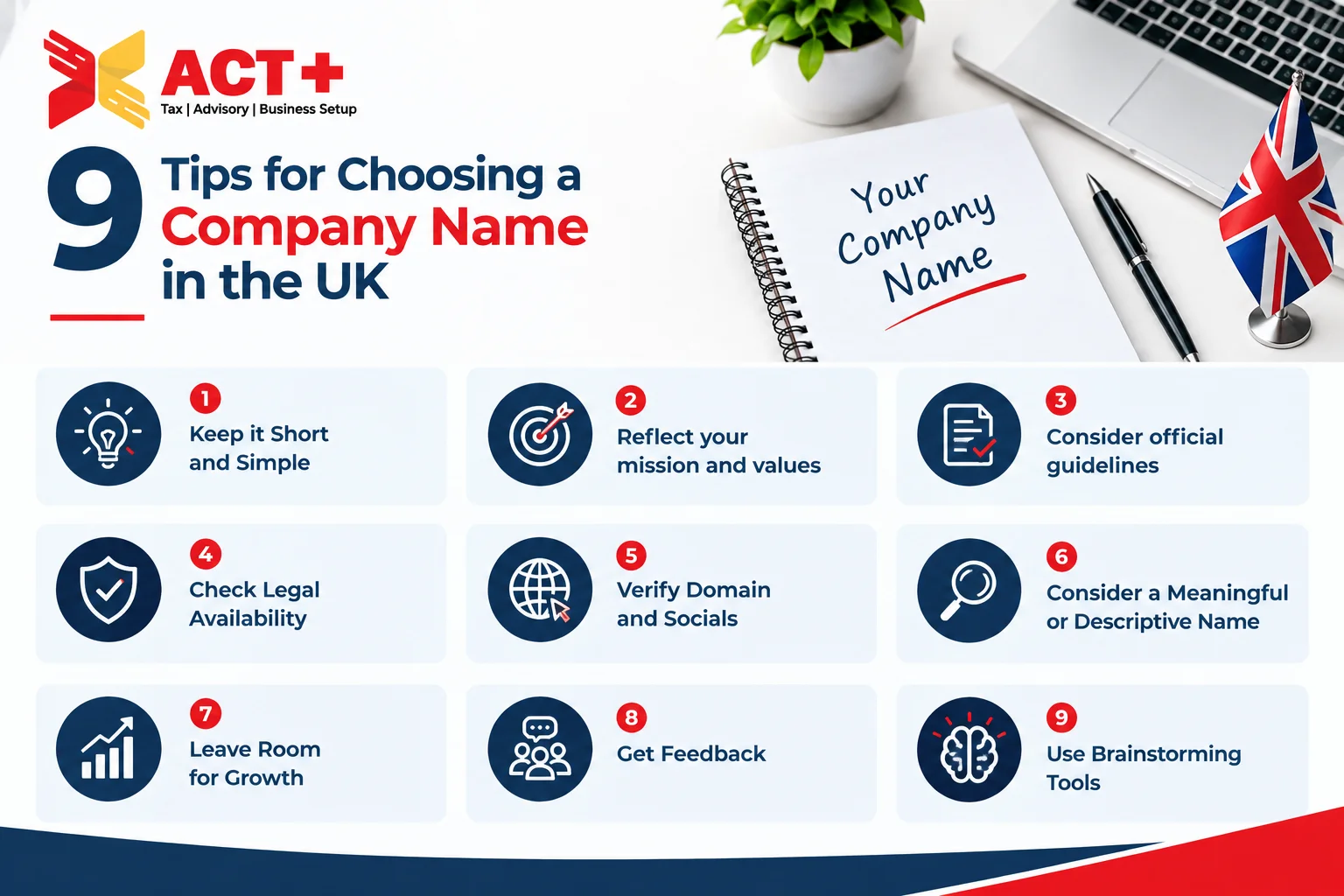
There are 9 practical tips for choosing a company name. Keep it simple, reflect your values, follow official rules, check legal availability, verify digital names, create meaning, allow growth, get feedback, and brainstorm widely.
A useful company naming strategy considers both legal and commercial factors. A creative company name has little value if you cannot register or safely build your brand around it. Use a simple five-check test before making your final decision. Check the name from legal, trademark, digital, brand, nd and growth perspectives.
The legal check considers Companies House rules. The trade mark check identifies potential intellectual property conflicts. The digital check covers domains and social usernames. The brand check considers recognition and memorability. The growth check asks whether the name will remain suitable as your company develops.
1. Keep It Short and Simple
Choose a company name that customers can easily read, pronounce, spell, ell and remember.
Simple names often work well across websites, invoices, advertisements, and conversations. Customers should not need an explanation every time they hear your business name. Avoid unnecessary words, complicated spellings, and confusing combinations of letters. These features can make online searches and recommendations more difficult.
Imagine a customer hears your company name during a telephone conversation. They should have a reasonable chance of remembering the name and finding your business afterwards. A memorable company name does not need to describe every service you provide. It needs to create a clear and recognisable identity.
2. Reflect your mission and values
Your company name can reflect the purpose, personality or values behind your business. Consider what you want customers to associate with the company. This could include trust, quality, simplicity, innovation, speed or sustainability. A professional services company may prefer a dependable and established name. A creative business may have greater freedom to choose something distinctive or playful. The connection does not always need to be literal. A brand name can create meaning through customer experience and consistent business branding. Think about the impression the name creates. Your company name becomes part of your wider brand identity alongside your logo, website and communications.
3. Consider official guidelines
Check the Companies House company name rules before committing to a proposed limited company name. A private company name must usually end with “Limited” or “Ltd”. A company whose registered office is in Wales can use ‘Cyfyngedig’ or ‘Cyf’ instead.
Companies House also applies rules to names considered the “same as” existing registered names. Minor changes involving punctuation, special characters or commonly used terms may not create sufficient distinction. A company name cannot be offensive. Restrictions also apply to certain sensitive words and expressions. Some names suggesting connections with government or public authorities require permission.
For example, the use of “accredited” requires permission from the Department for Business and Trade. These requirements are legal considerations rather than branding recommendations. Review them before paying for a logo, website, signage or marketing materials.
4. Check Legal Availability
Complete a Companies House company name check and a separate trade mark search before relying on your chosen name. These searches perform different functions. A UK-focused company may consider a .co.uk domain. The UK Intellectual Property Office maintains the register of UK trade marks. Registering a company name does not automatically give you trademark protection. It also does not guarantee that using the name cannot infringe another party’s trade mark rights.
Search similar names as well as exact matches. Companies House distinguishes between names considered the “same as” an existing name and names considered “too like” another registered name. A clear Companies House search is therefore an important first check. It does not guarantee that your proposed business identity is legally safe in every respect.
Consider a fictional founder planning to register Bright Oak Accounting Ltd. The founder could first search Companies House for “Bright Oak” and similar names. The next step would involve searching relevant UK trademarks. The founder could then check suitable domains and social media names. Finally, the founder could consider whether “Accounting” remains appropriate if the business later expands into wider financial or business advisory services. This process tests both legal availability and long-term commercial suitability.
5. Verify Domain and Socials
Check suitable domain names and important social media usernames before finalising your company name. Company name availability does not guarantee domain availability. Another individual or organisation may already own your preferred web address.
Check domain extensions relevant to your market. A UK-focused company may consider a .co.uk domain. A business with international plans may also consider a suitable .com address. Check the social platforms you intend to use. These may include LinkedIn, Facebook, Instagram, TikTok and YouTube.
Your legal company name, domain, and social usernames do not have to match perfectly. However, consistent naming can make your business easier to recognise. Complete these searches before investing heavily in business branding.
6. Consider a Meaningful or Descriptive Name
Choose a meaningful or descriptive company name when it helps customers understand or remember your business. A descriptive name can communicate what the company does. An accountancy firm, construction business or technology consultancy may use industry-related words for clarity. However, an overly descriptive name can become restrictive.
A distinctive or invented name takes a different approach. It may initially tell customers less about the service, but it can create a recognisable standalone brand. The best approach depends on your business model.
A small business serving a defined local market may benefit from immediate clarity. A startup planning several products or services may prefer a broader identity. Consider both customer understanding today and business development tomorrow.
7. Leave Room for Growth
Select a company name broad enough to support realistic future expansion. A narrow name can become inconvenient when the business develops. Suppose a company starts by selling office chairs. A name focused entirely on chairs may become unsuitable when the company adds desks, storage and other office furniture. Location can create a similar problem. Including a town or city may suit a local company. It can feel restrictive if the business later expands across the UK.
Think about where the company could reasonably be in three to five years. Consider future services, products, locations and customer groups. You do not need a name covering every possible direction. You need enough flexibility for realistic growth.
8. Get Feedback
Ask a small group of relevant people for feedback before making your final decision. A company name can sound clear to its creator but confusing to potential customers. Ask customers, colleagues, or trusted advisers what the name suggests. Check whether they can pronounce it correctly and remember it later. Ask whether the name sounds professional and appropriate for the intended market.
Feedback can also reveal unwanted meanings or associations. This becomes particularly important for businesses planning to operate internationally. Do not choose your company name purely through a vote. Use feedback to identify weaknesses, then compare the results with your wider business strategy.
9. Use Brainstorming Tools
Use brainstorming tools to generate company name ideas, then assess each idea against the same legal and commercial criteria. Start with words connected with your services, customers, values, and desired brand personality.
Combine words, shorten phrases,s or explore related concepts. A company name generator can provide additional business name ideas when you need inspiration. Treat generated suggestions as starting points rather than approved names.
Every serious option still needs the appropriate legal, trademark,rk and digital checks. Create a shortlist of around five company name ideas. Compare each option against the five-check test: legal, trademark, digital, brand and growth. This gives you a more structured company naming checklist.
Why Does Your Company Name Matter?
Your company name matters because it forms part of your legal identity and influences how customers recognise your business. For a limited company, the registered name appears on the Companies House register and certificate of incorporation. Companies also have legal requirements covering the display of their registered name. The commercial impact can last much longer.
Customers may encounter your company name before they know anything about your products or services. A clear name can make the business easier to remember, search for, and recommend.
The name also affects your wider business identity. It may influence your domain, email addresses, social media usernames, logo, and marketing materials. Changing these elements later can take time. Existing customers may also need reassurance that they are dealing with the same business. Choosing carefully at the beginning can reduce these practical problems.
How Do You Choose a Company Name?
Choose a company name by defining your brand, generating ideas, checking legal restrictions, and testing the strongest options. Start by writing down what your company does and who it serves. Add three or four qualities that you want customers to associate with the brand. Use these ideas to create a shortlist. Remove names that are difficult to pronounce, spell,l or remember. Consider whether each option gives the business enough room to develop.
Next, complete your legal and availability checks. Search the Companies House register and review the rules on sensitive words where relevant. Complete a separate trade mark search. Then check suitable domains and social media usernames. The strongest company name should work across all five areas: legal compliance, trade mark risk, digital identity, branding and future growth.
How Do You Check if a Company Name Is Available?
Check company name availability by searching the Companies House register for your proposed name and similar alternatives. Do not rely only on an exact match. Companies House distinguishes between names that are the “same as” existing names and names that are “too like” them. Small differences may therefore provide less distinction than expected.
For example, certain punctuation, special characters and commonly used company-name terms may not make a proposed name sufficiently different. Company name availability and trade mark availability are also separate issues. A name appearing available at Companies House does not automatically clear it for trademark purposes.
How do you check a company name on Companies House?
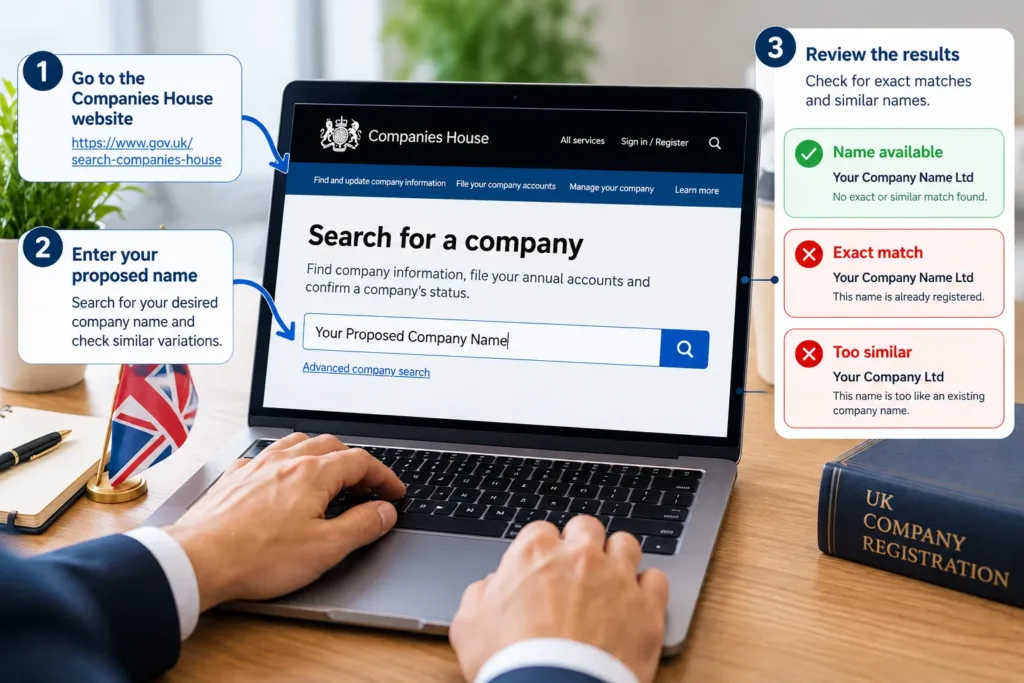
Search the Companies House register for your proposed company name and closely related alternatives before submitting an incorporation application. Enter the important words from your proposed name rather than searching only one exact phrase. Review similar results. Search alternative spellings, shortened forms and names that sound alike.
Companies House states that a company name cannot normally be the same as another registered company name. A company may also have to change a name following a successful “too like” complaint. Use the official Companies House guidance on choosing a company name when assessing your proposed name.
How do you do a limited company name search?
Complete a limited company name search by checking exact and similar names on the Companies House register. Search the main words in your proposed Ltd company name. Removing “Ltd” from your search can help reveal companies using a similar core name. Check spelling variations and abbreviations where relevant.
Do not treat the search result as a guarantee of wider legal rights. Companies House confirms that registering a company name does not prevent that name from potentially infringing trade mark law. A company name search therefore forms one part of the wider naming process.
Do You Get a Company Registration Number After Choosing a Name?
Companies House gives your company a company registration number when it incorporates the company, not when you simply choose its name. Choosing or checking a company name does not itself create a registered company. Companies House issues the company number following successful incorporation. The certificate of incorporation provides evidence that the company legally exists. The company registration number identifies the legal entity. Changing the registered company name later does not create a completely new company.
Where can you find your company registration number?
You can find your company registration number on your certificate of incorporation and the Companies House register. Companies also use their registration number within statutory company information and business documents where required.
Do not confuse the company registration number with other references. A Unique Taxpayer Reference identifies a taxpayer for relevant tax purposes. A VAT registration number identifies a VAT-registered person or business. These identifiers serve different functions.
Do you need to register a company name in the UK?
A UK limited company receives its registered company name when Companies House incorporates the company. Choosing or checking a name alone does not register the company. The position differs for sole traders and ordinary business partnerships. They do not incorporate a limited company simply by choosing a business name.
A registered company can also use another trading name. Different rules apply to registered company names and business names. Companies House treats choosing a name and registering the company as separate stages of the incorporation process.
How Do You Check if a Business Name Is Taken?
Check a business name across Companies House, the UK trade marks register, relevant domains and the wider market. No single search answers every question. Companies House identifies registered companies. The UK IPO trade mark database helps you identify existing registered trade marks. A domain name search establishes whether your preferred web address appears available. Searching social platforms can reveal businesses already using similar brand identities.
A wider web search can also identify organisations operating under similar trading names. The distinction matters. A registered company name, trading name, trade mark and domain name are different things. Securing one does not automatically give you rights over the others.
Should You Trademark a Company Name?
Trade mark registration can provide valuable brand protection when your company name identifies important goods or services. Companies House registration and trade mark registration serve different purposes.
Companies House incorporates the company under its registered legal name. The UK Intellectual Property Office manages UK trade mark registration. A registered trade mark can provide legal protection for the relevant brand within the goods and services covered by the registration.
UK trade marks last 10 years and can be renewed every 10 years. Trade mark protection can deserve particular consideration when your company name or brand has significant commercial value.
How do you trademark a company name in the UK?
Apply to the UK Intellectual Property Office to register an eligible company or brand name as a UK trade mark. Start by checking whether anyone has already registered an identical or similar trade mark. Next, identify the appropriate classes for your goods or services. Your application needs to specify the classes and terms you want to protect.
From 1 April 2026, a standard online UK trade mark application costs £205 for one class. Each additional class costs £60. A paper application costs £250 for one class. The IPO examines the application and searches for similar trademarks. An unopposed application can generally reach registration around three months after submission. Review the official UK trade mark application service before applying.
What is the difference between a company name and a trading name?
A company name is the registered legal name of a company, while a trading name is another name used commercially. For example, a company could register as “Northfield Digital Services Ltd” but trade publicly as “Northfield Digital”.
Companies House refers to a trading name as a business name used instead of the registered name. Trading names face restrictions too. A business name must not improperly include endings such as “limited”, “Ltd”, “LLP” or “PLC”. Sensitive words can also require permission. A trading name does not automatically create registered trade mark rights.
Should your company name and brand name be the same?
Your company name and brand name can be the same, but they do not have to match. Using one name can make business branding simpler. Customers see a consistent identity across your website, communications and marketing. Different names can provide greater flexibility.
One limited company may operate several brands or services under different trading names. The registered company remains the legal entity behind those brands. Keep the legal entity clear wherever UK company disclosure rules require it.
Can you buy a company name?
You cannot buy every legal right to a company name simply by purchasing a domain or paying to register a company. Different names and rights need to be considered separately. You may buy a domain name from its owner. You may acquire a registered trade mark through an assignment. You may also purchase a business containing valuable brand assets. However, these transactions do not automatically transfer every possible right connected with the words.
For example, owning example.co.uk does not automatically give you a registered trade mark for “Example”. Registering Example Ltd does not automatically give you ownership of the matching domain. Companies House registration, trade mark ownership, trading names and domain ownership therefore need separate checks.
What company name mistakes should you avoid?
Avoid choosing a company name that is difficult to remember, too similar to another business, legally restricted or too narrow for future growth. A simple name can make it easier for customers to recognise and find your business.
Check the Companies House register before settling on a name. It is also helpful to search the UK trade mark register, as company registration does not automatically provide trade mark protection. Consider your domain name and social media usernames before investing in a website, logo or marketing materials. Keeping these names reasonably consistent can support a clear brand identity.
Try not to choose a name based only on current products or one location. Your business may expand into new services or areas later. Take some time to review your options before company registration. A careful company name check can help you avoid unnecessary branding, legal, and administrative difficulties later.

About the Author: Ahmad Raza