Check UK company name availability through Companies House, the naming rules, trademarks, and digital channels. A careful search reduces rejection, disputes, rebranding costs, and customer confusion.
Finding no exact match does not guarantee acceptance. A name can still be too similar, offensive, restricted, or trademark-protected. This explains how to complete a reliable company name check in the UK. It covers legal names, trading names, trade marks, and domains.
What Are the Steps to Check UK Company Name Availability?
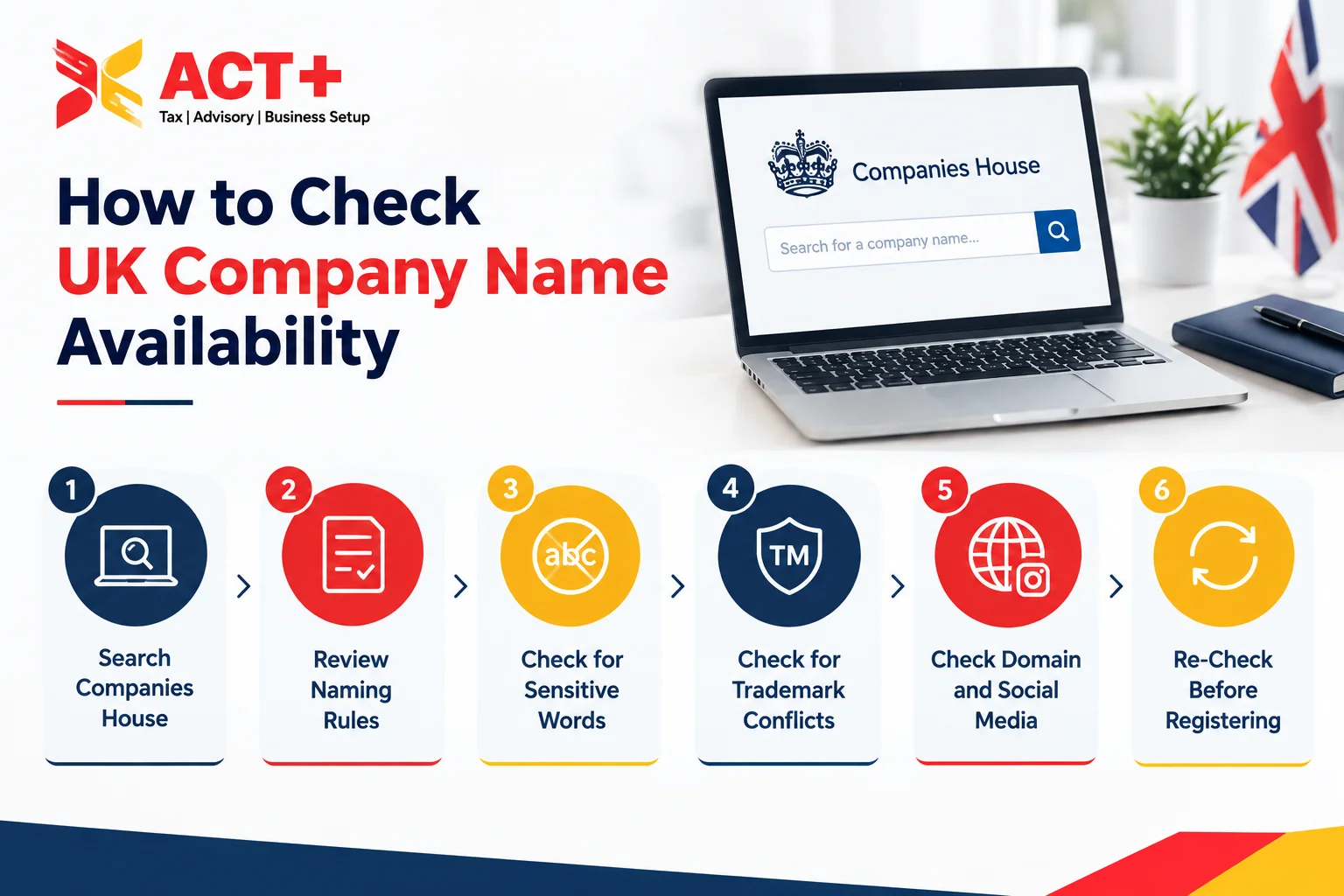
There are 6 practical steps to check the availability of a UK company name. Search Companies House, review the rules, and identify sensitive words. Then check trade marks, digital channels, and the register again.
Step 1: Search Companies House
Start with the Companies House name availability checker. Enter your proposed legal name, including “Limited” or “Ltd”.Then search the wider Companies House register. Try different spellings, plural forms, joined words, punctuation,n and phonetic alternatives.
Review active, dissolved and renamed companies. A dissolved record can still reveal branding risks connected with that name. Search results do not reserve or approve your name. Companies House decides when it examines an incorporation or name-change application.
Step 2: Review Naming Rules
Check the proposed wording against the official company name rules. A private limited company’s name usually ends with “limited” or “Ltd”. Companies registered in Wales may use “Cyfyngedig” or “Cyf”. The name cannot match an existing registered name. Companies House treats certain minor differences as “same as”.
These include specified punctuation and special characters. Companies House gives “Hands UK Ltd” and “Hand’s Ltd” as names treated like “Hands Ltd”. Group companies may qualify for an exception with written consent. A name must not contain offensive wording or falsely suggest official approval. GOV.UK’s company-name guidance explains these restrictions.
Step 3: Check for Sensitive Words
Review the official list if your proposed name contains a sensitive word. These words often concern government, professional status, or regulated activities. Some words require approval from a named government department or professional body. For example, using “Accredited” requires permission from the Department for Business and Trade. Obtain the required evidence before submitting the application. Keep a suitable alternative available if approval remains uncertain.
Step 4: Check for Trade Mark Conflicts
Search the UK Intellectual Property Office trade mark database by keyword, phrase and relevant variations. Check similar words, spellings and logos within your planned goods or services. A Companies House check tests the corporate name. A UKIPO search identifies protected brand rights which could create conflict.
Trade marks cover particular classes of goods and services. Conflict risk rises when the marks, customers and commercial activities overlap. Seek intellectual property advice if a close match appears. An adviser can assess classes, reputation and likely confusion.
Step 5: Check Domain and Social Media
Search your preferred domain through a reputable checker. Review .co.uk and .com endings. Check matching usernames on your main social platforms. A free company name can have an unavailable domain. Domain registration creates no automatic company name or trade mark rights. Choose a name that customers can spell and remember. Secure important domains and usernames after completing the legal and brand checks.
Step 6: Recheck Before Registering
Repeat the Companies House name search immediately before filing. Another applicant can register a name between your first search and your submission. Repeat the other checks if several weeks have passed. Save dated notes for comparison, although they create no ownership rights.
Can You Register a Company Name Before Starting a Company?
You cannot normally reserve a limited company name through a separate Companies House reservation service. Registering the company secures the name on the company register, subject to later challenges.
Some founders incorporate a dormant company to hold a preferred name. A dormant company must file annual accounts and a confirmation statement. Incorporation does not grant complete brand protection. Complete the Companies House and UKIPO searches before forming a name-holding company.
Check Company Name Availability
Enter your proposed company name to check the Companies House register.
This checker is provided by Companies House (GOV.UK). A result showing no matching name does not by itself confirm that the name can be registered or that it is clear of trade mark issues.What Happens After You Find an Available Company Name?
After finding an available company name, complete the incorporation details and submit the application to Companies House. You need a registered office, registered email address, director details, and an appropriate SIC code.
A company limited by shares also needs shareholder, share capital, and people-with-significant-control details. Directors may also need their Companies House personal codes. Companies House issues a certificate after approval. It confirms the legal name, company number, and formation date.
How Do You Check if a Company Name Is Available?
Before registering a company, it is important to check whether your preferred name is available. You can start by using the Companies House company name availability checker. This allows you to search existing registered company names and see whether the name you want is already in use.
Companies House may also reject a name that is too similar to an existing company name. For this reason, it is helpful to search for different spellings and similar versions of your chosen name before applying. You should also check whether the name contains any sensitive words or expressions. Some words require approval from Companies House or another relevant organisation before they can be used.
A company name check should not stop with Companies House. It is also sensible to search the UK trade mark register to make sure your proposed name does not conflict with an existing trade mark. You may also wish to check whether a suitable domain name and social media usernames are available. This can help you keep your business branding consistent. Once you are satisfied with the checks, you can use your chosen name when submitting your company registration application to Companies House.
How Do You Check a Company Name on Companies House?
You can check a company name by using the Companies House online search service. Enter the proposed name to see whether a company with the same or a similar name is already registered. It is also helpful to try different spellings and wording, as Companies House may reject names that are considered too similar to existing companies.
Before applying, check whether the name contains any sensitive words or expressions, as these may need approval. A Companies House search is a useful first step before registering your company and can help reduce the risk of your application being rejected.
How Do You Check a Limited Company Name?
You can check a limited company name by searching the Companies House register before submitting your incorporation application. Enter the proposed name to see whether the same or a very similar name is already registered.
It is sensible to search a few variations of the name, as Companies House may refuse names that are considered too similar to existing companies’ names.
You should also check whether the name includes any sensitive words or expressions that require approval. In addition, reviewing the UK trade mark register can help you avoid potential branding or legal issues later.
How Do You Check for Trade Mark Conflicts?
You can check for trade mark conflicts by searching the UK Intellectual Property Office trade mark register before using or registering a company name. Search for your proposed name as well as similar spellings, words and variations. A trade mark does not always need to be identical to create a potential conflict. Similar names used for related goods or services may also cause problems.
It is therefore sensible to review existing trade marks carefully before choosing your final business name. This can help reduce the risk of objections, legal disputes or the need to change your brand later.
How Do You Tell if a Company Name Is Taken?
A company name is taken when Companies House treats it as identical or “same as” an existing name. A close name can also attract a “too like” complaint.
You can tell if a company name is taken by searching the Companies House register. Enter your preferred name and review any companies with the same or a similar name.
Even if the exact name is not registered, Companies House may still reject it if it is considered too similar to an existing company name. It is therefore worth checking different spellings and variations.
You should also search the UK trade mark register, as a company name may be available at Companies House but still conflict with an existing trade mark. Checking both registers can help you choose a safer business name.
How Do You Check if a Company Is Already Registered?
Search the Companies House register using the company name, company number, or registered-office details. The record will show its current status and incorporation information. Not every business is registered as a limited company. Sole traders and some other businesses can trade without appearing on the Companies House register. This means that finding no result does not necessarily mean the business name is completely unused. It is also sensible to check the UK trade mark register, search online and review the wider market before deciding to use a particular business name.
Can I Use a Company Name That Already Exists in the UK?
You cannot normally register a company name if Companies House considers it the same as an existing registered company name. In some limited cases, companies within the same group may be able to use similar names where the required written consent is provided.
Even if a name is slightly different, it may still cause problems if customers could easily confuse it with another business. It is therefore sensible to check similar company names, trade marks and existing brands before applying. Choosing a clear and distinctive name can reduce the risk of objections, legal issues or the need to rebrand later.
What Happens If Your Company Name Is Rejected?
If Companies House rejects your proposed company name, you will need to correct the issue before the company can be registered. This may involve choosing a different name or providing any approval or supporting evidence that is required.
Before submitting again, check the spelling, sensitive words or expressions, and whether the name is the same as an existing company name. It is helpful to keep one or two alternative names ready. You should also avoid ordering signs, packaging or other branded materials until Companies House has accepted and registered the company name.
What Is the Difference Between a Company Name and a Trading Name?
A company name is the legal name registered with Companies House, while a trading name is a different name that a business may use when dealing with customers.
A limited company must use its registered company name for formal and legal purposes. This includes contracts, invoices, company letters and certain information shown on its website. A trading name, sometimes called a business name, does not create a separate legal entity. A company can trade under one or more trading names without changing its registered name at Companies House.
For example, “Northway Retail Limited” could trade as “Northway Home”. Its business documents still need the required legal details. A trading name must not use “limited”, “Ltd”, “LLP”, “plc” or similar protected endings. Sensitive-word and trademark rules can also apply.
Using a trading name does not give the business exclusive rights to that name. Before using one, check existing company names, UK trade marks, domain names and other businesses operating under similar branding. A trading name should also avoid wording that could mislead customers about which legal entity is providing the goods or services.
How Do You Check if a Business Name Is Available?
You can check business name availability by looking at Companies House, the UK Intellectual Property Office (UKIPO), and relevant commercial channels. This gives you a wider view of both legal availability and practical brand use.
Limited companies register their legal names with Companies House, so this is the main place to check whether a company name is already registered or too similar to an existing one.
However, sole traders and ordinary partnerships do not register a corporate name with Companies House. This means a name may still be in use even if it does not appear on the register.
It is also sensible to search the UK trade mark register, domain names, social media platforms and general online search results before making a final decision. These checks can help reduce the risk of confusion, trade mark disputes or the need to change your business name later.
How Do You Check if a Business Name Is Taken?
Search the exact phrase and close variations across official and commercial sources. Review UKIPO records, local businesses, domains, and social usernames. Check similar businesses in your sector. An unregistered business may have passing-off rights. A trade mark owner may hold registered protection.
Can You Register a Business Name in the UK?
The UK has no single general register for every business or trading name. Companies register legal names through Companies House, while trade marks are registered through the UKIPO. Sole traders can use business names without incorporating. Their names must follow trading-name rules. Trade mark registration offers separate protection.
Do You Need to Register a Company Name in the UK?
You must register a legal company name when you form a UK limited company. The name is registered with Companies House as part of the incorporation process.
Sole traders do not need to register a business name with Companies House simply to start trading. They should still make sure the name does not infringe an existing trade mark or mislead customers.
Registering a company name does not automatically give you full protection over the brand. You may still need to register a trade mark, secure a suitable domain name or obtain any licences required for your type of business. It is therefore sensible to check the name carefully before you start using it commercially.
How Much Does It Cost to Register a Company Name in the UK?
It currently costs £100 to register a company online with Companies House. If you apply by post using form IN01, the registration fee is £124. These fees cover the incorporation of the company rather than simply reserving or registering the company name.
Online registration is usually the quickest option. Companies House normally processes online applications within 24 hours, although more complex applications may take longer. Postal applications generally take longer to process.
Before paying the registration fee, it is sensible to check that your preferred company name is available and meets the Companies House naming rules. This can help reduce the risk of delays or rejection.
Can You Buy a Company Name?
You cannot simply buy ownership of a registered company name from Companies House. However, you may be able to buy the company that owns the name or arrange for the existing company to change its name before you register it.
Buying an existing company should be approached carefully because you may also take on its previous history, liabilities and legal obligations.
You should also check for existing trade mark rights, as acquiring or changing a company name does not automatically give you the right to use the name as a brand.
What Mistakes Should You Avoid When Checking Company Name Availability?
There are several common mistakes to avoid when checking whether a company name is available. These include carrying out only a narrow search, overlooking similar names, ignoring restricted words, and failing to check existing trade marks.
You should also check domain names, social media usernames and wider business use before making a final decision. Avoid spending money on branding, signs or packaging too early.
Keep your proposed name clear and distinctive. It is also helpful to check a few alternative names in the same way. Remember that a Companies House availability check does not cover every possible intellectual property or branding risk.
Can You Change a Company Name Later?
Yes, A registered company can change its name by following the required company procedure and filing the change with Companies House.
Depending on the circumstances, this will usually involve passing the appropriate resolution and submitting the required Companies House form or online application. The change becomes legally effective when Companies House issues the new certificate of incorporation upon change of name.
Changing a company name can create additional work. You may need to update bank accounts, contracts, invoices, licences, websites, stationery and customer communications. For this reason, checking your preferred name carefully before incorporation can help avoid unnecessary cost and disruption later.
Frequently Asked Questions
How Do I Check if a Limited Company Name Is Available to Register?
Use the Companies House name checker, review close variations and apply the naming rules. Complete a UKIPO search before relying on the result.
Is It Possible to Register Your Company Name Without Forming a Company?
Companies House does not normally offer a separate name-only reservation. You must incorporate a company to place its legal name on the register.
Does the Name Checker Also Check Trading Names and Trade Marks?
No, the Companies House checker does not search every trading name or trade mark. Search the UKIPO database and wider market separately.
What Words Cannot Be Used in a Company Name?
Company names cannot contain offensive wording, and sensitive expressions require approval. Names must not improperly suggest links with government, public authorities or regulated professions.
What Happens If My Company Name Is Too Similar to an Existing One?
You may need to change the name if Companies House upholds a “too like” complaint. A trade mark owner or established business may also take separate legal action.
Can Non-UK Residents Register a UK Company Name?
Non-UK residents can form a UK limited company, but it needs a suitable UK registered office. Applicants must meet current identity-verification requirements.

About the Author: Ahmad Raza