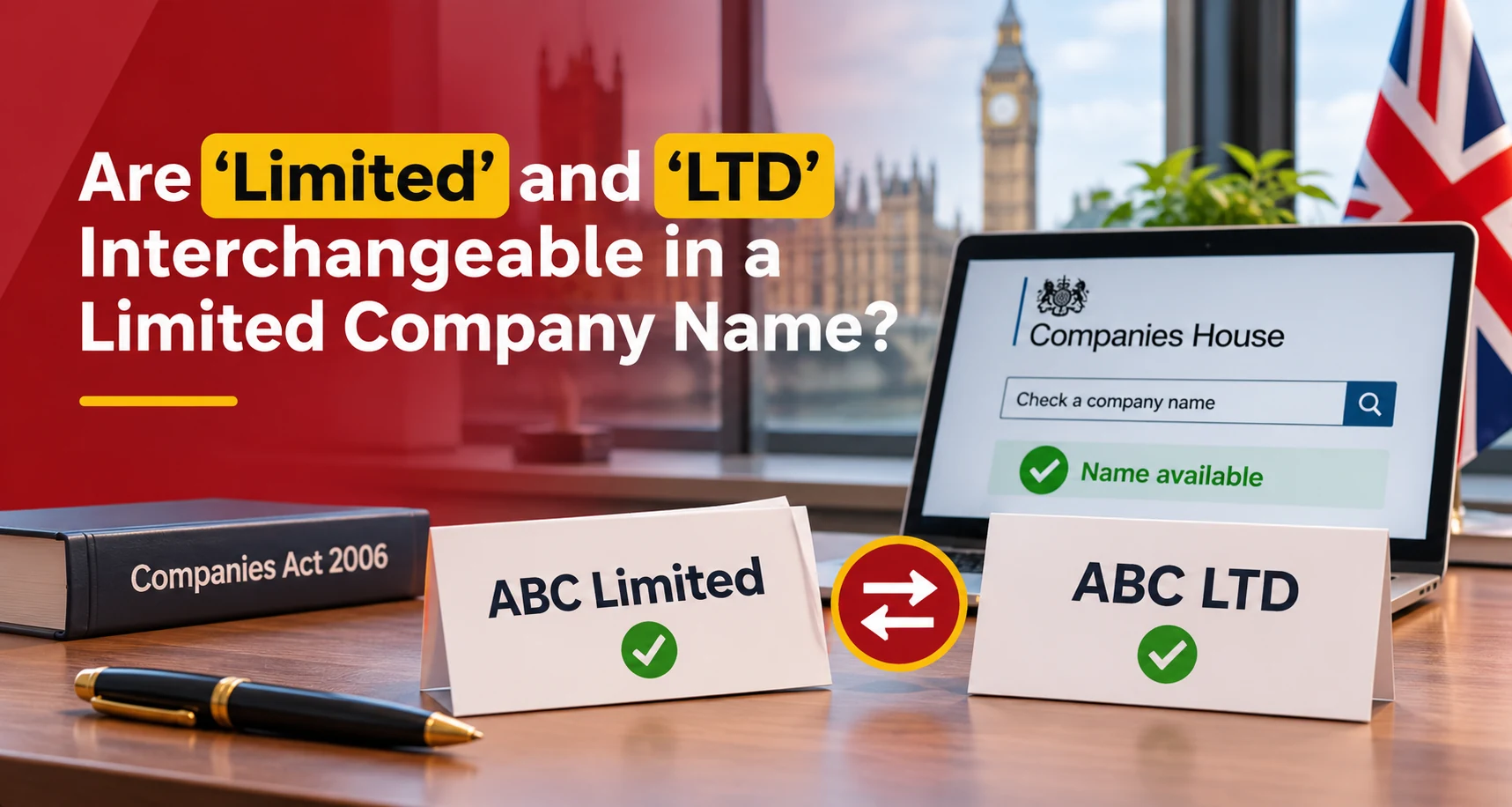
Limited and LTD are interchangeable in meaning, but invoices, letters, order forms, and websites must show your registered name exactly as it appears on your certificate of incorporation. Companies House ignores the ending when comparing names, so two unrelated companies cannot hold names that differ only by Limited or LTD. Company names have a 160-character limit, spaces included. Only two types of companies can drop the ending. One is a private company limited by guarantee that meets four conditions in its articles of association. The other is a private company that is a charity. Sole traders and partnerships cannot use either ending in a business name. LTD is distinct from LLC, a US state-law structure, LLP, a limited liability partnership, and plc, which marks a public company.
Three rules decide how you use the endings:
- Same Meaning: Limited is the full word, and LTD is its abbreviation. Both signal a private company whose members have limited liability.
- Match Your Registered Name: Copy the ending shown on your certificate into every template, so no document or web page mixes Limited and LTD.
- Trading Names: The suffix belongs to the registered name only. A trading name must not include it; for example, Brightside, not Brightside LTD.
What Is the Difference Between Limited and LTD?
The difference between Limited and LTD is length only. Limited is the full word, and LTD is its abbreviation, and the two mean the same thing in law. Both show that a company’s members have limited liability, so choosing between them is a matter of style at registration.
Schedule 2 of the Names and Trading Disclosures Regulations 2015 accepts both Limited and LTD as endings. It also allows LTD to be written with or without a full stop. The UK government’s incorporation and names guidance covers the ending. It confirms that a private company must end its name with Limited or LTD. This applies to a company limited by shares (owned by shareholders) and a company limited by guarantee (backed by guarantors, such as many clubs and charities). Companies House records the registered name in capital letters; the public register will read LIMITED or LTD, depending on the form chosen.
Welsh companies have two further options. Only a company whose registered office is stated as being in Wales can end its name with Cyfyngedig or Cyf instead, and Cyf can be written with or without full stops. A company with an England and Wales registered office must use Limited or LTD.
The table shows all four endings.
| English | Welsh | |
|---|---|---|
| Full word | Limited | Cyfyngedig |
| Abbreviation | LTD (or LTD.) | Cyf (or Cyf.) |
The wording you pick does not affect meaning, but the ending you register becomes part of your registered name. Where the law requires a company to show its name, such as on invoices and websites, the form to use is the one on the certificate, so match the registered name exactly.
What Does LTD Stand For?
LTD stands for Limited, the required ending of a UK private limited company’s name. It shows that the company’s members have limited liability. In a company limited by shares, each member can be asked to pay no more than any amount still unpaid on their shares.
The meaning of LTD comes from section 3 of the Companies Act 2006, which treats a company as limited when its members’ liability is capped, either by shares or by guarantee. Members are the people who own the company through shares or who guarantee it. A company limited by guarantee has guarantors instead of shareholders. Each guarantor owes only the amount promised to the company if it is wound up, which means closed down. When a company is wound up, its assets are used to pay its debts.
LTD is the abbreviation of the single word Limited. Under section 59 of the Companies Act 2006, a private limited company’s name must end with Limited or LTD. The explanatory note to the Names and Trading Disclosures Regulations 2015 calls this the required ending, the statutory indicator. LTD stands for Limited only. It does not stand for “limited liability company”, although some people expand it that way.
This answer applies to companies registered in the UK under the Companies Act 2006. Companies formed in other countries follow local law, so an overseas LTD is not necessarily governed by the same rules.

What Rules Apply to Company Names in the UK?
The rules for UK company names cover the ending, length, permitted characters, sensitive or offensive wording, and names already on the register. Companies House applies them when it registers a company, using the Companies Act 2006 and the Names and Trading Disclosures Regulations 2015. A name that breaks them can be refused at registration or ordered to change later.
The Companies House name rules are these:
- The name cannot be the “same as” a name already on the register, and the Limited or LTD ending is ignored when names are compared (your proposed name and every existing registered company name).
- Companies House can order a name change if a complaint shows the name is “too like” an earlier name, meaning it differs by only a few characters or looks and sounds the same.
- A private company’s name ends with Limited or LTD, and a public company’s name ends with public limited company or plc.
- The name can have no more than 160 permitted characters, and each blank space counts as one under regulation.
- The name can use letters, numbers and some punctuation like & or full stops, but it cannot be offensive, describe an offence or contain computer code.
- Sensitive words such as “Accredited”, “Chartered” or “Royal”, and names such as “Government” or “Council” suggesting a link to the UK government or a local authority, need permission.
- A name cannot be reserved before the application is made.
- A name cleared by Companies House is not cleared for trade mark because Companies House cannot consider alleged trade mark infringement when it decides a “too like” complaint.
Under Schedule 3 of the regulations, two names count as the same once the ending, specified punctuation, a leading “the”, a final “s,” and every character after the first 60 are ignored. Harbour Lane Bakery LTD and Harbour Lane Bakery Limited cannot both be registered, unless the existing company consents in writing or both belong to the same group.
Does a Company Name Need to Have Limited or LTD?
Yes, a private company limited by shares or by guarantee must end its name with Limited or LTD, unless exempt. Section 59 of the Companies Act 2006 sets this rule. A public company uses public limited company or plc instead.
The ending forms part of the registered name, so every LTD company name on the register includes either Limited or LTD, whichever was chosen at registration. A private company that qualifies for exemption from using Limited can apply to leave the ending out.
How Do You Register a Company with Limited or LTD?
You register a company with Limited or LTD by entering the full name, including your chosen ending, on the incorporation application. Companies House issues a certificate of incorporation showing the name exactly as registered. It normally processes online applications within 24 hours.
The registration has five steps:
- Decide whether to register the company name with LTD or Limited, then check the name against the register. A name cannot be reserved, so the check and the application should happen close together.
- Gather the company’s details. You need a registered office address in the company’s home nation (England and Wales, Scotland or Northern Ireland) and a company email address. You also need a SIC code for the business activity, for example, 43220 for plumbing installation. The company needs at least one director and shareholder (or one guarantor for a company limited by guarantee). The application also requires details of anyone with significant control, such as someone holding more than 25% of the shares or voting rights.
- Have each director verify their identity once through GOV.UK One Login. Verification produces a Companies House personal code, which the application asks for.
- Apply through commercial software, the GOV.UK online service or a postal application. At the time of writing, the standard software fee and the online fee are both £100; same-day software filing costs £156 if applied for by 3 pm from Monday to Friday, and a postal application on form IN01 costs £124 and takes 8 to 10 days.
- Receive the certificate of incorporation, which shows the company name including its ending, the company number, and the date of incorporation. The incorporation takes legal effect only when the certificate is issued, so wait for it before ordering stationery or opening a bank account in the new name.
A company that wants to leave out Limited cannot use the GOV. UK online service. It must register by post. Xact + Accountants’ company formation guide covers the full incorporation process.
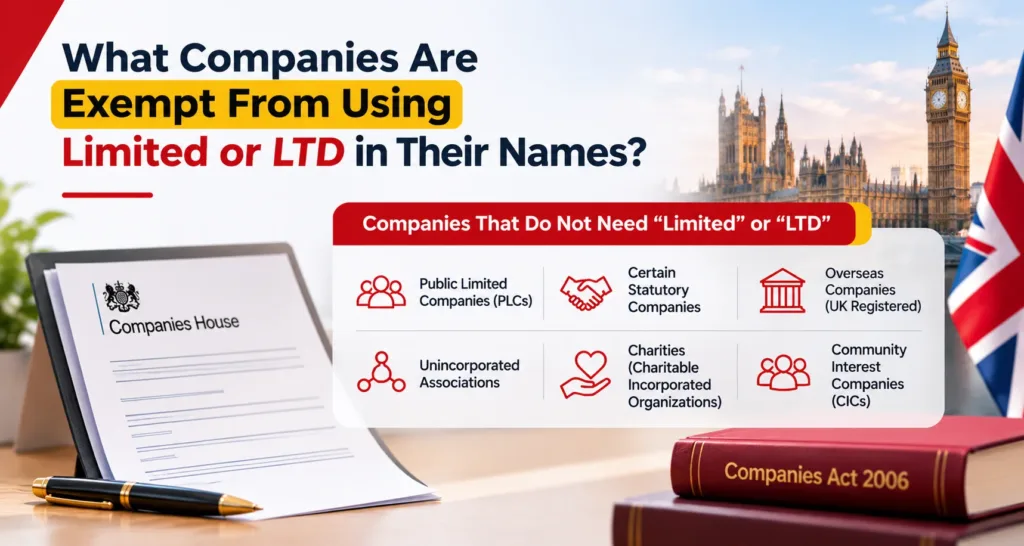
What Companies Are Exempt From Using Limited or LTD in Their Names?
Two types of private companies are exempt from using Limited or LTD in their names:
- A private company limited by guarantee that meets the conditions in regulation 3 of the Names and Trading Disclosures Regulations 2015.
- A private company that is a charity under section 60 of the Companies Act 2006.
A company limited by shares cannot use regulation 3. To qualify under regulation 3, a company limited by guarantee needs articles of association that meet four conditions:
- Objects that are the promotion or regulation of commerce, art, science, education, religion, charity or any profession.
- A requirement that income is applied in promoting those objects.
- A ban on dividends and on any return of capital to members.
- A requirement that the assets otherwise available to members pass on winding up to a body with similar objects or to a charitable body.
To claim the exemption, a company confirms on its registration application that it meets the conditions. Companies House guidance on incorporation and names says paper applicants complete section A3 of form IN01. At the time of writing, the GOV.UK online incorporation service cannot be used to apply for the exemption. An existing guarantee company that qualifies can claim it later by filing form NE01 with a change of name.
An exempt company still shows that it is limited. Regulation 25 requires its business letters, order forms and websites to say “limited company”. If a company stops meeting the conditions, the Secretary of State can order it to reinstate Limited in its name under section 64 of the Companies Act 2006, and Companies House allows at least 28 days to make the change. A community interest company uses the ending “community interest company” or “CIC” instead of Limited.
Can you remove limited or LTD from your company name?
No, you cannot remove limited or LTD from your company name unless the company is exempt. The ending is part of the registered name, so only a company that qualifies for the exemption can drop it through the company name change process. A company can market itself under a trading name without the suffix, but its registered name must appear wherever the law requires it.
Does limited or LTD change your legal protection?
No, limited or LTD does not change your legal protection. The legal protection of a limited company comes from incorporation, which creates a legal entity separate from the people who own or run it. The suffix tells the public that the members’ liability is limited. Adding the suffix to a business that has not been incorporated gives no protection. A business cannot operate as a limited company until it has been incorporated at Companies House.
Incorporation does not remove every personal risk either. A director who signs a personal guarantee can be pursued for that debt if the company cannot pay. A director who keeps trading while the company is insolvent can become personally liable for its debts. The Insolvency Service guidance on trading while insolvent explains this risk. Serious misconduct can also lead to disqualification for up to 15 years and an order to repay creditors. This is general information, not legal advice, so a director who has signed a personal guarantee or whose company may be insolvent should speak to a solicitor or an authorised insolvency practitioner.
Can LTD and limited be used interchangeably?
Yes, LTD and limited can be used interchangeably in meaning, but not wherever the law requires your registered name. Both endings mean the same, but invoices, letters, order forms and websites must show your registered name, so use the form on your certificate of incorporation.
Regulation 24 requires a company to show its registered name on business letters, order forms, invoices, receipts and other business documents, and on its websites. Letters, order forms and websites must also give the company’s registered number, its registered office address and the part of the UK where it is registered. The UK government’s guidance on signs, stationery and promotional material lists these details too. It adds that a company should usually write out its full registered name, ending in Limited or LTD, to make its limited status clear.
The table shows where either ending is fine and where to copy the certificate.
| Where the ending appears | Either form fine? | Basis |
|---|---|---|
| Meaning and the ending you register | Yes | Section 59 accepts both endings |
| Name availability checks | Yes | Schedule 3 ignores the ending when names are compared |
| Spoken references, logo and brand styling | Yes | Common practice |
| Business letters, order forms and other business documents | No, match the certificate | Regulations 24(1) and 25 |
| Invoices and receipts | No, match the certificate | Regulation 24(1)(e) |
| Websites | No, match the certificate | Regulations 24(2) and 25 |
| Forms filed with Companies House | No, match the certificate | Common practice |
The simplest way to meet these rules is to copy the ending on the certificate into every template. If your certificate shows Limited, your invoices, website footer and email footers should show Limited rather than LTD. Where documents already mix the two, change the templates now and use the certificate form.
At the end of trading disclosures, section 85 of the Companies Act 2006 disregards differences in capital letters, accents and punctuation, so LTD. with a full stop does not change the registered ending. However, neither section 85 nor regulation 24 allows you to swap Limited for LTD, or LTD for Limited, so matching the certificate is the safest approach.
How Do You Choose a Limited Company Name?
To choose a limited company name, start by running six checks before you register, because a name cannot be reserved and Companies House can order a change if it proves too similar to an existing one. The checks below take a few minutes and cover the legal rules, the trade mark position, and how the name will look on your domain, social media handles, and invoices.
Work through these six steps in order, using the rules in the previous section as the standard for each:
- Run the company name availability check to confirm no registered name is the same once the ending is ignored.
- Compare the name with similar registered names, then check it against the sensitive words in the UK government guidance, since some words need permission first.
- Search the UK Intellectual Property Office trade marks register. Company name approval does not clear a trade mark, so ask a solicitor or trade mark attorney about any similar mark.
- Look for a matching domain name and social media handles, because registering the company name secures neither.
- Count the characters, blank spaces included, against the 160 limit and confirm every character is permitted.
- Write the company name with LTD and then with Limited on a sample invoice, and pick the ending that reads better.
Our 9 tips for choosing a company name guide adds practical naming advice once these checks are done.

Can I Use Limited in My Trading Name?
No, you cannot use Limited in your trading name unless that name is your exact registered name. A company trading under a different name must not end that name with Limited or LTD, because Regulation 16 of the Names and Trading Disclosures Regulations 2015 allows those endings only for a company registered by that name.
A trading name is any name a company uses other than its registered name. The UK government’s incorporation guidance calls this a business name and says business names are not registered at Companies House. Take Brightside Plumbing LTD trading as Brightside. The trading name Brightside is allowed, but Brightside LTD is not, because that name does not register the company.
A trading name does not remove the disclosure duties. The registered name must still appear on invoices, letters and the website. A line such as “Brightside is a trading name of Brightside Plumbing LTD” shows customers how the two names connect; though it is common practice, the regulations do not prescribe that wording.
Breaking the rule is an offence under section 1197 of the Companies Act 2006, and every officer of the company who is in default can be guilty of it.
Can sole traders or partnerships use limited or LTD?
No, sole traders and partnerships cannot use limited or LTD in their business names, because Regulation 16 allows those endings only for a company registered by that name. A sole trader or partnership is not a company, so that ending would suggest limited liability. A limited liability partnership uses LLP as its own ending. The route to LTD is to incorporate a company and trade under its registered name.
Are LTD and LLC the same?
No, LTD and LLC are not the same because LTD is the ending of a UK private limited company, while an LLC (limited liability company) is a US business structure created under the law of an individual state. The UK has no company type called an LLC, so a UK business chooses a private limited company ending in LTD or Limited, or a limited liability partnership. A UK business chooses a private limited company ending in LTD or Limited, or a limited liability partnership.
A reader forming an LLC in the US should follow the IRS guidance on limited liability companies and the registry of the relevant state where the LLC is formed. Pty LTD is the ending Australian proprietary companies use and not a UK form.
Is LTD a private company?
Yes, LTD is a private company. A company whose name ends in Limited or LTD is a private company, while one ending in plc is a public company. A private company cannot offer its shares, such as ordinary shares or preference shares, for sale to the general public. A public company can, and its shares may be listed on an exchange like the London Stock Exchange.
Is LTD a corporation?
Yes, a UK LTD is a legal entity separate from the people who own or run it (its shareholders or guarantors, and its directors). However, the UK term is company, and corporation is mainly US wording. In UK documents, describe the business as a private limited company rather than a corporation.
What is a special limited company?
A special limited company is not a company type you can register in the UK. The types in the UK government’s incorporation guidance are private companies limited by shares or by guarantee, private unlimited companies and public limited companies.
People using the phrase mean one of four things. A special purpose vehicle is an ordinary limited company set up for one project or asset, such as buying a single property. A right to manage company lets long leaseholders in a block of flats take over its management. A community interest company is a limited company designed to benefit the community, and a company limited by guarantee is owned by guarantors rather than shareholders.
What mistakes should you avoid when choosing between limited and LTD?
These are the mistakes to avoid when choosing between limited and LTD, and a quick check of your documents (invoices, letters) and website against the registered name will show you which ones apply.
- Assuming two names exist. The ending is ignored when names are compared, so you cannot register both versions.
- Putting LTD in a trading name.
- Mixing suffixes on invoices such as sales invoices, VAT invoices and credit notes and the website, when both should copy the certificate.
- Leaving the registered number, registered office address and place of registration off the website.
- Leaving the suffix off the registered name on formal documents.
- Treating name availability as trade mark protection, which needs a separate trade mark search.
- Exceeding 160 characters, blank spaces included, or using non-permitted characters.
- Adding LTD as a sole trader.
Frequently Asked Questions
Can You Change from LTD to Limited After Registration?
Yes, you can change from LTD to Limited after registration, or change Limited to LTD, by changing your company name. This is typically done by special resolution and form NM01, filed with Companies House for £20 online or £30 on paper. The new ending applies once Companies House registers it.
What Happens if You Use LTD Without Being Registered?
Using LTD without being registered by that name is an offence. Regulation 16 limits these endings (Limited and LTD) to the registered company, and section 1197 of the Companies Act 2006 makes misuse an offence for which officers in default can also be liable.
Does Choosing Limited or LTD Affect Your Branding?
No, choosing Limited or LTD does not affect your legal status, and you can style the registered name in your logo with either ending. Your registered name must still appear on invoices, letters, and your website. Copying the certificate’s ending into every template keeps your branding consistent.
Can You Use Both Limited and LTD at the Same Time?
No, you cannot use both Limited and LTD at the same time in your registered name. The two mean the same thing, but your company has one registered form, so match it on invoices, letters, and the website. For the same reason, an unrelated company cannot register your name with the other ending.
Can a Foreign Company Use LTD in the UK?
Yes, a foreign company can use LTD in the UK if it was incorporated abroad with that name. Regulation 16 lets an overseas company trade in the UK under a name ending LTD on that basis, and Regulation 13 lets it register in the UK under such a name only if its members (shareholders or guarantors) have limited liability.

About the Author: Ahmad Raza