
A transfer of shares moves existing company shares from one owner to another person or organisation. It changes ownership without creating new shares. A UK private limited company may transfer shares during a sale, family gift, business restructure, or succession plan. The process usually involves a stock transfer form, company approval, and updated statutory records.
Tax also needs consideration. Stamp duty may apply when the buyer gives chargeable consideration for the shares. Capital Gains Tax may affect the seller or donor. The company’s articles of association can also restrict transfers. A shareholder agreement may contain further conditions, including pre-emption rights or valuation procedures.
This guide explains the complete share transfer process for a UK limited company. It covers documentation, Stamp Duty, Companies House reporting, family transfers, inherited shares, and company ownership records.
What Is a Transfer of Shares?
A transfer of shares moves existing shares from one shareholder to another holder. It does not increase the company’s issued share capital. The existing shareholder is usually called the transferor. The person receiving the shares is the transferee. A transfer can involve ordinary shares, preference shares, or another existing share class. The rights attached to those shares normally continue after the transfer.
The transfer may involve money or another form of consideration. Shares can also pass as a genuine gift without payment. The register of members plays an important role in legal ownership. Every company must keep a register showing its members and their shareholdings.
Under the model articles, the transferor remains the registered holder until the transferee enters the register of members. Beneficial ownership can differ from registered legal ownership in trust or nominee arrangements. These cases often require additional documentation.
How to Transfer Shares?
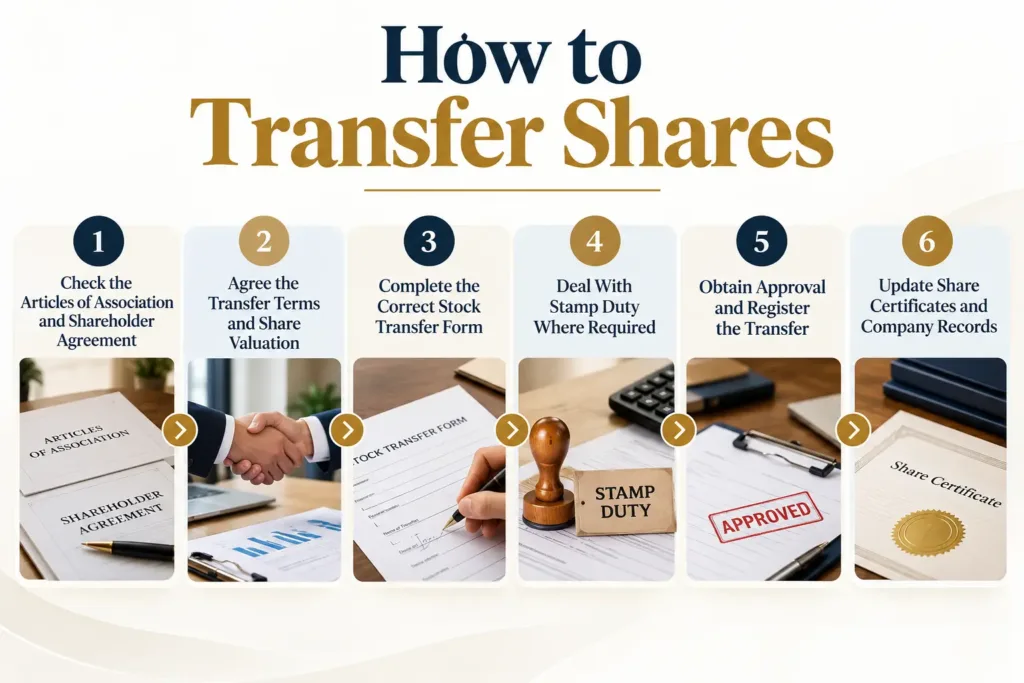
To transfer shares, follow six main stages from checking company rules to updating the statutory records.
Step 1: Check the Articles of Association and Shareholder Agreement
Review the company’s articles of association before starting the transfer. The articles can contain transfer restrictions or approval requirements. They may also give directors power to refuse registration. Check any shareholder agreement alongside the articles. It may contain pre-emption rights or restrictions on selling shares to outsiders. Some agreements require existing shareholders to receive the first opportunity to purchase the shares.
Step 2: Agree the Transfer Terms and Share Valuation
Agree how many shares will transfer, their class, and the price. Record any other consideration provided by the buyer. Consideration can include cash, shares, or certain assumed liabilities. A professional share valuation may be useful for private company shares. Valuation becomes particularly important for family transfers and connected persons. A substantial transaction may also require a share transfer agreement. The agreement can cover price, warranties, completion terms, and other obligations.
Step 3: Complete the Correct Stock Transfer Form
Complete the appropriate stock transfer form with accurate details. A stock transfer form, J30, is commonly used when transferring fully paid shares. Other forms may apply to partly paid shares.
The form should identify the company, share class, quantity, transferor, transferee, and consideration. HMRC requires the form to show the shares transferred and both parties’ details. It must also state the chargeable consideration.
Step 4: Deal With Stamp Duty Where Required
Check whether the transaction creates a Stamp Duty liability. Stamp Duty normally applies when shares are bought using a stock transfer form for more than £1,000. The current rate is 0.5%. HMRC rounds the amount up to the next £5. The buyer must normally send the relevant form and pay the duty within 30 days.
Step 5: Obtain Approval and Register the Transfer
Submit the completed documents to the company. The directors should review the transfer under the articles and any shareholder agreement. The company must either register a properly lodged transfer or issue a refusal with reasons. It must act within two months after the transfer is lodged. A board resolution or board minutes should record the directors’ decision where appropriate.
Step 6: Update Share Certificates and Company Records
Update the company’s register of members once the transfer becomes registered. Cancel the old share certificate where necessary. Issue an updated certificate showing the new shareholder’s holding. Review the company’s shareholder information and people with significant control positions. The transfer may also affect the company’s next confirmation statement.
How Do I Transfer Shares in a Limited Company?
You transfer shares in a limited company by completing the ownership, approval, tax, and registration requirements. Start by confirming the current shareholder’s holdings. Check the register of members and existing share certificate. Next, review the articles and shareholder agreement. Complete any required pre-emption or consent procedure before proceeding.
Agree the price or gift terms and complete the correct transfer document. Deal with Stamp Duty before the company registers the transfer where required. The company then records the new holder in its register of members. This step is important because registration determines the registered shareholder.
Who Approves a Share Transfer?
The company’s directors commonly approve registration, subject to the articles and any shareholder agreement. The model articles allow directors to refuse registration of a share transfer. A company’s bespoke articles may impose different conditions.
Some shareholder agreements also require approval from named shareholders. Approval requirements should therefore be checked before signing a substantial share transfer agreement or paying consideration.
What Are Directors’ Obligations on Registering the Transfer of Shares?
Directors must follow the company’s constitution and the statutory rules when considering a lodged share transfer. The company must register the transfer or notify the transferee of its refusal.
The refusal notice must include reasons. The company must take this action within two months after lodgement. Directors should also follow any valid transfer restrictions contained in the articles. Proper board minutes create a clear record of the decision and support good corporate governance.
Do You Need a Solicitor to Transfer Shares?
A solicitor is not normally required for a straightforward private company share transfer. An accountant or company secretarial adviser can often handle routine documents and company records. Legal advice becomes more useful where the transaction involves disputes, trusts, complex rights, or significant warranties.
A detailed share transfer deed or share sale agreement may also require legal drafting. Tax advice can help where gifts, connected persons, reliefs, or substantial gains are involved.
What Documents Are Required for a Share Transfer?
A typical company share transfer requires a stock transfer form, evidence of existing ownership, approval documentation, and updated company records. The existing share certificate confirms the current registered holding. The stock transfer form records the transaction. Board minutes or a board resolution can record approval.
The company then updates its register of members and prepares the appropriate share certificate. A larger transaction may also require a share transfer agreement. Family arrangements, trusts, or succession planning can require further documents.
What Is a Stock Transfer Form?
A stock transfer form records the transfer of existing shares from the registered holder to another person. It normally identifies the company, number of shares, class, transferor, transferee, and consideration. A J30 stock transfer form is commonly used for fully paid shares in a private company. HMRC does not provide a compulsory Companies House stock transfer form for ordinary private company transfers. Stock transfer forms can come from professional advisers or other suitable sources.
How Do You Complete a Share Transfer Form?
Complete the form with accurate details about the shares, parties, and consideration. Enter the company’s full name and describe the shares clearly. For example, the description could state “100 ordinary shares of £1 each”.Enter the registered shareholder’s name and the transferee’s details.
State the value of any cash or other chargeable consideration. Enter “Nil” where no consideration is given. The transferor must execute the instrument according to the applicable requirements.
How Do You Complete a J30 Stock Transfer Form?
Complete a J30 by recording the fully paid shares, parties, consideration, signatures, and relevant Stamp Duty information. Check the share quantity and class against the register of members before signing. Certificate 1 generally applies where consideration does not exceed £1,000. The transfer must not form part of a larger transaction exceeding that amount. Different rules apply to exempt transactions or relief claims. No certificate is normally required where the transferee gives no consideration.
What About Stamp Duty on the Transfer of Shares?
Stamp Duty normally applies at 0.5% when chargeable consideration for shares transferred by stock transfer form exceeds £1,000. HMRC rounds the calculated amount up to the next £5. For example, consideration of £2,001 creates Stamp Duty of £15 after rounding.No Stamp Duty is payable on consideration of £1,000 or less where Certificate 1 applies, and the transfer is not part of a larger transaction exceeding £1,000. A genuine gift with no consideration does not normally create stamp duty.
The current Stamp Duty system still applies in 2026. However, the rules are changing. The current Stamp Duty rules remain in force in 2026. HMRC published draft legislation on 13 July 2026 for a Securities Transfer Tax, planned for 2027. It will replace Stamp Duty and Stamp Duty Reserve Tax on securities transfers. It is planned for introduction in 2027. The new tax will replace Stamp Duty and Stamp Duty Reserve Tax on securities transfers.
How Long Does a Share Transfer Take?
A straightforward share transfer can be completed quickly when the documents, approval, and tax position are clear. The practical timescale depends on the company’s internal procedures. Stamp Duty can add another administrative stage when tax is payable. The Companies Act gives the company up to two months to register a lodged transfer or provide notice of refusal. This period represents the statutory limit rather than a standard waiting period.
Why Might a Shareholder Want to Transfer Shares?
Shareholders transfer shares for business sales, ownership changes, investment, family planning, and succession. A founder may transfer shares to another founder or external investor. An existing shareholder may sell their interest when leaving the business. Parents may transfer shares to children as part of succession planning.
Shareholders can also reorganize ownership between family members or group companies. Each purpose can create different tax and legal consequences. The underlying transfer process therefore needs to match the transaction.
Can Shares Be Transferred Without Payment?
Yes, shares can be transferred without payment as a genuine gift. The stock transfer form can show “Nil” consideration where the recipient gives nothing for the shares.No consideration does not automatically remove every tax issue.
A gift of shares can create a capital gains tax disposal even when the recipient pays nothing. HMRC generally uses market value when someone gifts shares to a person other than their spouse, civil partner, or charity. Available reliefs depend on the circumstances.
Can I Transfer Shares to a Family Member?
Yes, you can transfer shares to a family member where the company’s transfer rules allow it. The transfer can take place through a sale or gift. Check the articles and shareholder agreement before completing the transaction. A share valuation becomes important when transferring shares between connected persons.
HMRC’s connected-person rules can substitute open market value for the actual consideration when calculating a gain. Separate rules can apply to transfers between spouses and civil partners.
How to Complete a Stock Transfer Form?
To complete a stock transfer form, enter details of the shares being transferred, the existing shareholder, and the new shareholder accurately. For fully paid shares, a J30 stock transfer form is normally used. Enter the amount paid for the shares, the company name, the class of shares, and the number being transferred. Include the name and address of the person receiving the shares. The current shareholder, known as the transferor, must sign the form to authorise the transfer. Where applicable, the transferee’s details should also be completed carefully so the company can update its register of members.
If the consideration exceeds the relevant Stamp Duty threshold, the form may need to be submitted to HMRC, and any Stamp Duty paid before registration. Once completed, send the form to the company. The directors can then approve the transfer, update the statutory registers, and arrange a new share certificate for the transferee.
What Is the Difference Between Transferring Shares and Issuing Shares?
A share transfer moves existing shares, while a share issue creates new shares. A transfer usually leaves the company’s total issued share capital unchanged. For example, a company with 100 existing shares still has 100 shares after one shareholder transfers 20 shares. The ownership percentages change instead. An issue creates additional shares and can dilute existing shareholders. Companies House must normally receive notice when a company issues additional shares. A share buyback is also different. It involves the company acquiring its own shares under separate rules.
What Is the Difference Between a Share Transfer and Share Allotment?
A share transfer changes the owner of existing shares, while an allotment creates an entitlement to newly issued shares. An allotment can increase the company’s share capital and alter existing ownership percentages. A transfer redistributes existing company ownership without automatically increasing share capital. This distinction also affects Companies House filing requirements.
Does a Share Transfer Need to Be Reported to Companies House?
An ordinary transfer of existing shares is not reported by sending the stock transfer form directly to Companies House. The company keeps its own transfer records and updates the register of members. Shareholder information can then be updated through the confirmation statement. Companies House allows shareholder information changes through that filing. A share transfer is not the same as a share allotment. Form SH01 therefore does not apply simply because existing shares changed ownership.
A transfer can change the company’s PSC position. A person normally meets a PSC condition where their ownership or control crosses the relevant statutory threshold. Companies must report changes to PSC information within 14 days after confirming the change.
Frequently Asked Questions
Can I Transfer Shares Online?
Parts of the share transfer process can be handled electronically, but Companies House does not provide a simple online share-transfer service. Companies can maintain digital records and prepare documents electronically where the applicable requirements allow. HMRC also accepts electronic copies or scans of stock transfer forms when Stamp Duty processing is required. The company's own articles should still be checked for execution requirements.
How Long Does a Share Transfer Take?
The practical completion period depends on approvals, Stamp Duty, and the quality of the documents. A simple internal transfer can progress promptly where no restriction or tax issue causes delay. The statutory two-month period concerns the company's obligation to register or refuse a lodged transfer. It is not a required waiting period.
Can Shares Be Gifted?
Yes, shares can be gifted without the recipient paying for them. The transfer still needs to follow the company's articles and registration procedure. Stamp Duty is normally not payable where no consideration is given. Capital Gains Tax may still apply because a gift can count as a disposal at market value.
Is Stamp Duty Always Payable?
No, Stamp Duty is not payable on every company shares transfer. A genuine gift without consideration normally falls outside the usual charge. Qualifying transfers for £1,000 or less can also avoid Stamp Duty when the relevant conditions are satisfied. Reliefs and exemptions can apply to other transactions.
Can Directors Refuse a Transfer?
Yes, directors can refuse registration where the company's articles give them that authority. The model articles contain a power allowing directors to refuse a transfer. Bespoke articles or shareholder agreements may create different restrictions. The company must provide the required notice and reasons where it refuses registration.
What Happens if a Shareholder Dies?
A shareholder's death usually causes a transmission of shares rather than an ordinary voluntary transfer. The personal representatives deal with the deceased person's shares through estate administration.
Under the model articles, an entitled transmittee can choose to become the holder or transfer the shares onward. Probate or letters of administration may provide evidence of authority. A deceased PSC does not need to complete Companies House identity verification. The PSC should normally remain on the register until probate or letters of administration are received.

About the Author: Ahmad Raza