
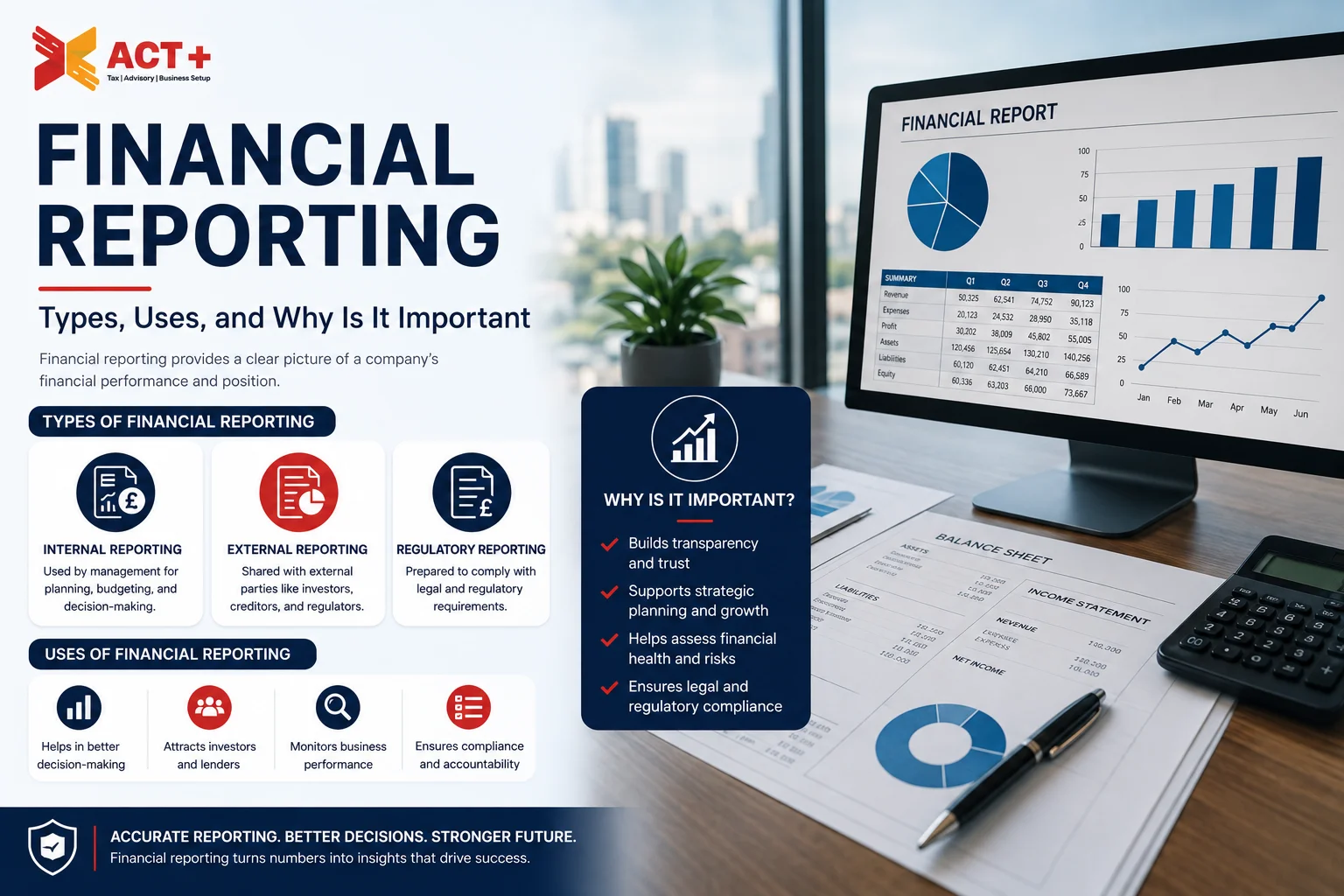
Financial reporting records, organizes, and presents a business’s financial information in a structured format. It helps business owners, investors, lenders, regulators, and other stakeholders understand a company’s financial performance and financial position. In the UK, financial reporting also supports compliance with legal requirements set by Companies House, HMRC, the Financial Reporting Council (FRC), and accounting standards issued by the International Accounting Standards Board (IASB).
Every business, from a sole trader to a multinational company, relies on accurate financial reporting to make informed decisions. Well-prepared financial reports improve transparency, support business growth, simplify tax compliance, and build trust with investors and lenders.
What Is Financial Reporting?
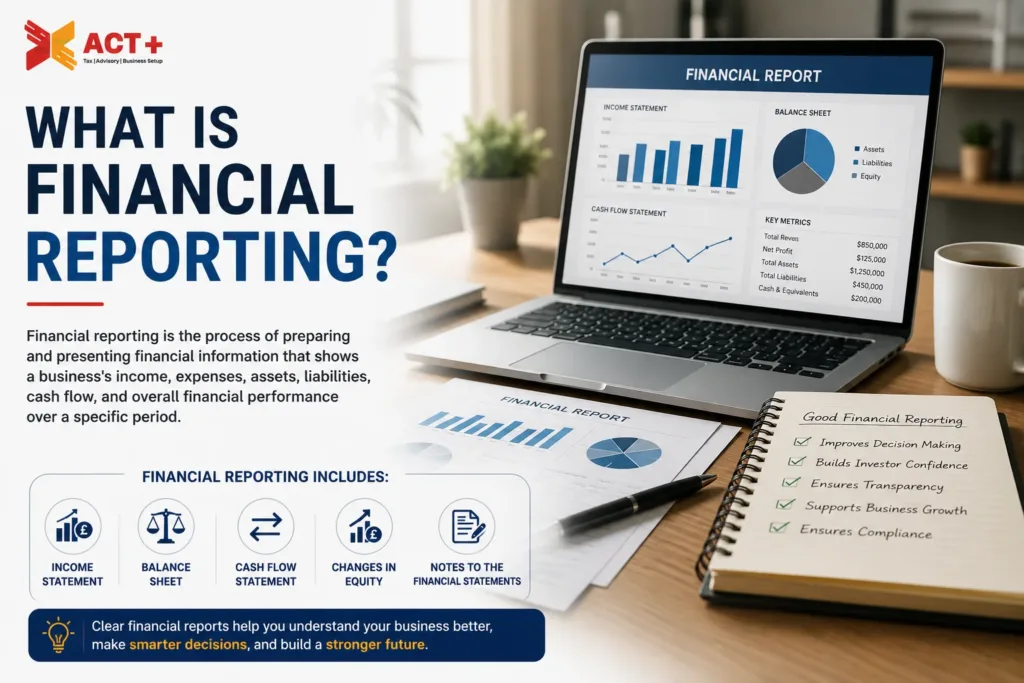
Financial reporting is the process of preparing and presenting financial information that shows a business’s income, expenses, assets, liabilities, cash flow, and overall financial performance over a specific period.
Financial reporting goes beyond producing annual accounts. It provides reliable financial information that helps businesses monitor performance, meet legal obligations, and plan for future growth.
A complete financial reporting process usually includes:
- Recording financial transactions
- Maintaining accurate bookkeeping records
- Preparing financial statements
- Reviewing financial performance
- Filing statutory reports where required
- Sharing reports with internal and external stakeholders
For UK limited companies, financial reporting often includes submitting annual accounts to Companies House and providing financial information to HMRC for corporation tax purposes.
Good financial reporting enables businesses to:
- Measure profitability
- Monitor cash flow
- Control spending
- Evaluate business performance
- Secure finance
- Meet regulatory requirements
- Build investor confidence
Without reliable financial reporting, businesses struggle to understand whether they are making money, losing money, or managing resources effectively.
Need Help with Financial Reporting?
Ensure your financial reports are accurate, compliant, and submitted on time. Our qualified accountants are ready to help your business.
Get Expert Help with Financial Reporting →What Are the Types of Financial Reporting?
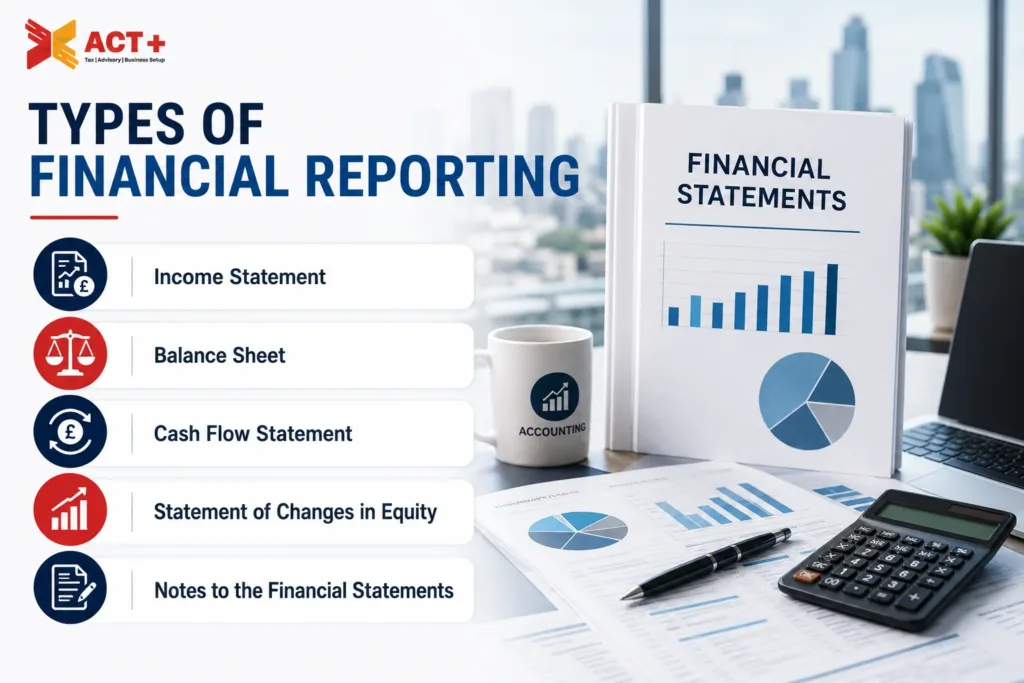
Financial Reporting Has 5 main types that are listed below:
Income Statement
The income statement shows whether a business generated a profit or incurred a loss during a specific reporting period. It normally includes revenue, cost of sales, gross profit, operating expenses, operating profit, finance costs, tax expenses, and net profit. Business owners use the income statement to evaluate profitability, compare financial performance across different periods, and identify areas where operating costs or other expenses can be reduced.
Balance Sheet
A balance sheet shows what a business owns and owes on a specific date. It is divided into three main sections: assets, liabilities, and equity. Assets include the resources owned by the business, while liabilities represent the amounts it owes to other parties. Equity reflects the remaining value belonging to the owners or shareholders after liabilities are deducted from assets. The balance sheet helps businesses assess financial stability, liquidity, and overall financial strength. For example, a company with substantial assets and relatively low debt will generally have a stronger financial position than a business with significant liabilities.
Cash Flow Statement
A cash flow statement explains how cash moves into and out of a business during a reporting period. It separates cash movements into operating, investing, and financing activities. Operating activities include cash generated from everyday business operations, while investing activities relate to the purchase or sale of long-term assets. Financing activities include transactions involving loans, share capital, and dividend payments. Profitable businesses fail because of poor cash flow rather than a lack of accounting profit. This report helps business owners identify potential cash shortages before they become serious and ensures the company has enough funds to meet its financial obligations.
Statement of Changes in Equity
A statement of changes in equity explains how shareholders’ equity changes during an accounting period. It records movements such as retained profits, dividend payments, new share issues, share buybacks, and comprehensive income. The statement connects the opening equity balance with the closing balance and explains the reasons for any increase or decrease. Investors often review this report to understand how the value attributable to company owners has changed over time.
Notes to the Financial Statements
The notes to the financial statements provide additional explanations and supporting information about the figures presented in the main financial reports. They may include details about accounting policies, asset valuation methods, outstanding loans, tax information, contingent liabilities, and related-party transactions. These notes improve transparency and help readers understand how financial figures were calculated. They also provide important information that may not be clear from the income statement, balance sheet, cash flow statement, or statement of changes in equity alone.
Who Uses Financial Reports?
Financial reports are used by many people, not just accountants. Business owners, directors, investors, banks, tax authorities, suppliers, and employees all rely on them for different reasons. Some want to measure profit and cash flow, while others check financial stability, legal compliance, or repayment ability. Clear reports help each group make more confident and informed decisions about the business overall.
Business Owners
Business owners use financial reports to monitor profitability, expenses, cash flow, and overall business performance. These reports help them understand whether the company is achieving its financial goals and operating efficiently. Owners may use this information to decide whether to invest in new equipment, expand into new markets, hire additional employees, increase prices, or reduce unnecessary costs.
Directors
Company directors use financial reports to fulfil their legal and management responsibilities. They must understand the company’s financial position, identify potential risks, and ensure the business can continue meeting its obligations. Regular financial reporting also helps directors make informed strategic decisions and confirm that the company remains financially healthy.
Investors
Investors review financial reports before buying shares or providing additional capital to a business. They normally assess revenue growth, profit margins, cash generation, debt levels, and return on investment. This information helps them evaluate the company’s performance, financial risks, growth potential, and ability to generate future returns.
Banks and Lenders
Banks and other lenders review financial reports before approving business loans, overdrafts, mortgages, or credit facilities. They assess profitability, liquidity, solvency, cash flow, and existing liabilities to determine whether the business can afford repayments. Strong, accurate, and consistent financial reporting can improve a company’s chances of obtaining finance and may help it secure more favourable lending terms.
HMRC
HM Revenue and Customs uses financial information to calculate Corporation Tax and verify that a business is meeting its tax obligations. Accurate financial reporting supports the preparation of correct tax returns and reduces the risk of errors, penalties, interest charges, and HMRC enquiries. Businesses should therefore ensure that their accounting records and financial statements are complete and reliable.
Companies House
Companies House is generally required to submit annual accounts to Companies House as part of their statutory reporting obligations. These filings provide publicly available information about the company’s financial position and performance. Filing accurate accounts on time helps the company remain compliant and avoid late filing penalties or other enforcement action.
Suppliers
Suppliers may review a company’s financial information before offering trade credit or agreeing to extended payment terms. They use this information to assess whether the business is financially stable and likely to pay invoices on time. Companies with strong financial records may receive higher credit limits, longer payment periods, or more favourable commercial terms.
Employees
Employees may review published financial reports to understand the company’s financial stability, performance, and long-term prospects. Strong financial results can provide reassurance about job security, salary payments, career development, and future business growth. Financial difficulties may indicate potential cost reductions, restructuring, or changes in employment conditions.
Why Is Financial Reporting Important?
Financial reporting is important because it improves decision-making, supports legal compliance, strengthens investor confidence, and helps businesses achieve sustainable growth. Reliable financial reports provide a clear picture of business performance rather than relying on assumptions.
Key benefits include:
- Better financial planning
- Improved budgeting
- Stronger cash flow management
- Easier tax compliance
- Better investment decisions
- Greater transparency
- Improved business valuation
- Increased lender confidence
- Reduced financial risk
Businesses that monitor financial reports regularly can respond more quickly to changing market conditions. Instead of reacting after problems occur, they can identify trends early and make informed decisions. For small businesses, regular financial reporting often highlights declining profit margins, rising expenses, or cash flow issues before they threaten business operations. It also supports long-term strategic planning by providing accurate historical financial data that managers can use to forecast future performance.
What Are the Financial Reporting Requirements?
Financial reporting requirements depend on a business’s legal structure, size, and the accounting framework it follows. In the UK, limited companies must comply with reporting obligations set by Companies House, HMRC, and the Financial Reporting Council (FRC). Although reporting requirements vary, most businesses must keep accurate accounting records and prepare financial reports that fairly represent their financial position.
Financial Reporting Requirements for UK Limited Companies
A UK limited company normally needs to:
- Maintain complete accounting records.
- Prepare annual accounts.
- File annual accounts with Companies House.
- Submit a company tax return to HMRC.
- Pay the corporation tax by the applicable deadline.
- File a Confirmation Statement each year.
- Retain accounting records for the required statutory period.
Companies must also ensure their reports comply with the relevant accounting standards.
Late or inaccurate filings can result in:
- Financial penalties.
- Interest on unpaid tax.
- Compliance investigations.
- Damage to the company’s reputation.
- Potential director responsibilities under company law.
Small companies may qualify for simplified reporting requirements. However, they must still prepare accurate financial information that complies with UK legislation.

What Are Financial Reporting Standards?
Financial reporting standards are accounting rules that ensure financial reports remain consistent, transparent, and comparable across different businesses. Without common standards, every company could present financial information differently. That would make it difficult for investors, lenders, and regulators to compare financial performance.
The two most recognized financial reporting frameworks are
International Financial Reporting Standards (IFRS)
International Financial Reporting Standards, commonly known as IFRS, are developed by the International Accounting Standards Board (IASB). Many countries require or permit listed companies and large organisations to prepare their financial statements in accordance with IFRS. These standards are designed to improve transparency, comparability, consistency, investor confidence, and the quality of global financial reporting. Businesses that operate internationally often use IFRS because it allows investors, regulators, and other stakeholders to compare financial information across different countries and markets.
Generally Accepted Accounting Principles (GAAP)
Generally Accepted Accounting Principles, or GAAP, refer to the accounting principles and reporting rules followed within a particular country. The term is commonly associated with accounting standards used in the United States. GAAP contains detailed requirements covering areas such as revenue recognition, asset valuation, expense recognition, financial statement presentation, and disclosure requirements. Although IFRS and GAAP both aim to improve the reliability and quality of financial reporting, they differ in several accounting treatments, calculation methods, and disclosure rules.
UK Financial Reporting Standards
Many companies follow UK GAAP, which includes standards such as
- FRS 102
- FRS 105 (for micro-entities)
- FRS 101 (Reduced Disclosure Framework)
The Financial Reporting Council (FRC) oversees these standards and updates them when necessary.
How Does Financial Reporting Help Business Growth?
Financial reporting helps business growth by providing reliable financial information that supports better decisions, stronger cash flow management, and long-term planning. Businesses grow faster when decisions rely on accurate financial data instead of assumptions. Financial reports help owners identify opportunities and risks before they affect profitability.
Improves Decision-Making
Managers rely on financial reports to assess overall business performance, compare actual results with targets, and monitor important financial trends. Regular analysis gives them a clear understanding of the company’s position and highlights warning signs that may require management action.
They can quickly identify:
- Falling profits
- Rising expenses
- Declining sales
- Cash shortages
- Inefficient operations
These insights help businesses respond before problems become significant.
Supports Financial Planning
Financial reporting gives businesses reliable historical data that supports more accurate budgeting and forecasting. By reviewing past income, costs, and cash movements, managers can identify trends, set realistic financial targets, allocate resources effectively, and prepare for future opportunities and challenges.
Businesses can estimate:
- Future revenue
- Operating expenses
- Hiring requirements
- Capital investments
- Cash flow needs
Better planning reduces financial uncertainty.
Helps Secure Business Finance
Banks and investors carefully review financial reports before approving loans or providing investment. Accurate and well-prepared statements show that a business is financially reliable, capable of meeting its obligations, and positioned to use external funding responsibly for development and expansion.
Strong financial reporting demonstrates:
- Stable income
- Healthy cash flow
- Responsible financial management
- Sustainable growth
Clear financial information increases lender and investor confidence.
Improves Risk Management
Regular financial reporting helps businesses identify potential risks before they become serious problems. By reviewing key financial trends, managers can detect warning signs, assess their impact, and take timely action to protect profitability, liquidity, operational stability, and long-term business performance.
Examples include:
- Declining profit margins
- Increasing debt
- Slow-paying customers
- Excess inventory
- Cash flow problems
Early detection allows businesses to take corrective action before issues escalate.
Builds Investor Confidence
Investors rely on transparent financial reporting to assess a company’s financial health, management quality, and future potential. Clear and accurate reports reduce uncertainty, support informed investment decisions, and show that the business is responsibly managed and prepared for sustainable growth.
Reliable reports demonstrate:
- Professional management
- Regulatory compliance
- Consistent financial performance
- Long-term business stability
Greater transparency often attracts additional investment.
What Is the Difference Between Financial Reporting and Financial Accounting?
Financial accounting and financial reporting are closely connected, but they are not the same. Financial accounting focuses on recording a company’s daily financial transactions, while financial reporting turns those records into clear and useful statements. They help businesses understand performance, meet legal requirements, support planning, and provide reliable information to owners, investors, lenders, and other stakeholders with greater confidence.
| Financial Accounting | Financial Reporting |
|---|---|
| Records financial transactions | Presents financial information |
| Focuses on bookkeeping and accounting records | Focuses on communicating financial performance |
| Produces accounting data | Produces financial reports and financial statements |
| Supports internal accounting processes | Supports external and internal decision-making |
| Forms the foundation of financial reporting | Uses accounting data to produce meaningful reports |
Financial accounting records and organises a company’s financial data, while financial reporting presents and explains that data to help stakeholders understand the business’s financial performance and position.
How Does Financial Accounting Support Financial Reporting?
Financial accounting supports financial reporting by collecting, classifying, and recording every financial transaction accurately. Financial reports are only as reliable as the accounting records behind them.
The accounting process normally includes:
Recording Transactions
Every business transaction is recorded in the accounting system to maintain complete and accurate financial records. These transactions may include sales, purchases, payroll expenses, loan repayments, and tax payments. Recording each transaction correctly helps the business monitor its financial activities and prepare reliable financial statements.
Maintaining Accurate Ledgers
Accountants organise transactions into ledger accounts. These records form the basis of the financial statements.
Reconciling Financial Records
Regular reconciliations identify discrepancies between accounting records and bank statements. This process improves accuracy before reports are prepared.
Preparing Trial Balances
A trial balance confirms that total debits equal total credits. It provides the starting point for preparing annual financial statements.
Producing Financial Statements
Accountants rely on complete and verified bookkeeping records to prepare accurate financial statements. Well-maintained records ensure that every transaction is properly classified, supported, and reflected in the accounts, helping businesses meet reporting obligations and make informed financial decisions with confidence.
Accountants use these records to prepare:
- Income statements
- Balance sheets
- Cash flow statements
- Statements of changes in equity
Accurate bookkeeping leads to reliable financial reporting. Poor bookkeeping can result in reporting errors, tax issues, and unreliable business decisions.
Need Help with Financial Reporting?
Ensure your financial reports are accurate, compliant, and submitted on time. Our qualified accountants are ready to help your business.
Get Expert Help with Financial Reporting →What Information Does Financial Reporting Include?
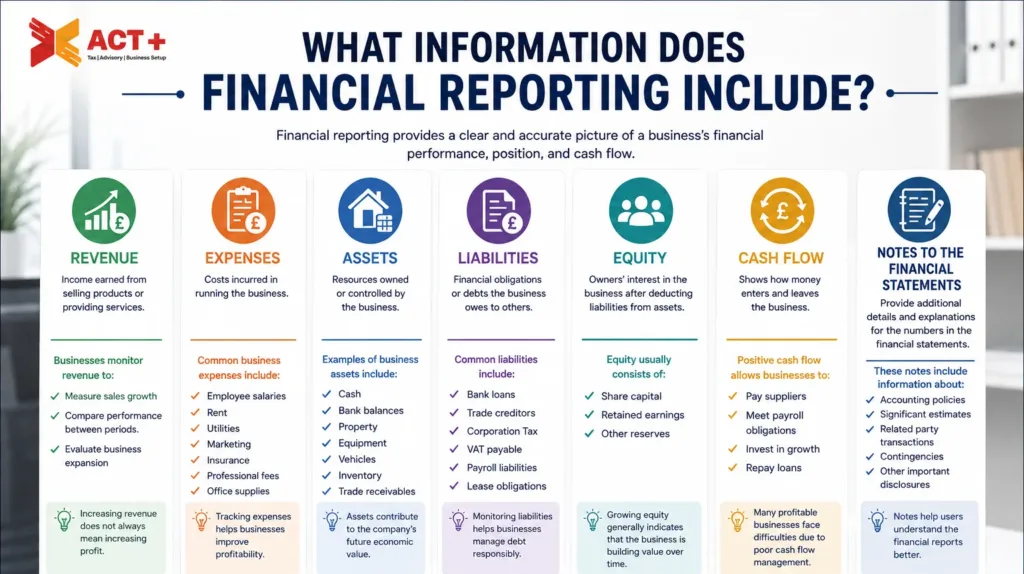
Financial reporting includes information about a company’s income, expenses, assets, liabilities, equity, cash flow, and financial performance. These figures provide a complete picture of how a business operates and whether it remains financially healthy.
Each section of a financial report answers a different business question.
Revenue
Revenue represents the income a business earns from selling products or providing services. Reviewing revenue regularly helps managers understand sales performance, customer demand, pricing effectiveness, and market trends. It also supports realistic target setting and growth planning by showing whether the business generates enough income from its core products and services over time.
Businesses monitor revenue to:
- Measure sales growth
- Compare performance between reporting periods
- Evaluate business expansion
Increasing revenue does not always mean increasing profit. Expenses must also remain under control.
Expenses
Expenses include the costs of running the business. Monitoring expenses helps businesses understand where money is being spent and identify unnecessary costs. Careful cost control supports better budgeting, protects profit margins, improves operational efficiency, and ensures that financial resources are used responsibly throughout every area of the organisation.
Common business expenses include:
- Employee salaries
- Rent
- Utilities
- Marketing
- Insurance
- Professional fees
- Office supplies
Tracking expenses helps businesses improve profitability.
Assets
Assets are resources that a business owns or controls. Reviewing assets helps a business understand the resources available to support daily operations and future growth. Accurate records also assist with valuation, depreciation, insurance, borrowing decisions, investment planning, and the preparation of reliable financial statements for internal and external stakeholders.
Examples of business assets include:
- Cash
- Bank balances
- Property
- Equipment
- Vehicles
- Inventory
- Trade receivables
Assets contribute to the company’s future economic value.
Liabilities
Liabilities represent the financial obligations of a business. Businesses must monitor liabilities carefully to understand upcoming payment obligations and their overall level of debt. Effective liability management supports cash flow planning, protects creditworthiness, reduces financial risk, and helps ensure that commitments are settled on time without disrupting operations.
Common liabilities include:
- Bank loans
- Trade creditors
- Corporation Tax
- VAT payable
- Payroll liabilities
- Lease obligations
Monitoring liabilities helps businesses manage debt responsibly.
Equity
Equity represents the owners’ interest in the business after deducting liabilities from assets. Analysing equity helps owners and investors understand how much value remains in the business after all obligations are deducted. It reflects accumulated profits, shareholder investment, and reserves, providing an important measure of financial strength, stability, and long-term business value creation.
Equity usually consists of:
- Share capital
- Retained earnings
- Other reserves
Growing equity generally indicates that the business is building value over time.
Cash Flow
Cash flow shows how money enters and leaves the business. Regular cash flow monitoring helps businesses understand whether enough money is available to meet short-term commitments. It supports payment planning, highlights potential shortages, improves working capital management, and enables managers to make confident decisions about spending, borrowing, investment, and growth.
Positive cash flow allows businesses to:
- Pay suppliers
- Meet payroll obligations
- Invest in growth
- Repay loans
Many profitable businesses experience financial difficulties because of poor cash flow management rather than low profits.
Notes to the Financial Statements
The notes explain how the figures in the financial statements were prepared. Notes to the financial statements provide context that cannot always be understood from the figures alone. They explain assumptions, accounting treatments, uncertainties, and additional details, allowing investors, lenders, regulators, and managers to assess the reported information more accurately and confidently.
They often include:
- Accounting policies
- Depreciation methods
- Significant estimates
- Loan terms
- Related-party transactions
- Contingent liabilities
These disclosures improve transparency and help readers interpret the financial statements correctly.
What Is an Example of Financial Reporting?
A financial reporting example shows how a complete set of statements presents a company’s performance, financial position, cash movements, and changes in ownership interest. For a UK limited company, the annual reporting package typically includes interconnected statements and supporting disclosures.
Imagine a UK limited company preparing its annual accounts for a complete accounting period. Its financial reporting package may include:
For example:
A retail company reports:
- Annual revenue of £850,000.
- Operating expenses of £710,000.
- Net profit of £92,000.
- Total assets of £480,000.
- Total liabilities of £165,000.
From these figures, investors, lenders, and directors can evaluate profitability, liquidity, and financial stability. Monthly financial reporting follows a similar structure but focuses on shorter reporting periods. Management teams often use monthly reports to monitor business performance throughout the year instead of waiting for annual accounts.
Who Is Responsible for Financial Reporting?
Company directors hold primary responsibility for financial reporting, even when accountants or bookkeepers prepare the reports. Many businesses involve several professionals in the reporting process.
Directors
Directors ensure that financial statements:
- Present a true and fair view.
- Comply with applicable accounting standards.
- Meet statutory filing deadlines.
Delegating preparation does not remove a director’s legal responsibility.
Accountants
Professional accountants:
- Prepare financial statements.
- Review accounting records.
- Ensure compliance with accounting standards.
- Advise on financial reporting requirements.
They also identify reporting issues before accounts are finalised.
Bookkeepers
Bookkeepers maintain accurate accounting records throughout the year.
Their responsibilities include:
- Recording transactions.
- Reconciling bank accounts.
- Maintaining purchase and sales ledgers.
- Managing payroll records.
Accurate bookkeeping creates the foundation for reliable financial reporting.
Auditors
Some companies require an independent audit. Auditors examine whether financial statements fairly represent the company’s financial position according to the applicable reporting framework. They provide independent assurance rather than preparing the financial statements themselves.
How Do You Prepare Financial Reports?
Preparing financial reports involves recording transactions, verifying financial data, preparing financial statements, and reviewing them for accuracy before submission. A structured process improves reliability and reduces reporting errors.
Step 1: Maintain Accurate Bookkeeping
Record every financial transaction throughout the accounting period.
Examples include:
- Sales
- Purchases
- Payroll
- Loan payments
- Bank transactions
Accurate bookkeeping reduces year-end adjustments.
Step 2: Reconcile Financial Records
Compare accounting records with:
- Bank statements
- Supplier statements
- Customer balances
- Payroll records
- Tax records
Reconciling accounts helps identify missing or incorrect transactions.
Step 3: Prepare a Trial Balance
A trial balance confirms that accounting entries remain mathematically accurate. Errors identified at this stage are easier to correct before producing financial statements.
Step 4: Prepare Financial Statements
Prepare the required reports, including:
- Income statement
- Balance sheet
- Cash flow statement
- Statement of changes in equity
- Supporting notes
The reports should comply with the applicable accounting standards.
Step 5: Review Compliance
Check whether the reports satisfy:
- Companies House filing requirements
- HMRC reporting obligations
- Applicable accounting standards
- Internal company policies
Reviewing reports before submission reduces the risk of penalties.
Step 6: File and Share Reports
Submit statutory reports before filing deadlines. Internal management reports can then support budgeting, forecasting, and strategic planning.
How Can You Read and Understand Financial Reports?
You can understand financial reports by reviewing profitability, financial position, cash flow, and financial trends instead of focusing on individual numbers. Looking at one figure in isolation rarely tells the full story.
Review the Income Statement First
The income statement answers an important question: is the business making a profit? When reviewing it, focus on revenue growth, gross profit, operating profit, net profit, and changes in expenses. It is better to compare several reporting periods rather than looking at one year alone, as this makes it easier to identify improvements, declines, and long-term financial trends.
Examine the Balance Sheet
The balance sheet provides information about the financial strength of a business. Review total assets, total liabilities, working capital, and shareholders’ equity to understand the company’s financial position. A financially healthy business generally maintains enough assets and available resources to meet its short-term and long-term obligations.
Analyse Cash Flow
Cash flow analysis can reveal financial problems before they become visible in the profit figures. Review whether the company’s operating activities generate positive cash and whether the business has enough funds to pay suppliers, employees, lenders, and tax liabilities. Consistent negative operating cash flow may indicate underlying financial difficulties, even when the company reports an accounting profit.
Compare Financial Ratios
Financial ratios make financial reports easier to understand and compare. Useful measures include the gross profit margin, net profit margin, current ratio, debt-to-equity ratio, and return on equity. Comparing these ratios across several accounting periods can highlight financial trends more effectively than reviewing individual figures alone. Ratios can also help businesses compare their performance with competitors or industry averages.
Read the Notes Carefully
Important information often appears in the notes rather than in the main financial statements. These disclosures may explain accounting policies, significant risks, loan agreements, financial commitments, contingent liabilities, and other matters that could affect the business. Reading the notes carefully provides valuable context and helps users understand details that the headline figures alone may not explain.
What Is the Difference Between Internal and External Financial Reporting?
Internal financial reporting helps management make business decisions, while external financial reporting provides financial information to parties outside the business. Although both rely on the same accounting records, they have different audiences, objectives, formats, and reporting requirements.
Internal and external financial reporting use the same underlying accounting records, but each serves a different audience and purpose. Understanding their differences helps businesses prepare suitable reports, meet legal obligations, support management decisions, and communicate financial performance clearly to stakeholders.
Both use the same accounting data that serve different purposes.
Internal Financial Reporting
Internal reports provide detailed and timely information that managers can use to monitor operations, control costs, allocate resources, and respond to emerging issues. Because these reports are designed for internal use, their format and frequency can be adapted to needs.
Internal reports may include:
- Departmental budgets
- Sales reports
- Cash flow forecasts
- Profitability analysis
- Key performance indicator dashboards
External Financial Reporting
External reports present formal financial information to parties outside the organisation, including regulators, investors, lenders, and tax authorities. They follow recognised accounting standards and reporting deadlines to ensure consistency, transparency, comparability, and compliance with legal and regulatory requirements for businesses.
External reports typically include:
- Annual financial statements
- Statutory accounts
- Auditor’s reports
- Corporation Tax information
- Investor reports
Successful businesses use internal and external financial reporting together. Internal reports support daily management and strategic planning, while external reports demonstrate accountability, compliance, and financial transparency to stakeholders outside the organisation.
What Is the Difference Between Financial Reporting and Financial Statements?
Financial statements are individual reports, while financial reporting is the complete process of preparing, presenting, and communicating financial information. Many people confuse these terms because financial statements form the core of financial reporting.
Financial reporting includes:
- Recording financial transactions.
- Maintaining accounting records.
- Preparing financial statements.
- Applying accounting standards.
- Reviewing financial performance.
- Filing statutory reports.
- Sharing financial information with stakeholders.
Financial statements usually consist of:
- Income statement.
- Balance sheet.
- Cash flow statement.
- Statement of changes in equity.
- Notes to the financial statements.
Financial statements are the output, while financial reporting is the entire process behind them.
What Is the Difference Between Financial Reporting and Management Reporting?
Financial reporting communicates financial information to internal and external stakeholders, while management reporting focuses on helping managers improve business performance. Management reports are not usually required by law.
Management reports often include:
- Budget variance reports.
- Department performance.
- Sales trends.
- Customer profitability.
- Cash flow forecasts.
- Business KPIs.
Financial reporting tells stakeholders what happened. Management reporting helps managers decide what to do next.
What Are Financial Reporting Best Practices for Small Businesses?
Small businesses improve financial reporting by maintaining accurate records, reviewing reports regularly, and following recognised accounting standards. Strong reporting habits reduce errors and support better financial decisions.
Best practices include:
Maintain Accurate Bookkeeping
Record every transaction promptly. Up-to-date records reduce year-end corrections and improve reporting accuracy.
Separate Business and Personal Finances
Use dedicated business bank accounts. Separating finances simplifies bookkeeping and improves financial transparency.
Reconcile Accounts Monthly
Compare accounting records with:
- Bank statements
- Supplier balances
- Customer accounts
- Payroll records
Regular reconciliations identify discrepancies early.
Review Financial Reports Regularly
Do not wait until year-end.
Review monthly:
- Revenue
- Expenses
- Profit margins
- Cash flow
- Outstanding debts
Regular reviews support faster decision-making.
Use Reliable Accounting Software
Modern accounting software automates many reporting tasks. Popular features include:
- Bank feeds
- Invoice management
- Expense tracking
- VAT reporting.
- Financial dashboards
Automation reduces manual errors and saves time.
Work with a Qualified Accountant
Professional accountants help businesses:
- Apply the correct accounting standards
- Meet filing deadlines
- Improve tax efficiency
- Identify financial risks
- Interpret financial reports
Expert advice often prevents costly reporting mistakes.
What Mistakes Should You Avoid in Financial Reporting?
Businesses should avoid financial reporting mistakes that reduce accuracy, delay compliance, or present misleading information. Errors in financial reports can affect decision-making, damage business credibility, and increase the risk of penalties, tax inquiries, or regulatory action.
Poor Bookkeeping
Poor or incomplete bookkeeping can lead to inaccurate financial statements. Even small errors, such as missing invoices, duplicated transactions, or incorrect classifications, can develop into larger reporting problems. Businesses should maintain complete and up-to-date accounting records throughout the year rather than waiting until the reporting deadline.
Missing Filing Deadlines
Missing financial reporting or tax filing deadlines may result in financial penalties, interest charges, regulatory action, and damage to the company’s reputation. Businesses should maintain a reporting calendar that records all important filing, payment, and compliance deadlines. Regular reminders can help directors and finance teams submit the required information on time.
Ignoring Cash Flow
Profit alone does not provide a complete picture of financial health. A business may report a profit but still struggle to pay employees, suppliers, lenders, or tax liabilities. Cash flow should therefore be monitored regularly to ensure that the company has enough available funds to meet its short-term and long-term financial obligations.
Using Incorrect Accounting Standards
Businesses must apply the financial reporting framework that is appropriate for their size, legal structure, and regulatory obligations. Using the wrong accounting standard may result in inaccurate disclosures, inconsistent financial statements, and compliance problems. Companies should confirm whether they need to follow IFRS, UK GAAP, FRS 102, FRS 105, or another applicable framework.
Failing to Review Reports
Financial reports should always be reviewed carefully before they are submitted or shared with stakeholders. A thorough review can identify calculation errors, unusual balances, missing disclosures, and inconsistencies between different financial statements. Independent or professional reviews may also detect issues that automated accounting systems fail to identify.
Not Keeping Supporting Documents
Businesses should retain invoices, receipts, contracts, payroll records, bank statements, and other supporting documents. These records provide evidence for the figures included in the financial statements and strengthen the reliability of financial reporting. Maintaining organised supporting documentation also makes future audits, tax enquiries, and regulatory reviews easier to manage.
Need Help with Financial Reporting?
Ensure your financial reports are accurate, compliant, and submitted on time. Our qualified accountants are ready to help your business.
Get Expert Help with Financial Reporting →Frequently Asked Questions
What skills are needed for financial reporting?
What is the difference between accounting reports and financial reports?
Can financial reporting help a business get a loan?
What is the difference between financial reporting and a tax return?
What are the responsibilities of an auditor in financial reporting?

About the Author: Ahmad Raza