A Unique Taxpayer Reference (UTR) is a 10-digit tax identification number that HMRC issues to individuals, partnerships and limited companies. It links tax returns (Self Assessment or Company Tax Return) and payments (Income Tax or Corporation Tax) to the right record, and it is separate from VAT, PAYE, company registration and National Insurance numbers.
Sole traders earning over the £1,000 trading allowance, partners, and landlords or directors with untaxed income register for Self Assessment to get a personal UTR, usually within 10 working days (21 days abroad), by 5 October after the tax year they first need to file. Limited companies receive a Corporation Tax UTR automatically after incorporation, posted to the registered office, but must still register for Corporation Tax within 3 months of starting business activity.
Individuals need a UTR to file a Self Assessment return, and companies need one for the Corporation Tax Return. It lets subcontractors join the Construction Industry Scheme and accountants, such as Xact+ accountants, act for taxpayers. Find it in your HMRC online account, on tax returns or on HMRC letters, and contact HMRC for a copy if lost, and do not register again. A director’s personal UTR cannot replace the company UTR.
What Is Unique Taxpayer Reference (UTR)?
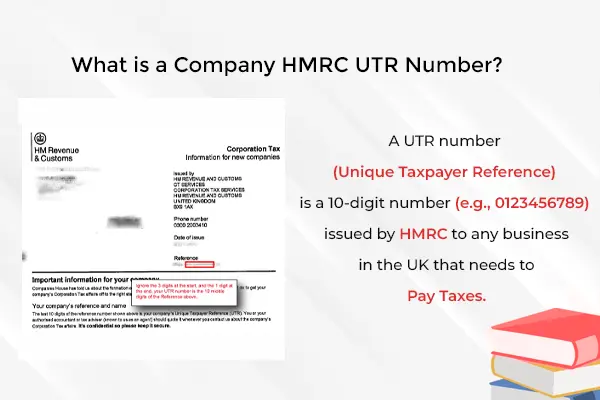
A Unique Taxpayer Reference (UTR) is a 10-digit number that HMRC issues to identify a taxpayer, tax returns and payments go to the right individual or limited company. An individual’s UTR identifies a single person, and a limited company’s UTR identifies that company alone. HMRC issues each UTR once, and it does not change. HMRC prints the UTR as two groups of five digits, for example 12345 67890.
Who Is Eligible to Get a UTR?
Both individuals and limited companies are eligible for a UTR. An individual qualifies when income must be reported on a Self Assessment return, and a limited company qualifies automatically once it is incorporated at Companies House.
Individuals who need a UTR include sole traders, partners in a partnership (such as business partners sharing profits), and landlords or directors with untaxed income (such as rental income or dividends). A sole trader must register for Self Assessment when gross self-employment income is above the £1,000 trading allowance in a tax year. An employee whose tax HMRC collects entirely through PAYE, where the employer deducts it from their salary, usually does not need a UTR.
- Every UK limited company is eligible for its own UTR, including private limited companies, PLCs and community interest companies. HMRC issues the company UTR after incorporation, whether or not the company has made a profit. A company that has not started business activity is dormant, but it has a UTR because HMRC issues it on incorporation, not when trading starts. The company must register for Corporation Tax within 3 months of starting business activity.
The table shows who qualifies, the usual reason, and which UTR HMRC issues:
| Taxpayer | Usual reason for needing a UTR | UTR HMRC issues |
|---|---|---|
| Sole trader | Gross self-employment income above the £1,000 trading allowance in a tax year | Personal UTR |
| Partner in a partnership | A share of the partnership’s profit, reported on the partner’s own return | Personal UTR for each partner |
| Partnership | Registration as a business with HMRC | Partnership UTR |
| Landlord or other individual | Rental or other untaxed income that HMRC does not collect through PAYE | Personal UTR |
| Company director | Untaxed income outside PAYE, such as dividends or benefits | Personal UTR |
| Private limited company | Incorporation at Companies House | Company UTR for Corporation Tax |
| PLC | Incorporation at Companies House | Company UTR for Corporation Tax |
| Community interest company | Incorporation at Companies House | Company UTR for Corporation Tax |
How Can an Individual and Limited Company Apply for a UTR?
An individual obtains a UTR by registering with HMRC, whereas a limited company receives its UTR automatically upon incorporation. Individuals and sole traders register for Self Assessment online, partnerships register as a business, and limited companies incorporate at Companies House.
There are four registration routes:
- Individuals who are not self-employed register for Self Assessment, then wait for HMRC to post the UTR.
- Sole traders register as self-employed through the same service, and HMRC posts the UTR after registration.
- Partnerships register as a business, and each partner registers individually for a personal UTR.
- Limited companies, including private limited companies, PLCs and community interest companies, incorporate through Companies House, and HMRC issues the company UTR without a separate application.
Need Help Understanding Your UTR?
Get professional support from Xact+ Accountants with HMRC registration, Self Assessment, and Corporation Tax.
Contact UsHow Does a UTR Differ from Other Tax Identification Numbers?
A UTR differs from other tax identification numbers because it identifies one taxpayer’s Self Assessment or Corporation Tax record. The other numbers are the company registration number, VAT registration number, employer PAYE reference and Accounts Office reference. Each identifies a different record. These numbers cannot replace the UTR, and it cannot replace them on a return, invoice or payment.
The table compares the UTR with four other numbers that a limited company may hold:
| Number | Issued by | What it identifies | Format | Where it appears |
|---|---|---|---|---|
| UTR | HMRC | One taxpayer's Self Assessment or Corporation Tax record | 10 digits | Tax returns and HMRC letters about those taxes |
| Company registration number | Companies House | The company on the public register | 8 characters | Certificate of incorporation |
| VAT registration number | HMRC | A VAT-registered business | 9 digits, sometimes with a GB prefix | VAT registration certificate and VAT invoices |
| Employer PAYE reference | HMRC | The company's payroll scheme | 3 digits, a slash, then the employer reference | P45s, P60s and HMRC payroll letters |
| Accounts Office reference | HMRC | The account that receives PAYE payments | 13 characters | HMRC's employer registration letter |

What Documents and Personal Information Are Required to Register for a UTR?
Individuals need personal details and limited companies need company details to register for a UTR. Individuals, including sole traders, partners, landlords and directors with untaxed income, need personal details and a National Insurance number, and the self-employed among them also need business details. Limited companies, including private limited companies, PLCs and community interest companies, need their Companies House details, which HMRC usually already holds from incorporation.
The 2 lists show what each group should gather.
For Individuals and Self-Employed Applicants:
- Full name
- Date of birth
- National Insurance number
- Home address
- Telephone number
- Email address
- Self-employment start date
- Type of business
- Business contact details (where applicable)
For Limited Companies:
- Registered company name
- Company Registration Number (CRN)
- Registered office address
- Trading start date
- Principal business address
- Standard Industrial Classification (SIC) code, the five-digit code that describes what the company does
- Accounting reference date, the date on which the company’s financial year ends
- Names and addresses of company directors
How to Apply for a UTR Number?
Sole traders and self-employed individuals apply for a UTR by registering for Self Assessment with HMRC. Limited companies do not apply separately because HMRC issues their UTR after incorporation. The registration deadline for individuals is 5 October after the end of the tax year in which they first need to file, so HMRC can issue the UTR before the return is due. Someone who started trading in June 2026, which falls in the 2026 to 2027 tax year, must register by 5 October 2027.
Individuals:
These 5 steps register an individual for Self Assessment and trigger the UTR letter:
- Visit the official portal: Open the Register for Self Assessment service on GOV.UK.
- Sign in or create an ID: Existing HMRC users sign in with their current Government Gateway user ID. New HMRC users are being asked to create a GOV.UK One Login.
- Provide personal details: Enter the personal details listed in the previous section, including the National Insurance number.
- Enter business details: Self-employed applicants give the type of business and the date self-employment started.
- Wait for delivery: HMRC posts the UTR to the address provided.
A partnership also registers as a business, and each partner registers individually for a personal UTR. HMRC does not charge for registration. A website that asks for a fee is not an HMRC service.
Limited Companies:
These four steps give a limited company its UTR and register it for Corporation Tax:
- Incorporate the company: Register the company with Companies House.
- Wait for the UTR letter: Companies House shares the company’s details with HMRC, and it posts the Corporation Tax UTR to the registered office address. The director does not submit an application.
- Set up Corporation Tax online: Sign in to the HMRC business tax account with a Government Gateway user ID and add Corporation Tax.
- Enter company details: Give the company UTR and the date business activity started, along with the registered company name, Company Registration Number, registered office address, SIC code and accounting reference date.
The company must register for Corporation Tax within 3 months of starting business activity, even if it has not made a profit.
How Long Does It Take to Get a UTR?
It takes up to 10 working days to get a UTR after registering for Self Assessment, or 21 days if you live abroad. A limited company’s UTR is posted to its registered office address after incorporation. The company can request a copy online if the UTR letter arrives within 15 working days. The activation code for the online Self Assessment service arrives in a separate letter. The code must be used within 28 days. Anyone who registers late should allow time for both letters before filing online.
What Are the Benefits of a UTR?
A UTR lets individuals and companies file tax returns and make tax payments. It lets subcontractors register for the Construction Industry Scheme, and taxpayers authorise an accountant. An individual uses a personal UTR on a Self Assessment return, and a limited company uses its company UTR on a Company Tax Return. Both use the UTR when they pay tax, so HMRC credits each payment to the right record. A UTR also lets a subcontractor register for the Construction Industry Scheme, where contractors deduct 20% from registered subcontractors and 30% from unregistered ones. An accountant needs the UTR to be authorised to deal with HMRC on a taxpayer’s behalf.
How to Find My Unique Tax Reference Number (UTR)?
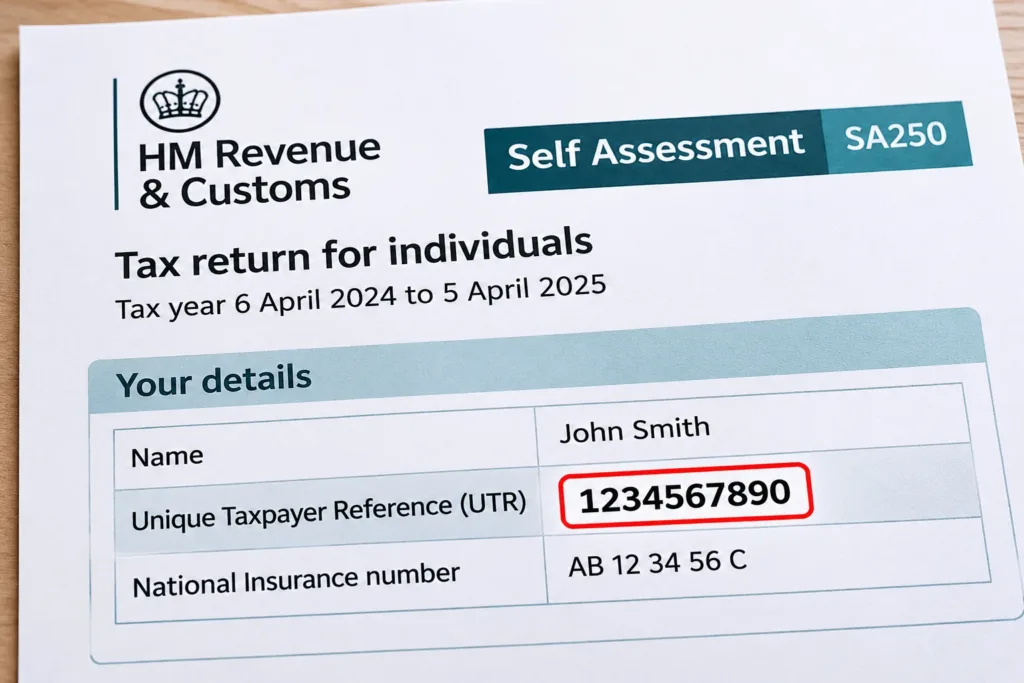
You can find your UTR in your HMRC online account, on previous tax returns or HMRC letters. The HMRC app also shows an individual’s UTR, and a limited company finds its UTR in its business tax account or on Corporation Tax letters.
These three checks help you find the number:
- Check your HMRC online account: Sign in to the personal tax account or the HMRC app and open the Self Assessment section. A company with a business tax account can see its UTR there.
- Review previous tax returns or HMRC letters: The UTR appears on Self Assessment returns, notices to file, payment reminders and the SA250 welcome letter sent at registration. The label may read “UTR”, “reference” or “official use”.
- Check Corporation Tax letters for company UTRs: The company UTR is printed on the letter HMRC posts after incorporation and on later notices to deliver a Company Tax Return.
What Happens If I’ve Lost My UTR Number?
If you have lost your UTR, contact HMRC and ask for a copy. Individuals should check the places listed above first. An individual who cannot find the UTR can ask HMRC to post a copy after identity checks. A limited company that has lost its Corporation Tax UTR can ask HMRC for a copy, and HMRC posts it to the registered office address, so the address on the Companies House register must be current before the request. Do not register again, because a second registration can create a second record. Xact+ accountants can help individuals and limited companies recover a lost UTR and deal with HMRC on their behalf.
Can I Use My Personal UTR for My Company?
No, you cannot use your personal UTR for your company. HMRC gives each limited company its own Corporation Tax UTR, and the personal UTR stays with the individual for Self Assessment. A director uses their personal UTR on their own Self Assessment return, and the company uses its UTR on the Company Tax Return and on Corporation Tax correspondence. The name on an HMRC letter shows which UTR it carries.
Do You Need a UTR Number to Submit Your Return?
Yes, you need a UTR to submit a Self Assessment tax return or a Company Tax Return. HMRC cannot attach a return to a taxpayer record without it. Online Self Assessment returns for the 2025 to 2026 tax year are due by 31 January 2027. An individual who has not yet received a UTR should register before then, because filing cannot start without the number.

FAQs
Why Is the UTR Number Important?
The UTR number is important because HMRC uses it to identify a taxpayer on every Self Assessment or Corporation Tax record. A return or payment that carries the wrong UTR cannot be matched to the right taxpayer. Keep the number private and share it only with HMRC and the accountant who acts for you.
How to Get UTR for Self-Employed by Phone?
To get a UTR by phone as a self-employed person, call HMRC's newly self-employed helpline and register over the phone. HMRC then posts the UTR to the address given. Callers need their National Insurance number and business details ready. The helpline number and opening hours change, so check GOV.UK before calling.
Can I Have More Than One UTR Number?
Yes, a taxpayer can hold more than one UTR number, but only one of them is personal. Each limited company and each partnership has its own UTR. A sole trader who directs a company therefore uses a personal UTR and a company UTR. Anyone who suspects a duplicate personal UTR should contact HMRC and not register again.
Is UTR the Same as National Insurance?
No, a UTR is not the same as a National Insurance number. HMRC issues the UTR to identify a taxpayer for Self Assessment or Corporation Tax. A National Insurance number identifies a person's National Insurance record and contributions. A UTR has 10 digits. A National Insurance number has two letters, six digits, and a final letter.
Are UTR and Tax Reference Number the Same?
Yes, a UTR and a tax reference number usually mean the same number. The official name is Unique Taxpayer Reference, and HMRC letters often print it under the label "tax reference". Other HMRC numbers, such as a VAT registration number or a PAYE reference, also contain the word reference, so check the label before quoting a number.

About the Author: Ahmad Raza