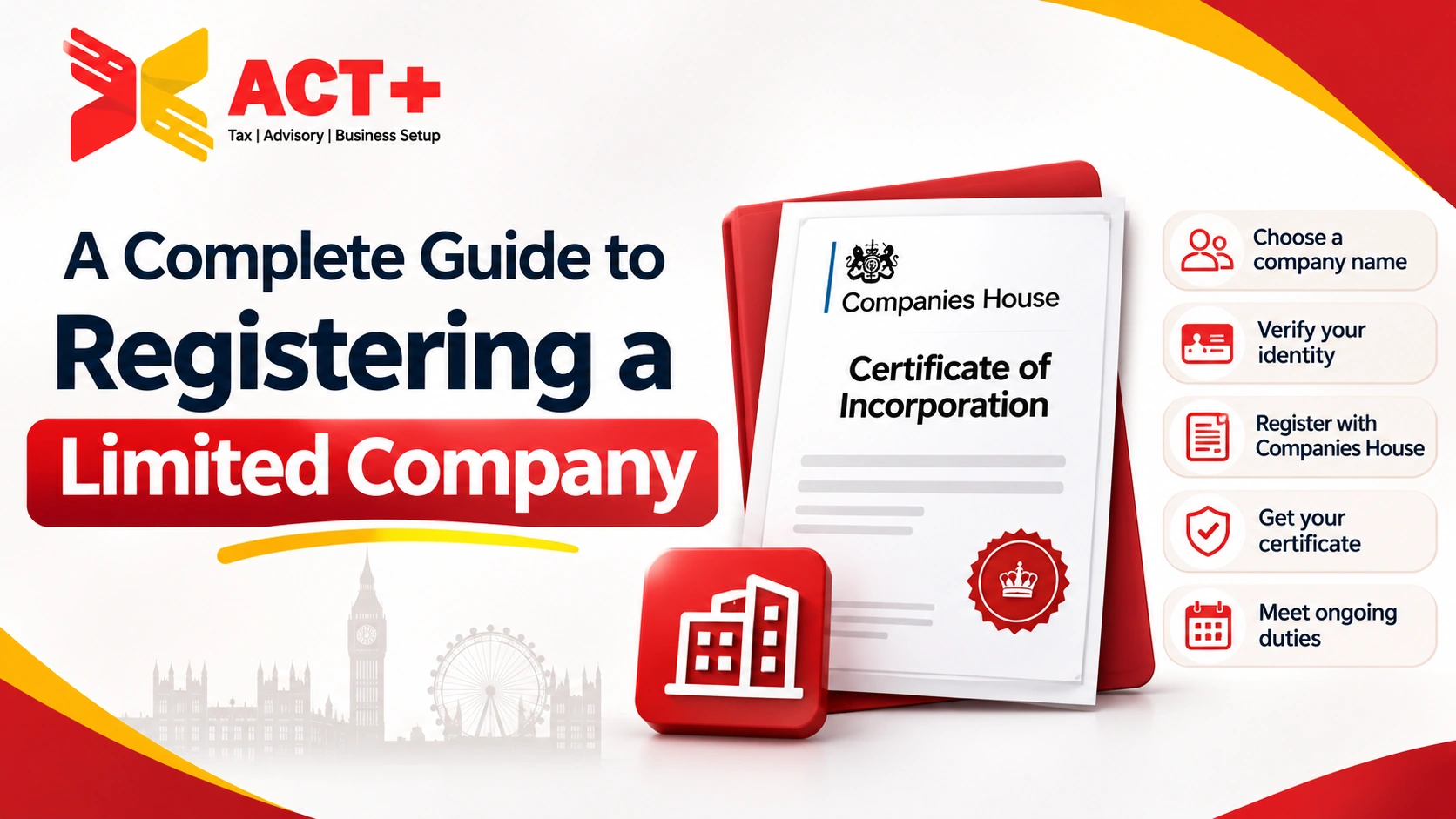
Companies House registration fee is £100 for an online application, £124 for a paper application, and £156 for same-day registration via software. Online applications are usually registered within 24 hours. These fees apply from 1 February 2026.
Before applying, first-time founders need a company name, registered office address, SIC code, at least one director and shareholder, constitutional documents, and verified director identities. Preparing these details usually takes longer than the filing itself. After the certificate of incorporation arrives, the directors tell HMRC about Corporation Tax, check the VAT threshold, set up PAYE and open a business bank account.
Accountancy, insurance and address services (such as preparing annual accounts and the Corporation Tax Return, business insurance, and a registered office address) add to that fee. A company limited by shares suits a trading business, and a company limited by guarantee suits a not-for-profit organisation. Owners then compare limited company status with sole trading in terms of liability, tax, and filings, and decide whether to file themselves or hire an accountant. Once the company exists, directors keep records, file annual accounts and a confirmation statement, and meet the tax deadlines.
How to Set Up a Limited Company
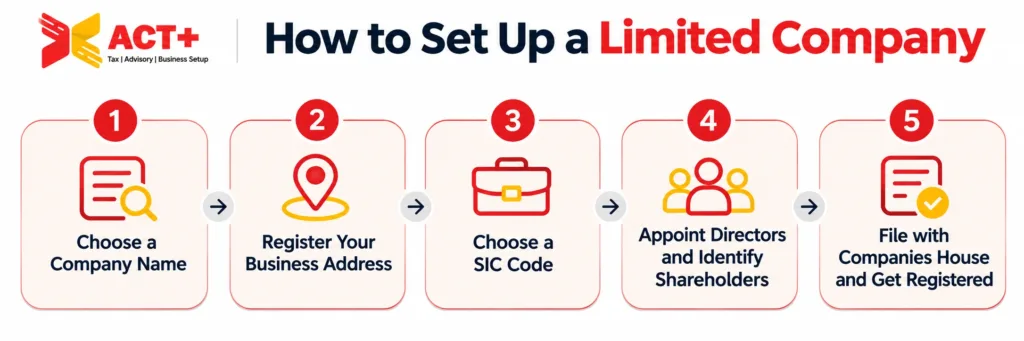
Registering a limited company involves filing an application with Companies House. This creates a company legally separate from its owners. Make five decisions before opening the online application. They are the company name, the registered office address, the SIC code, the directors and shareholders, and the constitutional documents.
Most people finish the form in one sitting once those decisions are made. The UK government publishes a step-by-step company registration guide, which you can consult to confirm current requirements.
Choose a Company Name
A company name must end in “Limited” or “Ltd”, must differ from every name already on the register, and must avoid sensitive words unless permission has been granted. Companies House checks all three points before it registers the name.
The ‘same as’ rule applies to more names (those that differ only by punctuation or a commonly used word) than founders may expect. Companies House ignores punctuation and commonly used words when it compares names, so “Hands UK Ltd” and “Hand’s Ltd” count as the same as “Hands Ltd”. Search the Companies House register before choosing a domain name or ordering stationery.
A sensitive word needs permission before the name is accepted. The same applies to a name that suggests a link with government or a local authority. GOV.UK lists the affected words and the body that grants permission for each.
Registering a company name does not create trade mark rights. A name that matches another business’s registered trade mark can still lead to a dispute, so search the Intellectual Property Office trade marks register as well. A solicitor or trade mark attorney handles disputes and infringement claims. Xact+Accountants gives further guidance in its tips for choosing a company name.
Register Your Business Address
The registered office is the company’s official address for post from Companies House and HMRC, and it appears on the public register. The address must be appropriate. That means a physical address in the same part of the UK as the company’s registration, where delivered documents would reach someone acting for the company and delivery can be acknowledged.
A PO box does not qualify as an appropriate address. A home address can serve as the registered office when the owner of the property gives permission, and it meets the rules, although it then appears on the public register. An accountant or solicitor can supply a registered office address that keeps the home address off the register, as long as that address meets every requirement.
The company also needs a registered email address. Companies House keeps this address off the public register and sends its emails there, so someone acting for the company must check it. A new company gives the email address during registration, and the company can change it later by notifying the registrar.
Choose a SIC Code for Your Business
Choose the SIC code that matches how the company earns most of its income. Add codes only for activities the company will carry out. The UK government publishes the full Standard Industrial Classification list on GOV.UK, so search it by keyword.
Read the description under each code rather than relying on the headline title, because neighbouring codes (for example, 62012 for software development and 62020 for IT consultancy) often cover different work. The company can update its SIC codes after registration, so an imperfect first choice does not block the application.
Appoint Directors and Identify Shareholders
Directors run the company. A private limited company needs at least one director, who must be 16 or over and must not be disqualified from acting as a director. A company secretary is optional. Directors owe their duties to the company and are legally responsible for its records and accounts.
Shareholders own the company. A company limited by shares needs at least one shareholder, and the same person can be both director and shareholder. The shares a person holds determine their share of any dividends. The statement of capital, covered under the documents heading below, records the number and value of the shares.
Can Non-UK Residents Set Up a UK Limited Company?
Yes, non-UK residents can set up a UK limited company. Directors do not have to live in the UK, but the company must have a registered office address in the UK. Each director must verify their identity with Companies House before the company is registered.
A founder living abroad still needs a registered office address in the UK. Many use an address supplied by an accountant or another provider, as long as it meets the appropriate address rules described earlier. Tax residence follows separate HMRC rules, so a non-UK resident director should take tax advice before registering. A bank decides for itself whether to open a business account for a company run from abroad.
Prepare the Necessary Documents
The type of company determines which of the four documents are required:
- Memorandum of association: A statement that the founders agree to form the company and take at least one share each. The online service creates it automatically, and it cannot be changed after registration.
- Articles of association: The written rules for running the company. Founders can adopt the model articles or upload their own.
- Statement of capital: The total number of shares, their total value, and who holds them. Companies limited by shares provide it.
- Statement of guarantee: A record that each guarantor agrees to contribute a set amount if the company is wound up. Only companies limited by guarantee provide it.
Model articles suit a straightforward company with one or two owners. Custom articles suit a company whose shareholders want agreed rules on share transfers or decisions, and a solicitor should draft them.

How to Register a Limited Company Online with Companies House
Register through the Companies House service on GOV.UK, which is the official route and charges only the Companies House registration fee.
The 5 stages below follow the order of the online service:
- Visit the Official Companies House Website: Start the Register your company service through xact+ accountants’ company name change service.
- Create the Company Registration Application: Sign in and start a new application for a private limited company. Each director should have a personal code ready before this stage.
- Provide the Required Company Information: Enter the company name, registered office address, registered email address, SIC code, directors, shareholders, people with significant control, statement of capital and articles of association.
- Submit Your Application: Confirm that the company’s intended activities are lawful, then pay the £100 fee online.
- Receive Your Certificate of Incorporation: Companies House usually issues the certificate within 24 hours. It shows the company number and date of incorporation, and the company exists legally from that date.
Verify Your Identity Before You Apply
Every new director must verify their identity before the company is registered, and each person with significant control must verify as well. Verification became compulsory for new directors and people with significant control on 18 November 2025. Existing directors and people with significant control have a 12-month transition period that began when verification became compulsory.
The check is free through GOV.UK One Login, which uses a passport or other photo ID. An Authorised Corporate Service Provider, such as an accountant, can complete the check instead. Both routes give each person a personal code from Companies House, and the application asks for each director’s code.
What Should You Do After Registering a Limited Company
After registering a limited company, tell HMRC the company is active for Corporation Tax, check the VAT registration threshold, register for PAYE if the company will run payroll, and open a business bank account. Each step has its own deadline, so note the dates when the certificate of incorporation arrives.
Register for Corporation Tax and VAT
The company must tell HMRC within three months of becoming active. Companies House passes the company’s details to HMRC at registration, and HMRC posts a letter with the company’s Unique Taxpayer Reference to the registered office. The directors then add Corporation Tax services to the company’s business tax account on GOV.UK.
VAT registration is only required when it applies. At the time of writing, a company must register for VAT when its taxable turnover for the last 12 months goes over £90,000. It must also register when it expects taxable turnover to pass £90,000 in the next 30 days. The deadline is 30 days from the end of the month in which the threshold was passed. A company below the threshold can register voluntarily to reclaim VAT on business expenses. For help with the application, see the Xact+Accountants VAT registration service.
Set Up PAYE
A company that pays staff through payroll registers as an employer with HMRC before the first payday. A director who takes a salary through payroll counts as an employee for this purpose, so the same registration applies. A company with no payroll does not need a PAYE scheme.
Open a Business Bank Account
A business bank account keeps company money in the company’s name and separate from the owners’ personal money. Mixing the two makes the accounting records harder to prepare. Banks run their own checks, so ask the bank which documents it wants before applying. Directors usually need the certificate of incorporation and proof of identity for each person on the account.
Make Your Company Registration Easier
Get expert support from Xact+ Accountants with company formation, registration requirements, and ongoing accounting responsibilities.
Contact UsWhat Are the Types of Limited Company
The types of limited company are the company limited by shares and the company limited by guarantee. Shareholders own a company limited by shares, and it suits most trading businesses. A company limited by guarantee has guarantors rather than shareholders and suits not-for-profit organisations.
- Limited by shares: Shareholders own the company, and their liability for business debts stops at the value of their investment. Profits reach shareholders as dividends.
- Limited by guarantee: Guarantors agree to contribute a set amount if the company is wound up. The company usually has no share capital.
How Much Does It Cost to Set Up a Limited Company
It costs £100 to set up a limited company online with Companies House. A paper application costs £124, and same-day registration costs £156 for software filers. These fees apply from 1 February 2026. Other costs depend on the provider. These include accountancy, insurance and registered office address services
The table lists the Companies House fees published by the UK government:
| Filing | Route | Fee |
|---|---|---|
| Incorporation | Online | £100 |
| Incorporation, same day | Software only | £156 |
| Incorporation | Paper | £124 |
| Confirmation statement | Online | £50 |
Fees can change, so check the Companies House fees page on GOV.UK before paying. The confirmation statement is an annual filing, so its fee recurs every year.
How Long Does It Take to Set Up a Limited Company
It takes about 24 hours to set up a limited company when the online application is complete and correct. Same-day registration is available to software filers, and paper applications take longer. Preparing the name, address, people, and identity checks usually takes longer than the filing itself.
Registration usually completes within 24 hours but is not guaranteed. Companies House can reject an application that contains errors, and the corrected application is processed again. Finish identity verification before applying, because the application asks for each director’s personal code. After registration, HMRC posts the Unique Taxpayer Reference to the registered office, so make sure someone collects the post.
Is a Limited Company the Right Choice for Your Business
No, a limited company is not the right choice for every business. It suits owners who want the business legally separate from themselves, plan to seek loans or investment, or expect profits that justify company tax. Sole trading can suit smaller or less certain income, because it needs no filings with Companies House.
A limited company is legally separate from the people who own it. Its owners are responsible for business debts only up to the value of their investment. A sole trader has no such separation and carries business debts personally.
A limited company pays Corporation Tax at 19% on profits up to £50,000 and 25% on profits above £250,000. Marginal relief applies between these thresholds. A sole trader pays Income Tax on all profits through Self Assessment. Money taken out of a company as dividends is taxed in the 2026 to 2027 tax year at 10.75% for basic rate taxpayers, 35.75% for higher rate taxpayers and 39.35% for additional rate taxpayers, after the dividend allowance.
| Sole trader | Limited company | |
|---|---|---|
| Legal status | The owner and the business are the same person | The company is legally separate from its owners |
| Liability for business debts | The owner is personally responsible | Owners are responsible up to the value of their investment |
| Tax on profits | Income Tax through Self Assessment | Corporation Tax on company profits, plus tax on money the owners take out |
| Filings | Self Assessment tax return | Accounts and confirmation statement at Companies House, plus the Company Tax Return |
A sole trader who wants to move into a company registers a new company, and the business then trades through it. This section gives general information, so a tax adviser should compare the after-tax figures for your own numbers before the move.
What Are the Legal Responsibilities of Registering a Limited Company
The legal responsibilities of registering a limited company fall on its directors. Directors must keep company and accounting records, file annual accounts and a confirmation statement with Companies House, file a Company Tax Return and pay Corporation Tax to HMRC, and keep the public register up to date.
The table lists the main duties and deadlines at the time of writing:
| Duty | Filed with | Deadline |
|---|---|---|
| Keep company and accounting records | Held by the company | Keep for at least 6 years |
| Annual accounts | Companies House | 9 months after the financial year ends |
| First annual accounts | Companies House | 21 months after the date of registration |
| Confirmation statement | Companies House | At least once every 12 months, within 14 days of the review period ending |
| Pay Corporation Tax | HMRC | 9 months and 1 day after the accounting period ends |
| Company Tax Return | HMRC | 12 months after the accounting period ends |
| Changes to directors | Companies House | Within 14 days |
Companies House applies automatic penalties to accounts filed late. A director who takes a salary or dividends may need to complete a Self Assessment return, and HMRC sets the rules for that return.
FAQs: Register a Limited Company
What Is a Limited Company?
A limited company is a business that is legally separate from the people who own it. Its owners are responsible for business debts only up to the value of their investment. The company can hold assets, sign contracts, and employ people in its own name.
Who Would Consider Setting Up a Limited Company?
Founders who want limited liability, owners who plan to apply for business loans or investment, and people running a business with co-owners would consider setting up a limited company. The comparison with sole trading earlier in this guide sets out the tax and filing trade-offs.
What Is a Company Registration Number?
A company registration number is the unique number that Companies House gives a company when it registers. The number appears on the certificate of incorporation. A company must show its registration number, its registered office address and its place of registration on business letters, order forms and its website.
Is Identity Verification Required to Register a Limited Company?
Yes, identity verification is required to register a limited company. Every new director must verify with Companies House before the application, and each person with significant control must verify as well. The identity verification section above explains the free route and the personal code.
What Is a SIC Code?
A SIC code is a Standard Industrial Classification code that describes the main activity of a company. Companies House shows the code on the public register. A company can list up to four codes, and the UK government publishes the full classification list for searching.
What Is a Person With Significant Control (PSC)?
A person with significant control, or PSC, is an individual who ultimately owns or controls a company. The usual test is holding more than 25% of the shares or voting rights. A person who can appoint or remove a majority of the directors, or who exercises significant influence or control, counts too.
Can I Register a Limited Company Online?
Yes, you can register a limited company online through the Companies House service on GOV.UK. The online route costs £100, and the service creates the memorandum of association automatically. Each director must verify their identity first, and the application asks for the registered office address, the registered email address, and the SIC code.
What Happens After My Company Is Registered?
After your company is registered, Companies House issues the certificate of incorporation and the company exists legally from the date shown on it. HMRC then posts the company's Unique Taxpayer Reference to the registered office. The directors must then tell HMRC about Corporation Tax within three months of the company becoming active.
Do I Need an Accountant for a Limited Company?
No, a limited company does not need an accountant by law. Directors can prepare and file the accounts, the confirmation statement and the Corporation Tax Return themselves. Many directors use accounting services for the annual accounts, the tax return and payroll, and the responsibility for each filing stays with the directors.

About the Author: Ahmad Raza