
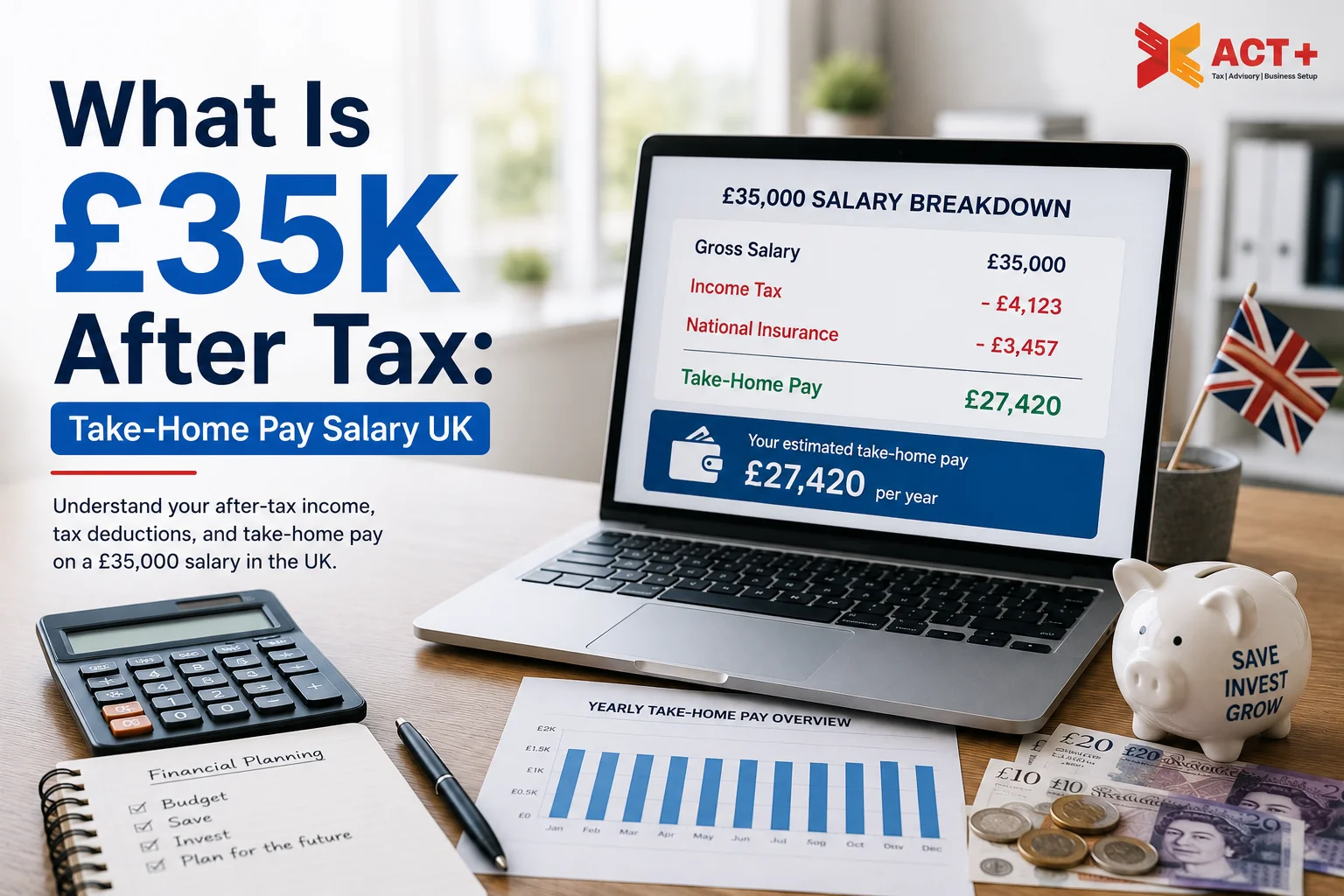
A £35k salary after tax in the UK provides an estimated annual take-home pay of around £28,690 for the 2025/26 tax year if you use the standard 1257L tax code, have no student loan deductions, and do not contribute to a workplace pension. This amounts to approximately £2,391 per month, or £552 per week, after Income Tax and National Insurance.
Your actual 35000 take-home pay can vary. Pension contributions, salary sacrifice, student loan repayments, taxable benefits, and a different tax code all affect your net salary. Understanding each deduction helps you estimate your income more accurately and plan your finances with confidence.
This guide explains £35,000 after tax, including Income Tax, National Insurance, employer contributions, monthly and weekly take-home pay, and the factors that can change your final salary.
UK Tax Calculator 2026/27
Estimate your Income Tax, National Insurance and take-home pay.
| Breakdown | Yearly | Monthly | Weekly |
|---|---|---|---|
| Gross Salary | £35,000 | £2,917 | £673 |
| Income Tax | £4,486 | £374 | £86 |
| National Insurance | £1,794 | £150 | £35 |
| Take-Home Pay | £28,720 | £2,393 | £552 |
Estimate only. Assumes standard 1257L tax code, England/Wales rates, no pension or student loan deductions. Actual pay may vary.
How Much Is £35,000 After Tax in the UK?
Earning £35,000 a year can provide a comfortable income for many UK workers, but the amount shown in your bank account will be lower than your gross salary. Income Tax and National Insurance are usually deducted through PAYE before you are paid. Your exact take-home pay can still vary depending on your tax code and any personal deductions or benefits.
This estimate assumes:
- Tax code 1257L
- One employment
- No workplace pension deductions
- No student loan repayments
- No salary sacrifice arrangements
- No taxable employment benefits
Many people search for terms such as 35k after tax UK, 35000 after tax UK, 35k monthly take home, 35k after tax and NI, or take home salary on 35000. These phrases all refer to the amount you receive after statutory deductions.
Estimated £35,000 Take-Home Pay
These figures are estimates based on current UK tax rates. Your actual take-home pay from 35000 may differ if additional deductions apply.
What Is the £35K Salary Breakdown?
A £35,000 salary consists of gross earnings before income tax, national insurance, and any additional payroll deductions. Knowing how each deduction works helps you understand where your salary goes and why your net income differs from your contracted salary.
Income Tax Deduction on a £35K Salary
On a £35,000 annual salary, you do not pay Income Tax on the full amount. Most employees receive a Personal Allowance, which means part of their earnings is tax-free. Only the income above this allowance is taxed. For someone using tax code 1257L, the taxable portion falls within the basic-rate band, so Income Tax is generally charged at 20% overall.
- Gross salary: £35,000
- Personal Allowance: £12,570
- Taxable income: £22,430
- Basic Income Tax rate: 20%
Estimated Income Tax:
£4,486 per year
The Personal Allowance lets most employees earn part of their salary tax-free before income tax applies.
National Insurance Contributions on £35,000
National Insurance is another deduction taken from your salary through PAYE. It is calculated separately from Income Tax and only applies once your earnings pass the relevant threshold. On a £35,000 salary, employee National Insurance reduces your take-home pay each month. These contributions also help you qualify for state benefits and build entitlement towards the State Pension in the future.
Estimated employee National Insurance:
- Annual NI: around £1,824
- Monthly NI: around £152
National Insurance funds several state benefits, including:
- State Pension
- Maternity Allowance
- Employment and Support Allowance
- Certain contribution-based benefits
Unlike income tax, National Insurance has different thresholds and rates.
Employer’s National Insurance Contributions
Employers have an additional payroll cost when they hire staff. Alongside paying the employee’s gross salary, they may also need to pay employer National Insurance to HMRC. This contribution is calculated separately and is never deducted from the employee’s wages. It affects the total employment cost for the business rather than directly reducing the worker’s annual or monthly take-home pay.
Estimated employer National Insurance:
- Approximately £4,150 per year (depending on current thresholds and allowances)
Employer National Insurance increases the overall cost of employing staff but does not affect your personal take-home pay.

How Much Will You Take Home From a £35,000 Salary?
A £35,000 gross salary produces an estimated annual take-home pay of approximately £28,690 after standard Income Tax and National Insurance deductions. People searching for terms such as “£35,000 after tax,” “35k take-home pay,” “£35,000 take-home pay,” “35k salary after tax,” or “take-home pay on £35,000” usually want to know how much they will receive each month, week, or day. The following breakdown explains the estimated deductions and provides a clearer picture of what a £35,000 salary looks like after tax.
The following breakdown provides a clearer picture.
Annual Salary Breakdown
Monthly Salary Breakdown
Many people searching for 35000 after tax per month or 35k after tax per month want this figure because it helps them budget for rent, bills, groceries, transport, and savings.
Weekly Salary Breakdown
Weekly figures are useful for employees paid every Friday or every four weeks.
Daily Equivalent
Assuming a standard five-day working week:
- Gross daily salary: £134.62
- Estimated daily take-home pay: £110
Daily calculations help compare salaried employment with freelance or contract work.
What Tax Code Is Usually Used for a £35k Salary?
Most employees earning £35,000 use tax code 1257L because it provides the standard Personal AllowanceTax code 1257L is the most common PAYE tax code in England, Wales, and Northern Ireland. It allows eligible employees to receive the standard Personal Allowance before Income Tax applies.
What Does Tax Code 1257L Mean?
The number 1257 represents a tax-free Personal Allowance of £12,570.The letter L shows that you qualify for the standard Personal Allowance without major adjustments.
HMRC may issue a different tax code if you:
- Receive taxable company benefits
- Owe tax from previous years
- Have more than one job
- Receive taxable state benefits
- Receive a company pension
- Have additional taxable income
Using the correct tax code helps ensure you pay the correct amount of Income Tax throughout the year. An incorrect code may result in underpaid or overpaid tax.
How Much Is £85K After Tax?
A salary of £85,000 provides an estimated annual take-home pay of around £59,000 to £61,000 during the 2025/26 tax year, depending on your tax code, pension contributions, and other deductions.
Employees earning £85,000 pay:
- Income Tax at the 20% and 40% rates.
- Employee National Insurance.
- Additional deductions if they contribute to a pension or repay a student loan.
Higher-rate taxpayers lose a larger proportion of their salary to Income Tax than employees earning £35,000. As a result, the increase in take-home pay is smaller than the increase in gross salary.
How to Increase Your Take-Home Pay Legally
There are several legal ways to improve the value of your salary without breaking any tax rules. The right steps depend on your job, benefits, pension, expenses, and tax code. Checking your payroll details and using available workplace schemes can help you keep more of your income. Every option should suit your personal circumstances and long-term financial goals carefully.
Small changes can significantly improve your annual net income.
1. Check Your Tax Code
An incorrect tax code may cause you to pay too much income tax. Review your PAYE tax code regularly. Contact HMRC if you believe your code is incorrect.
2. Join a Workplace Pension
Pension contributions may reduce your taxable income while helping you save for retirement.Many employers also match or increase contributions.
3. Consider Salary Sacrifice
Salary sacrifice schemes can reduce taxable earnings.Common examples include:
- Pension contributions
- Cycle to Work schemes
- Electric vehicle schemes
- Childcare benefits where available
4. Claim Tax Relief
Many employees forget to claim tax relief on eligible work-related expenses.
Examples include:
- Professional subscriptions
- Uniform cleaning costs
- Business mileage not reimbursed
- Working-from-home expenses where applicable
5. Increase Your Gross Salary
Negotiating a higher salary remains one of the most effective ways to increase your net income.Even after additional tax, a higher salary usually results in greater take-home pay.
6. Review Employee Benefits
Some benefits offer better value than receiving additional taxable salary.
Examples include:
- Private medical insurance
- Enhanced pension contributions
- Employee discounts
- Health cash plans
Understanding your total reward package helps maximize your overall financial position.
Is £35k a Good Salary in the UK?
A salary of £35,000 is generally considered a good full-time income in many parts of the UK, particularly for a single person living outside London. However, whether £35,000 is enough depends on several personal and financial factors, including your location, housing costs, household size, lifestyle, debt repayments, and savings goals.
A £35,000 salary may allow you to cover essential living expenses, save money regularly, build an emergency fund, contribute to a workplace or private pension, and maintain a comfortable lifestyle in many UK regions. Depending on your deposit, credit history, existing debts, and affordability assessment, this salary may also help you qualify for a range of mortgage products.
Living in London can be more challenging because everyday costs are generally higher than in many other parts of the UK. Rent, transport, childcare, utilities, and entertainment can take up a larger proportion of your monthly income. As a result, a £35,000 salary may provide less disposable income in London than in cities such as Manchester, Leeds, Sheffield, or Newcastle.
Comparing £35k With the UK Average
A £35,000 salary sits around the middle of UK full-time earnings. Many employees use online salary comparison tools and an income after-tax calculator to compare their earnings with national averages and estimate future salary increases.
How Does National Insurance Affect a £35k Salary?
National Insurance reduces your take-home pay because it is deducted from qualifying earnings before your salary reaches your bank account. National Insurance (NI) is separate from income tax. Both deductions appear on your payslip, but they serve different purposes.
Employee National Insurance helps fund several public services and benefits, including:
- State Pension
- Maternity Allowance
- Employment and Support Allowance
- Bereavement benefits
- Certain contribution-based benefits
For a £35,000 salary, employee National Insurance is approximately £1,824 per year under standard assumptions. National Insurance contributions affect your monthly take-home pay and overall annual net salary. They also help determine your eligibility for certain state benefits and contribute towards the qualifying years needed for the State Pension. Missing or incomplete National Insurance contributions may create gaps in your record and could reduce your future State Pension entitlement.
Are There Other Deductions From a £35k Salary?
Yes. Income Tax and National Insurance are only two possible payroll deductions. Other deductions may further reduce your take-home pay. Your employer may deduct additional amounts depending on your circumstances.
Common payroll deductions include:
- Workplace pension contributions
- Student Loan repayments
- Postgraduate Loan repayments
- Salary sacrifice arrangements
- Child maintenance orders
- Attachment of earnings orders
- Trade union subscriptions
- Company benefit adjustments
- Cycle to Work salary sacrifice
- Charitable payroll giving
Not every employee has these deductions. Many workers only pay Income Tax and National Insurance.
Student Loan Repayments
Student loan deductions begin only when your earnings exceed the repayment threshold for your specific loan plan. The applicable threshold and deduction rate depend on whether you have a Plan 1, Plan 2, Plan 4, Plan 5, or Postgraduate Loan. If student loan repayments apply, your actual take-home pay on a £35,000 salary will be lower than the standard after-tax estimate because the repayment is deducted directly through payroll.
How Pension Contributions Affect Your Take-Home Pay?
Workplace pension contributions reduce your take-home pay today, but they help build retirement savings for the future. Most UK employers automatically enrol eligible employees into a workplace pension.
Contributions usually come from three sources:
- Employee contributions
- Employer contributions
- Government tax relief
For example, if you contribute 5% of a £35,000 salary, your monthly take-home pay decreases slightly. However, your employer also contributes to your pension, increasing your long-term retirement savings.
Pension Contributions Can Lower Taxable Income
Pension contributions can affect both your current take-home pay and your future financial security. Depending on how the scheme is arranged, contributions may be taken before tax is calculated, which can reduce the amount of Income Tax you pay. Some salary sacrifice schemes may also lower National Insurance, while helping you build a larger retirement fund over time more effectively.
This may:
- Reduce Income Tax.
- Lower National Insurance in some salary sacrifice arrangements.
- Increase long-term retirement savings.
Always review your pension scheme to understand how contributions affect your payslip.
Frequently Asked Questions
Is £35,000 a good salary in the UK?
How much is £35,000 a year after tax in the UK?
How much is £35,000 a year per month after tax?
How much is £35,000 a year per week after tax?
Does your take-home pay change if you have a different tax code?

About the Author: Ahmad Raza