
Receiving a BR tax code on your payslip can be confusing, especially if you do not know why HMRC assigned it to you. Many employees notice a sudden increase in tax deductions and start asking questions.
Understanding the BR tax code is important because it directly affects how much tax you pay through PAYE. In many cases, a BR code is correct. However, some people receive it by mistake and end up paying more tax than necessary.
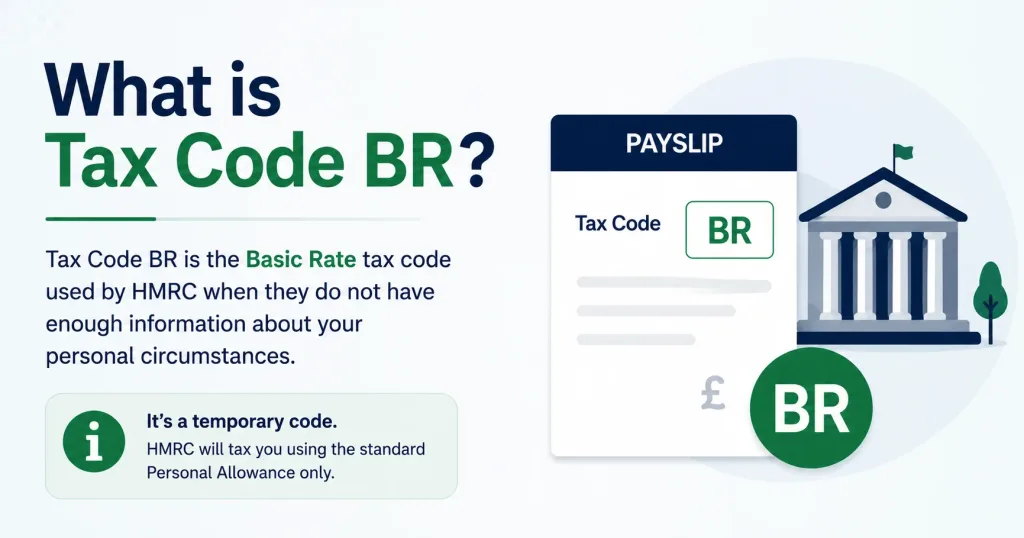
What is Tax Code BR?
The BR tax code is a PAYE tax code used by HMRC when all income from a job or pension should be taxed at the basic rate. Under this code, you do not receive any tax-free Personal Allowance against that income source.
The meaning of tax code BR is simple. Every pound you earn from that employment is taxed at the basic rate of Income Tax. Currently, the basic rate is 20% for most taxpayers in England, Wales, and Northern Ireland.
If you see code BR tax on your payslip, HMRC usually believes that your Personal Allowance is already being used elsewhere. This often happens when you have more than one job or receive a pension alongside employment income.
The meaning of the BR tax code does not automatically indicate a problem. BR tax is always worth checking because an incorrect tax code can lead to overpaying tax.
Common causes of a BR tax code include:
- Having a second job
- Receiving a workplace pension
- Starting a new job without a P45
- HMRC waiting for updated income information
- Employer payroll errors
- Changes to employment during the tax year
What Does BR Stand For?
BR stands for Basic Rate. The letters indicate that all income from that employment or pension is taxed at the basic rate of Income Tax.
Unlike standard tax codes such as 1257L, a BR tax code does not include any tax-free Personal Allowance. This means the employer deducts tax from the first pound earned.
For example, if you earn £1,000 in a month under a BR tax code, the full amount is subject to basic-rate taxation before PAYE deductions are calculated. This is why many employees notice higher tax deductions when they move onto a BR tax code.
How to Change a BR Tax Code?
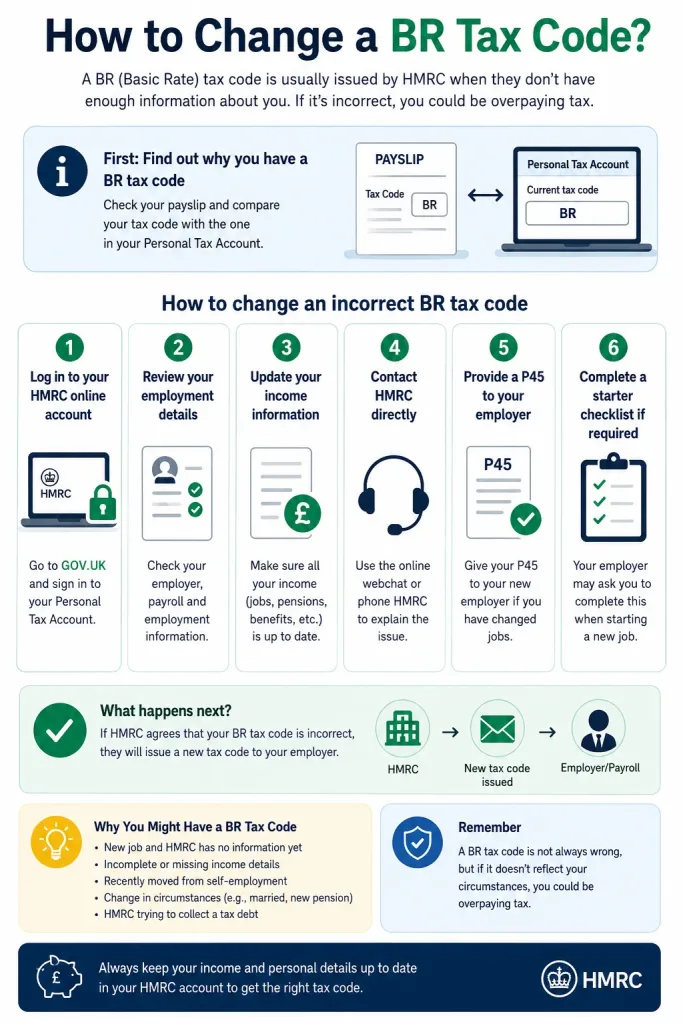
To change or fix a “BR” (Basic Rate) tax code, you must first determine why HMRC issued it.
Start by reviewing your payslip and checking the tax code shown. Then compare it with the tax code listed in your Personal Tax Account.
You can change an incorrect BR tax code by:
- Logging into your HMRC online account
- Reviewing your employment details
- Updating income information
- Contacting HMRC directly
- Providing a P45 to your employer
- Completing a starter checklist if required
If HMRC agrees that the BR code is incorrect, they will issue a new tax code to your employer. Payroll will then adjust future deductions.
How to Check if Your Tax Code is Correct
Checking your tax code is one of the easiest ways to avoid paying too much tax. Begin by looking at the tax code displayed on your payslip. Next, compare it with the information held by HMRC.
Follow these steps:
- Log into your Personal Tax Account.
- Review all employment records.
- Check pension income details.
- Confirm estimated annual earnings.
- Verify benefits and allowances.
- Review any recent job changes.
- Compare HMRC records with your payslip.
If anything looks incorrect, contact HMRC immediately. You should also check:
- You have more than one employer.
- Your Personal Allowance is allocated correctly.
- HMRC has duplicate employment records.
- A previous job remains active on their system.
Many BR tax code issues arise because HMRC has incomplete or outdated information.
Is BR Tax Code an Emergency Tax Code?
No, the BR tax code is not automatically an emergency tax code.
Many people confuse BR with emergency tax codes because both can result in higher deductions. However, they are different.
Typical emergency tax codes include:
- 1257L W1
- 1257L M1
- 0T W1
- 0T M1
Emergency tax codes are usually temporary. HMRC uses them when insufficient information is available to calculate tax correctly.
A BR code, on the other hand, can be either temporary or permanent depending on your circumstances.
For example, if you have a second job, HMRC may intentionally apply a BR tax code to ensure your Personal Allowance remains attached to your main employment.
Is BR1 an Emergency Tax Code?
No, BR1 is not generally treated as an emergency tax code. The BR1 code operates similarly to BR but uses a non-cumulative tax calculation method. It focuses on the current pay period rather than the entire tax year. HMRC may use BR1 temporarily while awaiting updated information.
Is BR 0 an Emergency Tax Code?
Not necessarily. The BR/0 tax code often indicates that income is taxed at the basic rate without allocating a Personal Allowance. Whether it functions as an emergency code depends on the circumstances behind its issue. The point is that the BR/0 tax code and emergency tax codes are not always the same thing.
When is the BR Tax Code Used?
HMRC commonly uses the BR tax code in several situations. The most common example involves employees with a second job. Because the Personal Allowance is usually assigned to the main source of income, the second job may receive a BR tax code.
Other situations include:
- Receiving multiple pensions
- Starting a new job without a P45
- Changes in employment records
- Temporary payroll adjustments
- Delayed reporting from employers
A BR cumulative tax code may also appear when HMRC adjusts tax calculations across the entire tax year.
What is an example of PAYE on Tax Code BR?
Imagine Sarah earns £12,000 annually from a second job. HMRC allocates her Personal Allowance to her main employment.
Her second employer applies PAYE tax code BR. Because the BR code taxes all earnings at the basic rate, tax is deducted from the full amount earned through the second job.
Will I Get a Refund if I Overpay Tax?
Yes, if HMRC later determines that too much tax was deducted under a BR code, you can receive a refund.
Refunds often occur when:
- HMRC issues a corrected tax code.
- Employment records are updated.
- Income estimates change.
- Duplicate jobs are removed from records.
The refund may arrive through payroll adjustments or directly from HMRC.
Will I Get a Tax Refund on a BR Code?
Yes, you may receive a tax refund if the BR tax code was incorrect or resulted in excess deductions. Many people who ask “Will I get a tax refund on a BR code?” receive refunds after HMRC updates their records.
A refund is not automatic simply because you have a BR tax code. If the code was correct from the beginning, there may be no overpayment to refund.
Is the BR Tax Code the Same as 1257L?
No, the BR tax code and 1257L tax code operate very differently. The 1257L code provides the standard Personal Allowance, while the BR code does not.
Employees on 1257L usually pay less tax than employees on a BR code when earning the same income.
What Are the Letters on Tax Codes?
Tax code letters help HMRC identify how tax should be calculated. Common examples include:
- L
- BR
- K
- M
- N
- T
- S
- C
Each letter carries a different meaning and affects tax calculations differently.
What Are All the Tax Codes in the UK?
Some common UK tax codes include:
- 1257L
- BR
- D0
- D1
- K codes
- NT
- 0T
- S1257L
- C1257L
Each code reflects different tax circumstances and allowance arrangements.
Does a BR Tax Code Have to Be on a Payslip?
Yes, Employers must show the tax code used for PAYE calculations on your payslip. The tax code helps employees understand how Income Tax is being deducted from their wages. If you see a BR tax code on your payslip, it means your employer is taxing all earnings from that job at the basic rate.
You should check your payslip regularly to make sure the tax code matches the information held by HMRC. If you notice a change from 1257L to BR or another code, investigate it as soon as possible.
What Does CBR Mean in a Tax Code?
CBR is the Scottish equivalent of the BR tax code. The letter “C” identifies a taxpayer who is subject to Welsh rates of Income Tax, while “SBR” is used for Scottish taxpayers. Depending on the region and tax rules that apply, HMRC may use slightly different versions of the BR code.
The purpose remains the same. Income covered by the code is taxed at the basic rate without applying a Personal Allowance.
What Is the Difference Between BR and 1257L Tax Codes?
The biggest difference between BR and 1257L is the treatment of the Personal Allowance. Under the 1257L tax code, employees receive the standard tax-free Personal Allowance before paying Income Tax.
Under the BR tax code, no tax-free allowance applies to that source of income. The result is often higher PAYE deductions under a BR code.
| Feature | BR Tax Code | 1257L Tax Code |
|---|---|---|
| Personal Allowance | No | Yes |
| Tax-Free Income | None | Available |
| Basic Rate Tax | Applied to all earnings | Applied after allowance |
| Common Use | Second jobs and pensions | Main employment |
| HMRC Purpose | Prevent duplicate allowances | Standard tax treatment |
Someone earning £1,000 per month under a BR code will generally pay more tax than someone earning the same amount under a 1257L code.
Frequently Asked Questions
Can I Change My BR Tax Code?
Many taxpayers successfully change their BR tax code after providing updated employment information. If the code is correct because it applies to a second job, HMRC may leave it unchanged.
What Is Basic Rate Tax?
This is where the term "Basic Rate" originates. The BR code simply instructs payroll software to deduct Income Tax at the basic rate from all taxable earnings.
Why Am I on a BR Cumulative Tax Code?
You may be placed on a BR cumulative tax code because:
- You have multiple employments
- HMRC adjusted your records
- A previous tax code was incorrect
- PAYE calculations require year-to-date adjustments
Will SBR Be Free in 2026?
Income covered by an SBR code remains taxable at the applicable Scottish basic rate. Taxpayers should not assume that SBR provides any additional Personal Allowance.
What Are the Rules for the SBR in 2026?
- The taxpayer is a Scottish taxpayer
- Personal Allowance is allocated elsewhere
- HMRC determines that Scottish basic-rate taxation should apply
What Is the 0T Tax Code?
HMRC often uses a 0T tax code when they do not have enough information to allocate allowances correctly. Many employees receive a temporary 0T code after starting a new job without providing a P45.
Does the BR Tax Code Apply to Second Jobs?
For example, if your main employment uses tax code 1257L, your second job may use tax code BR. This arrangement helps ensure the correct amount of tax is collected throughout the year.

About the Author: Ahmad Raza