
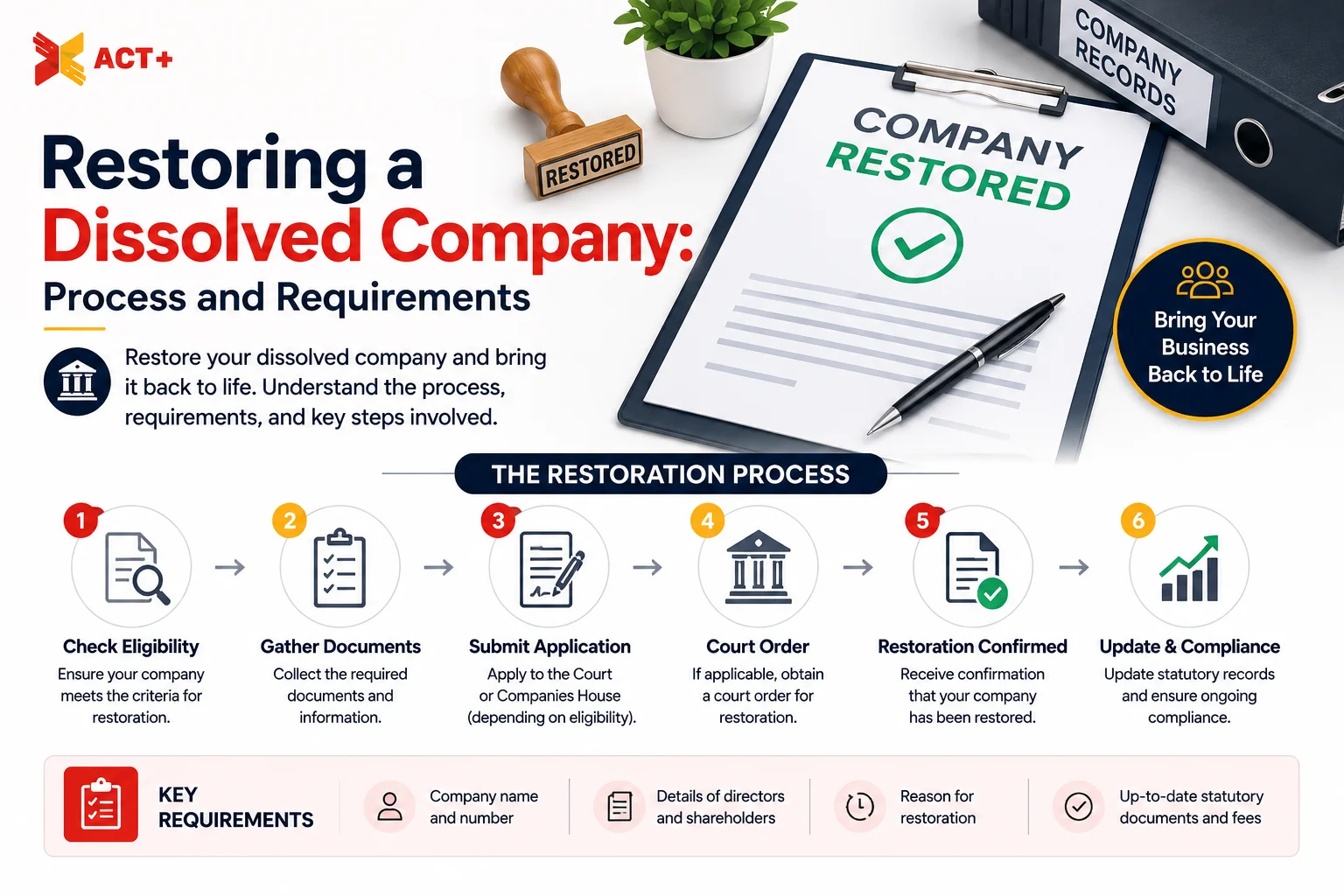
Restoring a dissolved company means bringing a business back onto the Companies House register after dissolution. Many UK companies become dissolved because of overdue filings, missed confirmation statements, inactive trading status, or unresolved HMRC compliance issues. Once a company gets struck off, it loses its legal existence, and company assets may pass to the Crown under Bona Vacantia rules. This guide includes administrative and court options, RT01 forms, costs, timelines, and how to recover your frozen company assets.
What is a Dissolved Company and What Does It Mean?
A dissolved company no longer appears as an active business on the company register. Companies House removes the business after a gazette notice confirms the strike-off process.
The Companies Act 2006 allows dissolution through voluntary dissolution or compulsory dissolution. A company loses its legal identity after dissolution. It cannot trade, sign contracts, or continue normal business activity.
Many people confuse the “struck-off” status with the “dissolution” meaning. A struck-off company enters the final stage before the authority removes it completely from the register. The company’s trading status ends immediately after dissolution.
Key effects of dissolution:
- Company bank accounts may freeze
- Company assets transfer under Bona Vacantia
- At that stage, directors can no longer act on behalf of the business.
- Legal proceedings usually stop
- Creditors may lose recovery options
How to Restore a Dissolved Company?
To restore a dissolved company, you first check why and when it was dissolved, then either apply for administrative restoration (if it was struck off by the registry for non‑filing and it is recent) or go through court restoration (if it was voluntarily dissolved, very old, or does not meet the simple conditions).
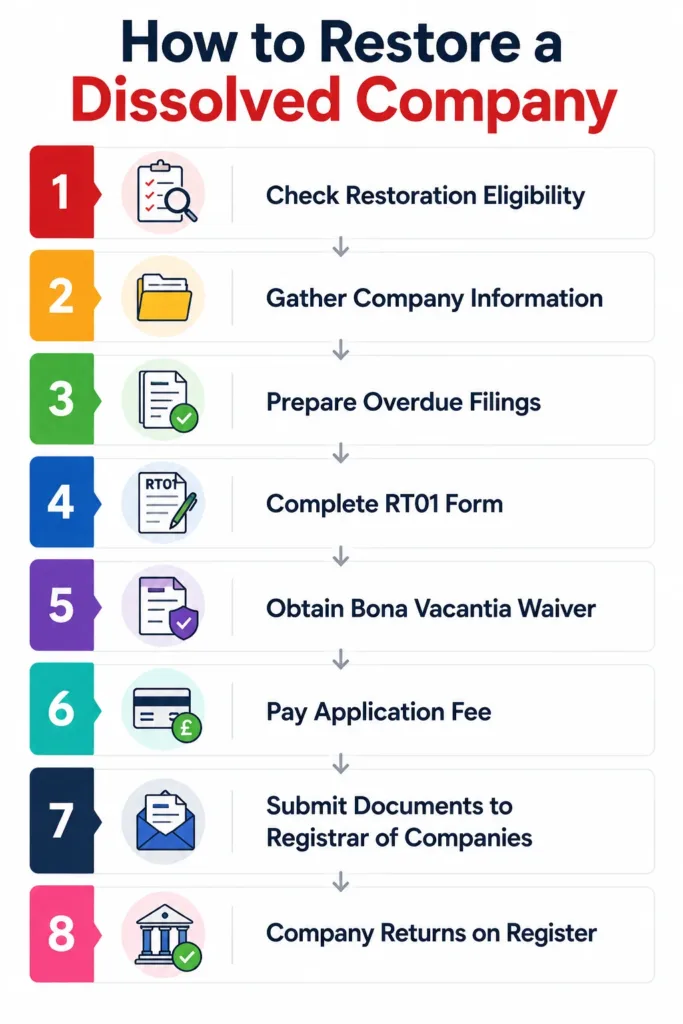
Here’s a step-by-step process on how to restore a dissolved company:
1. Check Restoration Eligibility
Confirm whether administrative restoration or court order restoration applies.
2. Gather Company Information
- Company number
- Dissolution details
- Overdue filing history
- HMRC information
3. Prepare Overdue Filings
Complete overdue accounts, annual accounts, confirmation statement documents, and corporation tax returns.
4. Complete RT01 Form
The RT01 form supports administrative restoration applications.
5. Obtain Bona Vacantia Waiver
A waiver letter may become necessary if company assets are transferred to the Crown.
6. Pay Application Fee
Companies House charges an application fee for restoration.
7. Submit Documents to Registrar of Companies
The registrar of companies reviews the application.
8. Company Returns on Register
Companies House publishes a final gazette notice after approving the restoration.
Fix Your Company Status Now
Restore your dissolved company quickly and stay legally compliant with expert support from certified professionals.
Restore Your Company TodayWhat Documents Are Required for Company Restoration?
To restore a dissolved company, you must prepare several important documents before applying to Companies House. The exact requirements depend on the type of company restoration. Most restoration applications require several compliance documents.
Common documents include:
- Overdue accounts
- Annual accounts
- Confirmation statement filings
- Corporation tax returns
- RT01 form
- Application fee payment proof
- Bona Vacantia waiver letter
- HMRC correspondence
Missing documents often delay restoration approval.
How Much Does It Cost to Restore a Dissolved Company?
The cost of restoring a dissolved company depends on the restoration method and the amount of overdue work involved. Every case includes an application fee payable to the registrar of companies. Extra costs often arise when companies fail to file annual accounts or other compliance documents for several years.
Late filing penalties can increase the total cost significantly. Some companies also face corporation tax penalties from HMRC. If the company needs a court order restoration, the cost becomes higher because of court hearing expenses and legal proceedings.
Many directors also pay professional fees for preparing overdue accounts, restoration forms, and compliance filings. For an administrative restoration, Companies House charges a flat paper application fee of £341 using Form RT01. While this statutory fee is fixed, delaying the process can still increase your overall costs due to accumulating late-filing penalties and outstanding HMRC liabilities.
✓ Fast support • Expert guidance
How Long Does It Take to Reinstate a Dissolved Company?
The Company restoration timeline depends on whether the company uses administrative restoration or a court order process. Administrative restoration usually takes less time because Companies House handles the application directly through the registrar of companies.
Once Companies House receives the documents, it reviews the application, checks compliance records, and publishes a gazette notice before placing the company back on the register. Delays often happen when documents are incomplete or overdue accounts remain missing.
Court order restoration normally takes longer because it involves legal steps and court approval. Some cases finish within a few weeks, while more complex restorations can take several months. Proper preparation often helps speed up the process.
What Happens After Restoration?
Once Companies House restores a dissolved company, the business returns to active status as if dissolution never happened. Following approval, the business regains active status, and the company appears again on the company register. In many cases, frozen bank accounts and other company assets can also return to the company.
After restoration, the business must continue meeting all legal obligations. Directors must file annual accounts, confirmation statements, and corporation tax returns on time. HMRC compliance requirements also restart immediately. If the company lost assets under bona vacantia rules, additional steps may be necessary before the assets return fully. Directors should also review all outstanding liabilities and compliance issues after restoration.
Are There Any Penalties for Restoring a Dissolved Company?
Yes, Companies often face penalties after restoration because overdue filings remain payable. Companies House may charge late filing penalties for missing annual accounts and confirmation statement filings. HMRC can also apply corporation tax penalties and interest on unpaid amounts.
The total penalty usually depends on how long the company remained dissolved and how many filings became overdue. Some companies also face extra costs if legal action is started before restoration.
Directors should act quickly because delays normally increase the financial burden. Proper compliance after restoration helps avoid future penalties and further enforcement action.
How Long Does an Administrative Restoration Take?
Administrative restoration normally takes a few weeks after Companies House receives the application. The timeline depends on how quickly the registrar of companies reviews the documents and whether all records are complete.
To begin the restoration process, the applicant must submit the RT01 form, pay the application fee, and file all overdue documents before approval. Companies House may also publish a gazette notice during the process.
Once approved, the company goes back on the register and regains active status. Missing information or unpaid penalties can delay the restoration significantly.
How Long Does a Court Order Restoration Take?
Court order restoration usually takes longer because it involves formal legal proceedings and court approval. The timeline varies depending on the complexity of the case and the court schedule.
The applicant must prepare legal documents, attend a court hearing in some cases, and obtain a restoration order before the registrar restores the business after reviewing the application. The application fee and legal costs also increase in more complex matters.
Under the Companies Act 2006, the court reviews whether restoration remains legally valid before approving the request. Some court order restorations finish within a few months, while others take longer.
What Is the RT01 Form?
The RT01 form is the main document used for administrative restoration in the UK. Directors or former members submit this form to the registrar of companies when applying for company reinstatement.
The form includes company details, dissolution information, and confirmation that all legal conditions have been met. Companies House also requires the application fee and supporting documents before processing the request.
Once approved, Companies House publishes a gazette notice and restores the business to the company register. The RT01 form plays an important role in bringing the company back into active status.
RT01 application for administrative restoration to the register
PDF, 470 KB, 3 pages
Reference: GOV.UK Official DocumentHow Does a Company Strike Off Lead to Dissolution?
A company strike-off starts when a business applies for voluntary strike off or when Companies House begins compulsory strike-off action because of compliance failures.
During the process, the registrar of companies publishes a gazette notice to inform the public about the proposed removal. If no objections arrive, the registrar removes the business permanently from the register.
A voluntary strike-off usually happens when directors close a company that no longer trades. Compulsory strike-offs often happen because of overdue filings, inactive status, or ignored compliance notices. Once the process completes, the company becomes dissolved legally.
✓ Fast support • Expert guidance
Can You Stop a Strike Off Before Your Company Gets Dissolved?
Yes. You can usually stop a strike off before Companies House dissolves the company. The most important step is acting quickly after receiving the gazette notice. Many companies face strike off because of overdue accounts, missing annual accounts, or an overdue confirmation statement.
Directors can often stop the process by filing all missing documents with Companies House. If the company still trades or owns assets, you can also object to the strike off. Once Companies House accepts the filings, it may suspend or cancel the dissolution process.
Why Do Companies Get Dissolved?
Companies usually face dissolution because they stop trading or fail to meet legal filing duties. Some businesses choose voluntary dissolution when directors no longer need the company. Others face compulsory dissolution because of overdue accounts or ignored compliance notices.
Companies House normally publishes a gazette notice before removing the business from the company register. If nobody responds or files the missing documents, the company will be dissolved officially.
Can a Dissolved Company Be Restored?
Yes. A dissolved company can usually be restored through administrative restoration or a court order, depending on the circumstances. The Companies Act 2006 allows restoration if the company meets the legal conditions.
Administrative restoration usually applies within the six-year limit after dissolution. If that period passes, directors or shareholders may still apply through a court order in certain situations. The restoration method depends on the company’s history and reason for dissolution.
Why Restore a Dissolved Company?
Many directors restore a dissolved company to recover company assets or continue business activity. After dissolution, company assets can transfer to the Crown under Bona Vacantia rules as Crown property.
Restoration may also become necessary to recover frozen bank balances, settle company debts, restore trading status, or continue legal matters. Some businesses also restore companies because creditors or clients still require action from the company.
How Bona Vacantia Impacts Restoration?
Bona Vacantia means that ownerless company assets pass to the Crown after dissolution. This may include bank funds, property, trademarks, or other business assets.
The Treasury Solicitor usually manages these assets on behalf of the Crown. Under the Companies Act 2006, companies often need extra approval before recovering Crown property during restoration. In many cases, the company must return to the company register before assets can be transferred back.
What Happens to the Debts of a Dissolved Company?
Company debts do not automatically disappear after dissolution. Creditors and HMRC may still take action in certain situations.
Even though the business no longer exists legally, creditors can sometimes apply to restore the company to recover unpaid amounts. HMRC may also continue investigating unresolved tax issues or unpaid corporation tax liabilities.
If the company closes with significant debts, insolvency concerns may arise later. In some situations, creditors begin legal proceedings or apply for winding-up action after restoration.
Directors should also understand that dissolution does not remove responsibility for wrongful conduct before closure. Where misconduct, unpaid taxes, or fraudulent activity exists, authorities may still take enforcement action against former directors.
What Happens to the Director of a Dissolved Company?
After a company becomes dissolved, the company director loses legal authority to act on behalf of the business. The company disappears from the company register, and its trading status ends immediately. A former director cannot continue using the company name, sign contracts, or trade through the dissolved business.
Under the Companies Act 2006, directors remain responsible for actions taken before dissolution. If the company failed to meet legal duties, authorities may still investigate the former director after closure.
Directors may also face problems if they continue trading after dissolution or misuse company assets. In some cases, HMRC or creditors may take further action where unpaid taxes or debts remain unresolved. If the company gets restored later, the company director may regain authority once the business returns to active status on the company register.
What Happens After a Company Is Dissolved?
After dissolution, the company disappears from the company register completely. Companies House removes the business from the company register after publishing the final gazette notice. At this stage, the company loses its legal identity and cannot continue trading or sign contracts.
Any remaining company assets may transfer under bona vacantia rules. This means bank balances, property, trademarks, or other business assets can become Crown property. The Crown may then control or claim those assets unless the company is restored later. Directors also lose authority to act for the company after dissolution. In many cases, company bank accounts freeze immediately after the dissolution process completes.
Some businesses later apply for restoration because they need to recover company assets or resolve outstanding legal matters. Once restored, the company may return to the company register and regain active status.
Can a company still operate if it has been dissolved?
No, A dissolved company cannot legally continue business operations. The company loses its trading status immediately after removal from the company register. Using the company number after dissolution may lead to legal proceedings and director liability issues. The authority treats the company as legally inactive after dissolution.
Can You Restore a Dissolved Company After 6 Years?
The six-year limit mainly applies to administrative restoration cases. After this period, restoration usually requires a court order and a formal restoration order application.
Under the Companies Act 2006, courts may still approve restoration in special situations involving Crown property, legal claims, or unresolved matters. These cases often involve more complex legal procedures.
What Is the Difference Between a Dissolved Company and a Struck Off Company?
Many people use the terms dissolved company and struck off company in the same way, but they describe different stages of the closure process. A struck-off company is a business going through removal from the company register, while a dissolved company has already been removed completely by the authority.
A company may enter voluntary strike-off when directors choose to close the business. It may also face compulsory strike-off if Companies House takes action due to missing filings or compliance failures. Before removal occurs, the registrar of companies publishes a gazette notice to inform the public of the proposed strike-off.
Once the notice period ends and no objections remain, the authority removes the business from the company register. At that point, the company officially becomes dissolved and no longer exists legally.
What Is the Difference Between Voluntary and Compulsory Dissolution?
Voluntary dissolution happens when directors decide to close a company that no longer trades or has no future business activity. The directors apply to the UK registrar for strike off and confirm that the company has cleared its obligations before removal from the company register.
Compulsory dissolution happens when the registrar removes a business because of compliance failures. This usually happens after overdue accounts, missing filings, or ignored warning letters. The official register publishes a gazette notice before removing the company officially.
In both situations, the company disappears from the company register after dissolution is complete. However, the reason behind the closure and the process involved are very different.
What is the Difference Between Dissolving and Liquidating a Company?
Dissolution removes the company legally from the register. Liquidation focuses on insolvency and winding up business affairs properly.
Liquidation involves:
- Selling company assets
- Paying company debts
- Handling creditor claims
- Formal insolvency procedures
Not every dissolved company enters liquidation first.
What Is the Role of Companies House in Restoring a Dissolved Company?
The official register manages the restoration process through the registrar of companies. The registrar reviews restoration applications, compliance history, and supporting documents carefully.
The registrar reviews:
- RT01 form submissions
- Company register records
- Gazette notice publications
- Compliance documents
- Restoration eligibility
The Companies Act 2006 gives Companies House authority over restoration applications.
Do You Need a Solicitor to Restore a Dissolved Company?
Not always. Many administrative restoration cases proceed without legal help. Complex legal proceedings or court order applications may require a solicitor.
A court hearing and restoration order process usually involves more technical legal work. The total application fee and legal costs may also increase in these situations.
Are There Any Penalties for Restoring a Dissolved Company?
Yes, Companies House and HMRC may charge late filing penalties after restoration. These penalties often relate to overdue accounts, annual accounts, missing confirmation statement filings, or unpaid corporation tax.
The longer the company remains non-compliant, the higher the penalties may become. Directors should complete all filings quickly after restoration.
What Are Common Mistakes When Restoring a Dissolved Company?
Many restoration applications face delays because of simple filing mistakes. Missing overdue accounts or incorrect RT01 form details often create problems during the process.
Some directors also ignore late filing penalties or fail to submit annual accounts correctly. Missing gazette notice deadlines can also delay restoration approval. Careful preparation helps avoid unnecessary issues and rejection.
Fix Your Company Status Now
Restore your dissolved company quickly and stay legally compliant with expert support from certified professionals.
Restore Your Company Today
About the Author: Ahmad Raza