
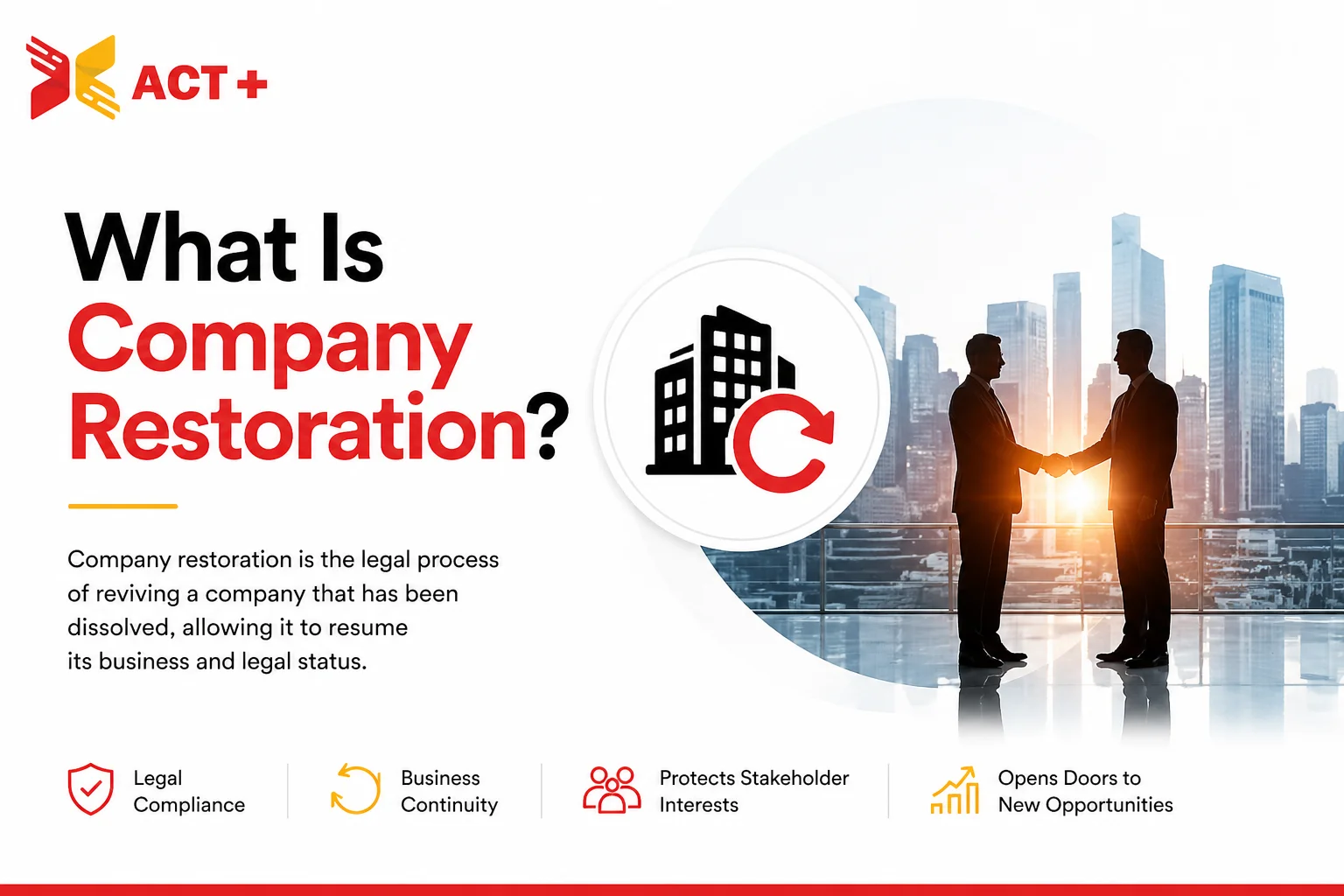
Company restoration is a legal process created by the Companies Act 2006, through which a previously dissolved business is restored to its standing on the official register. A dissolved company struck off the register does not always reach a clean legal conclusion. Unresolved assets, outstanding obligations, and third-party interests persist long after removal. A company restoration guide is a process to restore the company to a legal status for those who have an ongoing interest in the company.
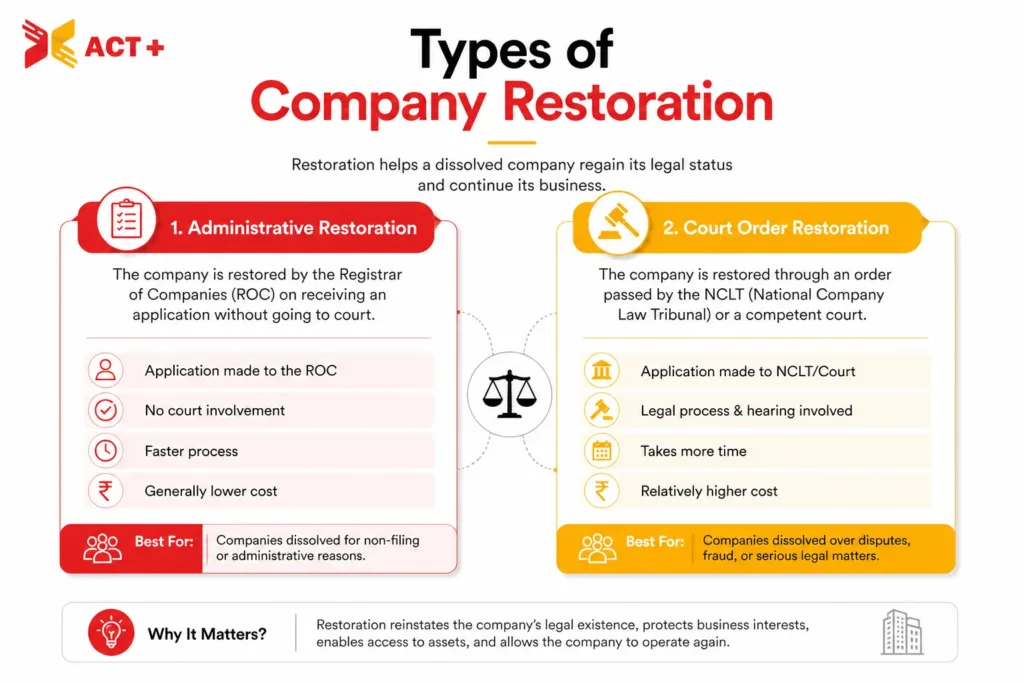
The types of company restoration include administrative restoration and court order restoration. An administrative restoration is a route pursued directly through Companies House using the RT01 form, and a judicial route requires a court order for more complex cases. Each type has a different purpose, yet both lead to the same outcome, which is to reinstate a company as though dissolution never occurred.
What Is Company Restoration?
Company restoration is the legal process of reinstating a dissolved company or a business that has been struck off the company registers. The process aims to return the dissolved company to its active legal status. Former directors, members, or creditors can apply to reinstate a company that has been removed from the register under the Companies Act 2006. The act permits the company to be reinstated by a court order or administrative restoration through Companies House. This company restoration guide outlines how the process works, who can apply, and the conditions to meet for restoring a company to its former standing.
Fix Your Company Status Now
Restore your dissolved company quickly and stay legally compliant with expert support from certified professionals.
Restore Your Company TodayWhat are the types of Company Restoration?
The types of company restoration are administrative restoration and court order restoration.
| Type of Restoration | Description | Best Suited For |
|---|---|---|
| Administrative restoration | A court-free process applied directly through the Registrar of Companies under the Companies Act 2006. | Companies that are struck off due to missed filings. This type is ideal for a former director or member who needs a quick, cost-effective restoration without legal proceedings. |
| Court order restoration | A formal legal process requiring a court order, available to a wider range of applicants, including creditors and third parties. | Cases where more than six years have passed, or when the applicant is a creditor, third party, or involved in legal disputes requiring court action. |
-
Administrative restoration
Administrative restoration is a simple, court-free route that allows eligible applicants to restore a dissolved company directly through the Registrar of Companies without the need for legal proceedings.
Administrative restoration under the Companies Act 2006 is available when a company is removed from the register by Companies House for failing to file accounts or confirmation statements. This route is faster, more cost-effective, and does not require a court order, making it the preferred option where eligible.
The following conditions must be met to qualify for administrative restoration.
- The applicant must be a former director or member of the dissolved company.
- The application must be made within six years of the date of dissolution.
- The business must have been open or doing business at the time it was struck off.
- All past-due filings must be completed.
- Any applicable penalties and fees must be settled before the Registrar of Companies will approve the restoration.
-
Court order restoration
Court order restoration is a legal process by which a broader range of applicants can petition a court to have a dissolved company reinstated on the company register. This option is relevant when administrative restoration is not available.
Court order restoration under the Companies Act 2006 is available in cases where the administrative route is not possible. For example, where more than six years have passed since dissolution, or where the applicant is not a former director or member. This route involves making a formal application to the court. It is used by creditors, former employees, or any other person with a legitimate interest in the company’s restoration.
The important features of court order restoration are listed below.
- It is available to a broad range of applicants, which includes creditors, shareholders, and third parties with a legal interest.
- There is no strict time limit, but the court can refuse to accept unreasonable delays.
- The court may impose conditions on the restoration, like making sure that all outstanding payments or filings are made.
- A court order is issued upon approval, which is then filed with the Registrar of Companies to reinstate the company formally.
- It is often used to recover assets or resolve disputes related to dissolution.
What Documents are Needed for Company Restoration?
The documents required depend on whether the restoration is done through the administrative restoration route or a court order.
The documents needed for administrative restoration are mentioned below.
- RT01 form: The RT01 form is an official application form submitted to the Registrar of Companies. It must be completed by a former director or member of the dissolved company and signed as a formal request to restore the company to the register.
- The Bona Vacantia (waiver letter): Written consent from the Treasury Solicitor must be obtained before restoration can proceed. This applies in cases where company assets have passed to the Crown as bona vacantia upon dissolution.
- Outstanding annual accounts: Any unfiled annual accounts for the period up to the date of dissolution must be prepared and submitted to Companies House with the restoration application.
- Confirmation statement (CS01): Any outstanding confirmation statements (referred to as annual returns) need to be submitted and updated before the application can be approved.
- Application fee: The £341 restoration fee and filing fees for each missing statement.
- Payment for penalties: All outstanding filing penalties and the applicable restoration fee must be settled. Companies House will not process the application until all financial obligations are cleared.
The documents required for court order restoration are outlined below.
- Claim Form (N208): The applicant must file a claim form with the relevant court, usually the Companies Court or a Chancery Division court. This form formally requests the restoration of the dissolved company.
- A witness statement: A detailed witness statement must be submitted explaining the conditions for restoration. This statement must also explain the applicant’s interest in the company and the reason for its reinstatement.
- Evidence of standing: The applicant must provide evidence confirming their legal interest in the restoration. For example, proof of being a creditor, former member, or third party with a legitimate claim connected to the dissolved company.
- Court fee: The Court Fee of £318 is the mandatory charge required by the HMCTS (His Majesty’s Courts and Tribunals Service) to initiate a legal claim for restoration.
- Sealed court order: The sealed court order is the final, legally binding document issued by the court that officially commands the Registrar of Companies to restore the company to the register.
- Bon Vacantia (waiver letter): The applicant must obtain written consent from the Crown’s representative before the court will grant the restoration order, where bona vacantia applies.
- Outstanding accounts and filings: All overdue annual accounts and confirmation statements must be prepared and ready for submission to Companies House. This requirement is similar to administrative restoration and must be fulfilled upon the court granting the order.
When Would You Need to Restore a Company?
The most common reason for company restoration is to recover assets, such as unfreezing bank accounts or transferring property held by the Crown. It is also important for resuming trade after an accidental strike-off. Company restoration allows for collecting debts and handling insurance or pension distributions that require a legally active entity.
What Is the RT01 Form?
The RT01 form is the official document used to apply to the Registrar of Companies for administrative restoration. This form is an important part of the company restoration process and must be submitted to Companies House with the required application fee. A gazette notice is published once approved, legally confirming the company has been restored to the register.
✓ Fast support • Expert guidance
How Does Companies House Handle Company Restoration?
Companies House handles company restoration by reviewing the application, verifying outstanding filings, checking for Bona Vacantia, and processing the restoration fee. It publishes a Gazette notice, updates the company register, and issues a new certificate of incorporation.
The ways Companies House handle company restoration are discussed below.
- Reviewing the application: The company restoration process begins when Companies House receives either a completed Form RT01 or a court order from the applicant. The Registrar of Companies then reviews the application to confirm that all eligibility requirements, like outstanding filings, unpaid penalties, and any necessary approvals, have been met.
- Verifying outstanding filings: The Registrar of Companies checks the company’s filing history for any overdue annual accounts or confirmation statements. All outstanding documents must be submitted and accepted before Companies House progresses the application.
- Checking for Bona Vacantia: Companies House checks whether any company assets passed to the Crown as bona vacantia upon dissolution. Written consent from the Treasury Solicitor must be obtained, confirming that the Crown has no objection to the company being reinstated to the company register.
- Processing the restoration fee: A restoration fee must be paid to Companies House before the application is processed. Payment must be received and confirmed before the Registrar of Companies proceeds with updating the company register.
- Publishing a Gazette notice: Companies House arranges for a Gazette notice to be published in the London Gazette once the restoration is approved. The Gazette notice serves as the official public announcement that the company has been restored to the company register. It notifies creditors, third parties, and the public of the reinstatement.
- Updating the company register: The Registrar of Companies updates the company register to show the company’s restored status. All prior legal rights, obligations, and liabilities are reinstated under the Companies Act 2006.
- Issuing a new certificate of incorporation: Companies House issues a new certificate of incorporation upon successful restoration. This certificate confirms the company’s legal existence and active status on the company register. It allows the company to resume trading, hold assets, and enter into contracts.
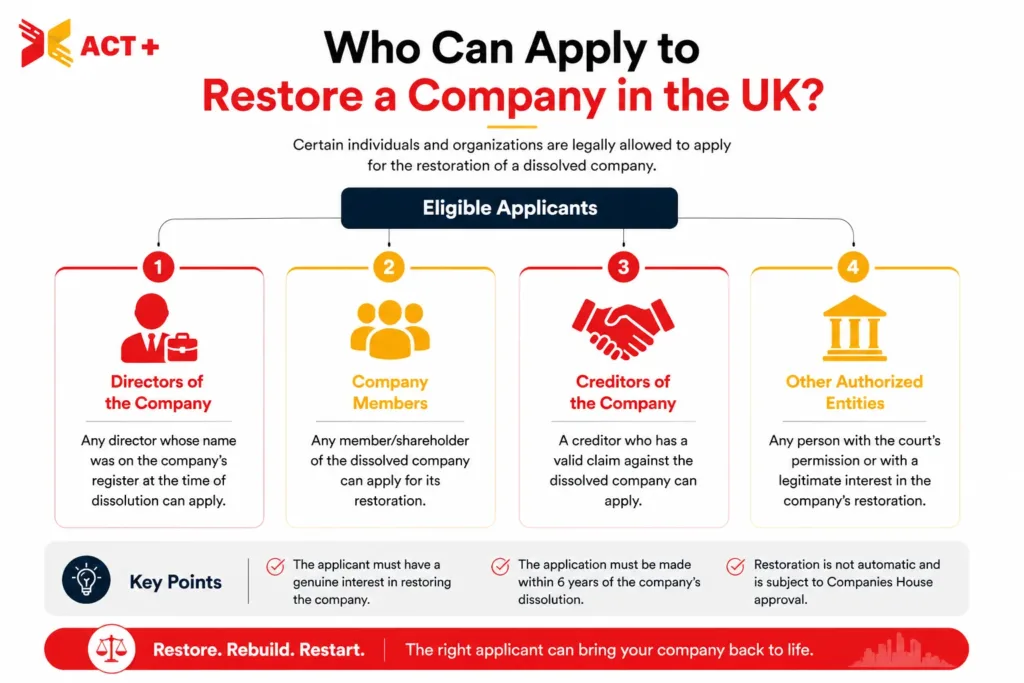
Who Can Apply to Restore a Company?
Eligibility depends on the route under the Companies Act 2006. Only a former director or shareholder who held office at dissolution can apply for administrative restoration. Any company director, member, or creditor with a legitimate interest can petition for court restoration. The court route includes liquidators or anyone with a legal claim and makes sure all stakeholders can protect their rights.
How Long Does it Take to Reinstate a Dissolved Company?
The process for administrative restoration is quick, taking around one month from the submission of the RT01 form to the final approval by Companies House. This route is handled directly by the Registrar, provided all outstanding accounts and fees are paid on time.
Court order restoration is a time-consuming process that takes four to six months. This schedule is determined by the timeline of how the N208 claim is processed by the court and the time needed for a judge to review the witness statements and issue a formal order. It requires further time to process the physical document with Companies House and complete the reinstatement on the public register after the sealed court order has been granted.
What is the Cost of Restoring a Company to the Register?
Administrative restoration involves a £341 application fee, while a court order requires a £318 filing fee. Total costs increase with late filing penalties, often up to £1,500 per year and backdated confirmation statement fees. Legal representation fees apply if the case requires a court hearing. A £64 waiver letter is mandatory to reclaim assets from the Crown.
How Much Does It Cost to Reinstate a Dissolved Company?
The cost includes a £341 application fee for administrative restoration or a £318 court fee for a court order. Total expenses include late filing penalties, backdated fees, and Bona Vacantia waivers.
Can You Restore a Dissolved or Struck-Off Company?
Yes, you can restore a dissolved or struck-off company through Companies House. The method depends on how it was closed. A compulsory strike off by the Registrar allows for administrative restoration, and a voluntary strike off by directors requires a court order. A gazette notice is published to officially confirm that the company is active again once the process is complete.
Can You Restore a Company After 6 Years?
A strict six-year limit applies to applications for a court order to restore a dissolved company under the Companies Act 2006. You cannot reclaim assets held as Bona Vacantia once this period expires. There is an exception that is if the restoration is for a personal injury claim, an application can be made at any time.
Do You Need a Solicitor for Company Restoration?
No, a solicitor is not legally mandatory under the Companies Act 2006, but is recommended for a court order. A court hearing involving legal proceedings is complex, even if you can pay the application fee and handle administrative restoration alone. Professional help confirms witness statements are accurate and prevents the court from rejecting your claim due to procedural errors.
Who Are Company Restoration Solicitors?
Company restoration solicitors are legal specialists who handle the process of reinstating a dissolved business to the Companies House register. They work within Commercial Litigation or Insolvency departments.
✓ Fast support • Expert guidance
What Happens After Your Company Is Restored?
The company is legally treated as if it had never been dissolved once the Registrar confirms it is back on the register. The restored company still needs to meet immediate compliance obligations.
- Submitting Outstanding Documents
The priority is bringing your filings up to date. You must submit all annual accounts and every confirmation statement that were missed while the company was dissolved. Failure to submit these overdue accounts quickly results in the company being struck off again.
- Settling Financial Penalties
Companies House imposes late filing penalties for any accounts that were overdue at the time of dissolution. These fines must be paid to keep the company in good standing. The original fines remain due even if penalties do not usually accrue during the period the company was actually dissolved.
- Tax and Banking
You must notify HMRC (Her Majesty’s Revenue and Customs) that the company is active again to manage corporation tax obligations. Restoring the company also allows you to present the “Certificate of Restoration” to your bank. This certificate is the only way to unfreeze accounts and reclaim funds that were held as Bona Vacantia.
- Continued Trading
The company can now legally enter into new contracts, resume its business operations, and employ staff. Any property or assets that had reverted to the Crown are automatically vested back in the company.
What Is Company Restoration by Court Order?
Company restoration by court order is a legal procedure under the Companies Act 2006, applied to reinstate a dissolved company when administrative routes are unavailable. This company restoration process requires filing a formal petition, attending a court hearing, and paying the application fee. It is necessary to follow a voluntary strike-off or to resolve complex legal proceedings and asset disputes.
What Steps Are Involved in Court-Ordered Company Restoration?
The process begins by receiving a Bona Vacantia “no objection” letter and filing a Part 8 claim form with the court. Applicants must submit a witness statement, pay the application fee and serve papers to the Registrar. The sealed court order is sent to Companies House to get the dissolved company reinstated officially after a court hearing.
What Are Common Mistakes To Avoid When Restoring a Company?
Common mistakes to avoid when restoring a company are using the RT01 form when a court order is required and failing to file all overdue accounts at the same time. Neglecting to budget for late filing penalties or missing the final gazette notice also disrupts the entire restoration process.
Is It Worth Using a Company Restoration Service?
Yes, using a specialist is often worth the cost to make sure a dissolved company get back on the register without procedural delays. They handle the complexities of an administrative restoration or a court order, managing the application fee and legal filings. Their expertise prevents errors in witness statements or accounts during the demanding process of company restoration.
How Do Accounting Services Help After Company Restoration?
Accounting services help a restored company meet its compliance deadlines. They prepare all overdue accounts and the confirmation statement required by Companies House to prevent a second strike-off. Accountants also calculate late filing penalties, manage corporation tax filings with HMRC, and draft current annual accounts. Accounting services in the UK help the business remain in good standing while managing complex post-restoration requirements.
Fix Your Company Status Now
Restore your dissolved company quickly and stay legally compliant with expert support from certified professionals.
Restore Your Company Today
About the Author: Ahmad Raza