

Different share types give shareholders different rights to ownership, voting, dividends, and company capital. A UK company can have one or several share classes. Most private limited companies start with ordinary shares. More complex businesses may use preference, redeemable, alphabet, deferred, or non-voting shares. Each share class can carry different rights. These include voting rights, dividend rights, capital distribution rights, and redemption rights.
This flexibility helps companies divide ownership according to commercial needs. Founders may want stronger voting control. Investors may prefer priority dividend or liquidation rights. Employee share schemes may use restricted or non-voting shares. The Articles of Association define these rights. A shareholders’ agreement can add contractual protections between shareholders. Companies House also requires clear information about each class within the statement of capital. The prescribed particulars cover voting, dividends, capital distributions, and redemption rights. Understanding the different types of shares helps founders and investors choose a suitable ownership structure. It also reduces problems during investment, share transfers, dividends, and future company sales.
What are the different types of shares?
This covers 5 share arrangements commonly found within UK company structures. They include ordinary, preference, redeemable preference, convertible preference, and treasury shares. These do not represent a complete statutory list. UK companies can create many classes with different rights and restrictions.
1. Ordinary shares
Ordinary shares are the standard form of equity ownership used by most UK private limited companies. An ordinary shareholder usually receives voting rights, dividend rights, and rights to remaining capital. A common structure gives each ordinary share one vote. However, the Articles of Association can create a different arrangement. Ordinary shareholders can receive dividends from available distributable profits. They do not receive an automatic dividend simply because they own shares.
The company must follow its constitutional rules when approving dividends. Ordinary shareholders usually rank after creditors and preference shareholders on a winding-up. They receive any remaining capital according to their share rights.HMRC describes ordinary shareholders as holders of the company’s residual equity. They participate after prior claims have been settled. Companies can also divide ordinary shares into separate classes. Common examples include Class A shares, Class B shares, and alphabet shares.
2. Preference shares
Preference shares usually give shareholders priority over ordinary shareholders for specified dividends or capital distributions. The exact preference depends on the rights attached to the share class. A preference shareholder may receive a fixed dividend before ordinary shareholders receive their dividend.
Some preference shares also rank ahead of ordinary shares when the company distributes capital during a winding-up. Preference shares often carry limited voting rights. There is no universal voting rule for every preference share. Companies can create different categories of preference shares.
Cumulative preference shares can carry unpaid dividend entitlements into later periods. Participating preference shares can provide an additional share of profits or capital under agreed terms. Non-participating preference shares generally limit the holder to the specified preferential return. HMRC recognises dividend priority, restricted voting, and capital priority as common features of preference shares.
3. Redeemable preference shares
Redeemable preference shares give the company or shareholder redemption rights under agreed conditions. Redemption allows the company to buy back or redeem the shares according to their terms.
The terms can set a fixed date. They can also permit redemption after a specified event or period. The Companies Act 2006 permits limited companies to issue redeemable shares. However, a company cannot issue redeemable shares when no non-redeemable shares remain in issue.
This restriction means a company cannot structure its issued share capital entirely with redeemable shares. The redemption provisions should explain the price, timing, notice requirements, and redemption conditions.
The directors must determine the terms before allotment where the articles or a company resolution gives them that authority. The articles must state those terms. Redeemable preference shares can suit investors who want priority rights alongside a planned exit mechanism.
4. Convertible preference shares
Convertible preference shares can convert into another class of shares under agreed conversion terms. They can combine preference rights with future participation in ordinary equity. An investor may initially receive preferred dividend or capital rights. The shares can later convert into ordinary shares.
The conversion terms normally identify the conversion event and conversion ratio. A funding round, business sale, or specified date might trigger conversion. These arrangements often appear in investment structures where investors want additional protection before conversion. The company must ensure its Articles of Association support the required share rights. The directors must also have proper authority for any allotment resulting from the conversion.
5. Treasury shares
Treasury shares are not a separate share class in the same sense as ordinary or preference shares. They are shares that a company has bought back and continues to hold.UK rules allow public and private companies to hold qualifying repurchased shares in treasury, subject to the relevant conditions.
The underlying shares retain their original class. For example, ordinary shares can become treasury shares after a qualifying buyback. However, the company cannot exercise normal shareholder rights against itself. Voting and distribution rights remain suspended while the company holds those shares in treasury. The company can later sell, transfer, or cancel treasury shares under the applicable rules. Treasury shares can support employee share schemes and future equity arrangements.
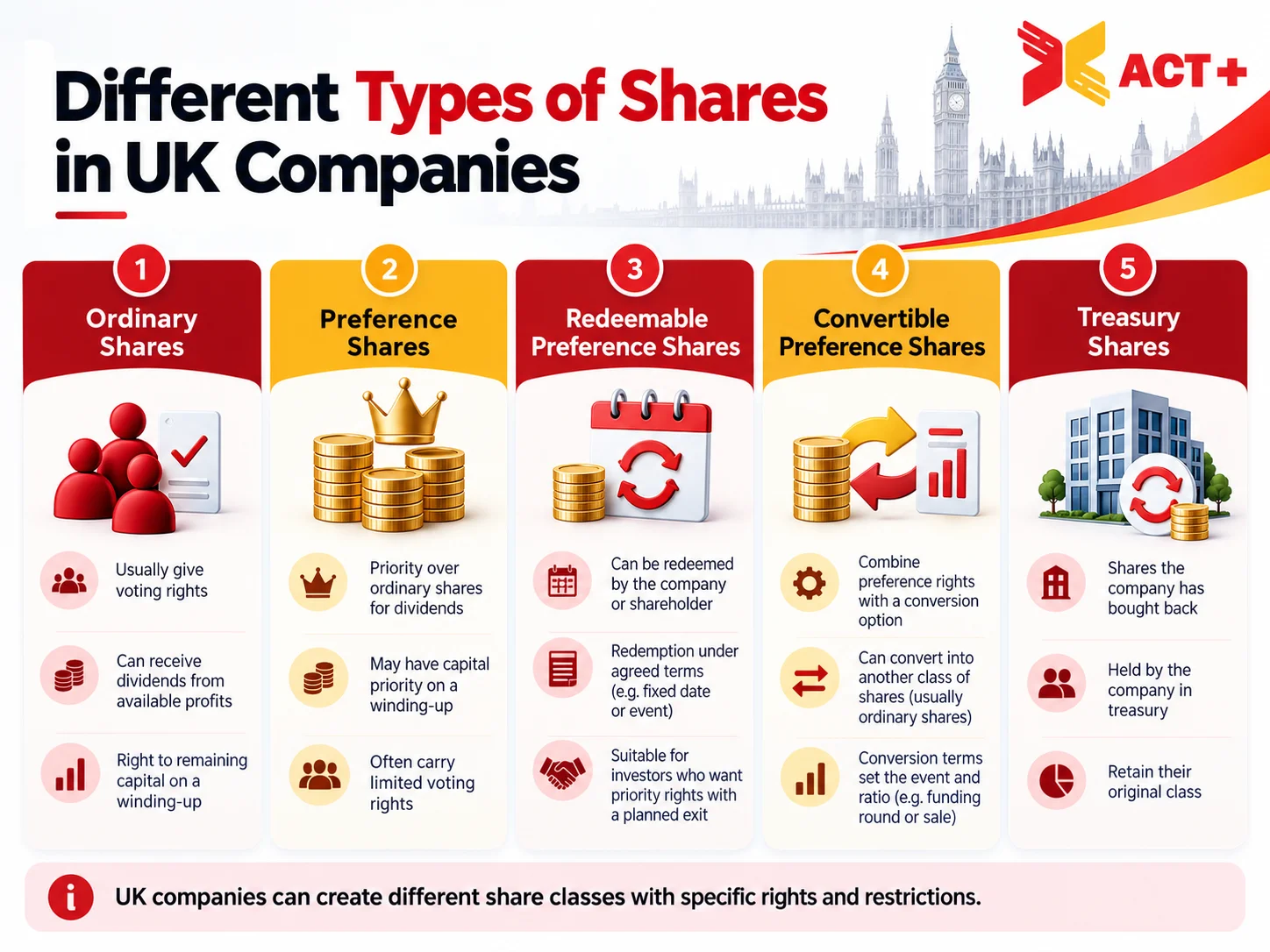
These are common characteristics rather than fixed rights. The company’s constitutional documents determine the precise position.
How are share classes created?
A company creates share classes by setting the rights attached to each class, obtaining the necessary approvals, and updating its company records. Different voting, dividend, or capital rights can create separate share classes.
The company should first check its Articles of Association and amend them if required. Creating a share class and allotting shares are separate steps. Directors may need authority under sections 550 or 551 of the Companies Act 2006, depending on the company’s share structure. Pre-emption rights may also apply where new equity shares are issued for cash.
After the allotment, the company should update its Register of Members, issue Share Certificates, and file form SH01 with Companies House within one month. The Memorandum records the original subscribers, while the Articles govern the company’s ongoing constitutional arrangements.
What are the different classes of ordinary shares?
Ordinary shares can be divided into different classes, but the class name does not determine the legal rights attached to the shares. Common examples include:
- Class A shares – may carry enhanced voting, dividend, or control rights, depending on the Articles of Association.
- Class B shares – may have different voting, dividend, or transfer rights from Class A shares.
- Alphabet shares – use labels such as A, B, C, or D and are often used to give different shareholders different dividend or voting rights.
- Non-voting shares – usually provide economic ownership without normal voting rights.
- Deferred shares – normally rank behind other share classes for certain dividends or capital distributions.
- Founders shares – can be created with specific voting, control, or economic rights for company founders.
- Management shares – may give directors or senior management tailored voting, dividend, or participation rights.
The company’s Articles of Association and relevant resolutions determine the actual rights attached to each share class. A class name alone does not create any particular legal right.
Can a company issue multiple classes of shares?
Yes. A UK company can issue multiple classes of shares with different rights and restrictions. Companies House states that companies can have different share types with different conditions attached to them. A startup could give founders voting ordinary shares and investors preference shares. Employees could receive non-voting shares through an employee share scheme. A family company could use alphabet shares to separate economic rights.
Multiple classes offer flexibility, but they also increase administration. The Articles of Association, Register of Members, Share Certificates, resolutions, and statement of capital should remain consistent.
Which type of share has voting rights?
Ordinary shares most commonly carry voting rights, but the actual entitlement depends on the share class. Companies House states that ordinary shareholders usually receive one vote per share. However, companies can create different voting arrangements. Class A shares might carry several votes each. Class B shares might carry one vote or no normal voting rights. Preference shares often have restricted voting rights.
Non-voting shares generally remove ordinary voting power while preserving other economic rights. Companies House requires prescribed particulars to disclose voting rights, including rights arising only in specific circumstances. A shareholder should therefore check the actual class rights rather than relying on the share name.
How many shares does a company have?
A company has the number of shares it has formally issued to its shareholders. There is no standard number for every private limited company. A single-owner business can issue one ordinary share. That shareholder then owns 100% of that class. Another company might issue 100 shares. Two equal owners could hold 50 shares each.
Growing companies can issue thousands or millions of shares. Larger numbers make ownership percentages easier to divide. Share count also affects dilution, voting percentages, dividends, and company ownership. The following questions explain how these elements connect. The number of shares differs from their market value.
For example, 100 shares with a nominal value of £1 create £100 of nominal share capital. The company could issue each £1 share for £5. The £1 nominal amount forms share capital. The additional £4 normally enters the share premium account. Share capital does not represent the market value of the company. Companies House makes this distinction in its incorporation guidance.
How do shares in a company work?
Shares divide company ownership and give shareholders the rights attached to their particular share class. A company creates new ownership through a share allotment. A share transfer works differently. It moves existing shares from one shareholder to another. A transfer does not normally increase issued share capital. The company records its members in the Register of Members. Further share issues can dilute an existing shareholder’s percentage.
For example, a founder holding 50 of 100 identical shares owns 50%. If the company issues another 100 identical shares, the founder holds 50 of 200 shares. The founder’s percentage falls to 25%. Different voting or economic rights can make ownership calculations more complex.
Which shares receive dividends first?
Preference shares usually receive dividends before ordinary shares when their class rights provide dividend priority. Companies House recognises this priority as a common feature of preference shares. Cumulative preference shares can also carry unpaid dividend rights into later periods.
Ordinary shareholders generally participate after any preferential entitlement. However, share ownership does not guarantee a dividend. The company needs sufficient distributable profits and must follow the applicable company rules.
What rights do shareholders have?
Share-class rights mainly cover voting, dividends, capital distributions, and redemption. Companies House requires companies to describe these matters within prescribed particulars. Voting rights determine how shares influence shareholder decisions. Dividend rights determine how a class participates in profit distributions. Capital rights determine entitlement during capital distributions or winding-up.
Redemption rights determine whether the company or shareholder can redeem shares. Shareholders can also hold statutory and contractual rights beyond these four areas. A Shareholder Agreement may cover transfers, director appointments, reserved matters, disputes, and exit arrangements.
What are shares in business?
Shares in a business are units of ownership in a company limited by shares. Each share gives its holder the rights attached to its class. A share does not always represent a fixed ownership percentage. One share represents 100% where only one identical share exists. One share represents 1% where 100 identical shares exist. Different classes can separate economic ownership from voting control. This distinction matters for founders, investors, and employee shareholders.
What is the difference between ordinary and preference shares?
Ordinary shares usually focus on standard equity ownership, while preference shares provide specified priority rights. Ordinary shareholders commonly receive voting rights and participate in future company growth. Their dividends can vary according to profits and company decisions. Preference shareholders commonly receive dividend priority. They may also rank ahead of ordinary shareholders during certain capital distributions. Preference shares often carry fewer voting rights. Neither type is automatically better. Founders may prefer ordinary shares for control and long-term growth. Investors may prefer preference shares for stronger economic protection.
Frequently Asked Questions
What Are Shares?
Shares are units of company ownership carrying rights determined by their share class. Those rights can include voting, dividends, capital participation, and redemption.
Which shares have voting rights?
Ordinary shares most commonly have voting rights. However, Class A, Class B, preference, and other classes can carry different voting arrangements.
Can I have more than one class of shares?
Yes. A company can have several share classes with different rights. The company must properly define and record those rights.
What are alphabet shares used for?
Alphabet shares separate shareholders into classes such as A, B, C, or D shares. Companies can use them to create different voting, dividend, or capital rights.
What is an ordinary share?
An ordinary share is a standard equity share that usually carries voting, dividend, and capital rights. The Articles of Association determine its precise rights.
Can shareholders own different types of shares?
Yes. Different shareholders can own different classes, and one shareholder can hold several classes. Their rights depend on each class they hold.
Are preference shares better than ordinary shares?
Preference shares are not automatically better than ordinary shares. Preference shares can provide stronger economic priority. Ordinary shares may provide greater voting and growth participation.
Can share rights be changed?
Yes. A company can change class rights by following its Articles of Association and the Companies Act 2006. Where the articles contain no variation procedure, section 630 generally requires written consent from three-quarters of that class's nominal value. A special resolution at a separate class meeting can provide an alternative route.
Which share class is best for investors?
The best share class depends on the investor's required return, control, protection, and exit terms. Growth investors may favour ordinary equity. Other investors may prefer dividend priority, liquidation rights, redemption rights, or conversion rights.
Can startups issue multiple share classes?
Yes. Startups can create different share classes for founders, investors, and employees. Founders may hold voting ordinary shares, investors may receive preference shares, and employees may receive non-voting or restricted shares.
A clear and simple share structure is usually easier to manage. Each class should have clearly defined rights covering voting, dividends, capital, and transfers. This can also make future investment rounds, share transfers, and ownership changes easier to handle.

About the Author: Ahmad Raza