
What Does an Accountant Do?
An accountant records, analyses, and reports financial information to help businesses and individuals stay compliant, manage cash flow, and make sound financial decisions. Accountants prepare financial statements, file tax returns, and manage accounting records. And provide a wide range of services that support business operations.
An accountant is a trained financial professional who manages financial records, prepares financial documents, and ensures that an organisation’s financial information is accurate. Accountants work across industries, from small businesses to multinational corporations, government bodies, and non-profit organisations.
What Is An Accountant?
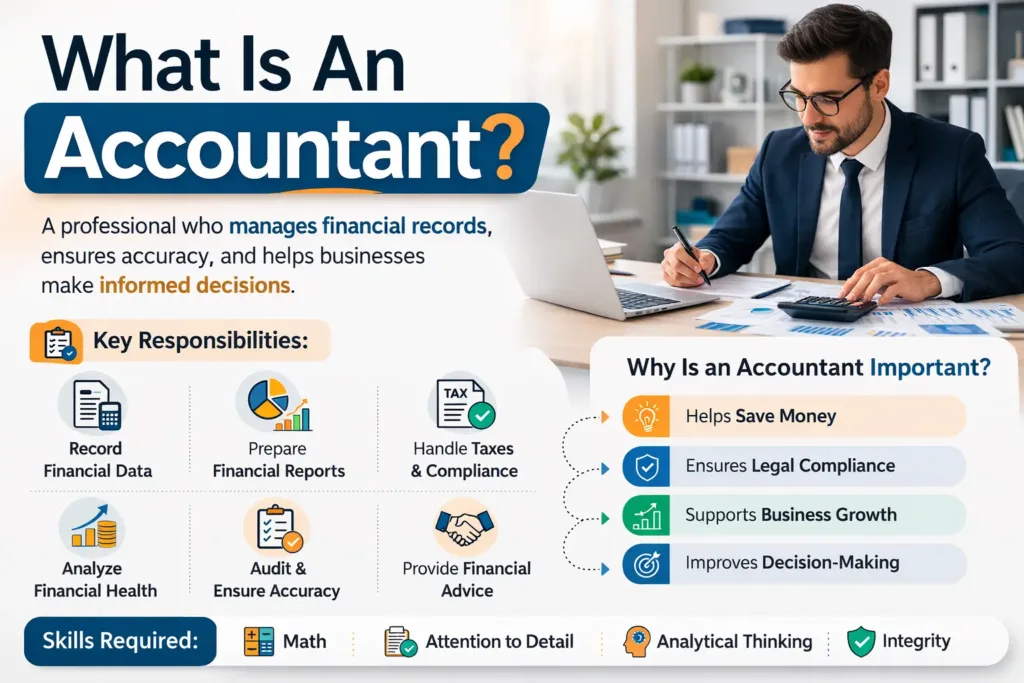
An accountant is a trained financial professional who manages financial records and prepares financial documents. It ensures that an organisation’s financial information is accurate, complete, and compliant with accounting principles. Accountants work across industries, from small businesses to multinational corporations, government bodies, and non-profit organisations.
Accountants maintain accounting records that track every financial transaction a business makes. These records form the foundation for reporting, tax compliance, and strategic planning. The financial information accountants produce is used by business owners, investors, lenders, and regulators.
The core function of an accountant involves applying accounting principles, standardised rules such as Generally Accepted Accounting Principles (GAAP), to ensure financial documents reflect an accurate picture of financial position.
What are the roles of an accountant?
The roles of an accountant include:
- Financial recorder: An accountant captures every financial transaction in the correct accounts, maintaining a complete and accurate ledger.
- Financial reporter: An accountant prepares the income statement, balance sheet, and cash flow statement at the end of each reporting period.
- Tax advisor: An accountant calculates tax liabilities, prepares tax returns, and identifies legal strategies to reduce tax exposure.
- Compliance officer: An accountant ensures financial records and reports meet legal standards, including GAAP, IFRS, or jurisdiction-specific regulations.
- Business advisor: An accountant analyses financial data to guide pricing, budgeting, investment, and cost-control decisions.
- Audit support: An accountant prepares documentation and reconciliations needed for internal or external audit processes.
The roles an accountant fills depend on the size of the business, the industry, and whether the accountant works in-house or in public practice.
What are the Responsibilities of an Accountant?
The responsibilities of an accountant include maintaining accurate financial records such as ledgers, balance sheets, and income statements. Accurate records help organisations track financial performance and make informed financial decisions.
Accountants ensure tax compliance by preparing and reviewing tax documents so that businesses meet government regulations and avoid penalties. They prepare financial reports, including profit-and-loss statements and cash-flow reports, which help managers evaluate business performance. Accountants record and review credit and debit entries in company accounts to ensure that transactions are accurate and that financial data remains reliable.
What are the types of accountants?
There are 5 main types of accountants, each specialising in a different area of financial management.
- Financial accountants: prepare external financial statements, including the balance sheet, income statement, and cash flow statement, in accordance with GAAP or IFRS. Financial accountants work primarily with publicly traded companies, large corporations, and organisations that require audited statements.
- Management accountants: Management accountants produce internal reports that help business leaders make operational decisions. Management accountants focus on budgeting, forecasting, variance analysis, and performance measurement rather than external compliance.
- Tax accountants: Tax accountants manage all aspects of a business’s or an individual’s tax position. Tax accountants prepare tax returns, advise on tax planning strategies, and ensure compliance with tax laws at every level of government.
- Forensic accountants: Forensic accountants investigate financial fraud, embezzlement, and financial crimes. Forensic accountants analyse records, trace transactions, and produce evidence-based reports used in legal proceedings and regulatory investigations.
- Public practice accountants: Public practice accountants work within accounting firms, providing audit, tax, and advisory services to a wide range of clients. Public practice accountants include Certified Public Accountants (CPAs) in the United States and Chartered Accountants (CAs) in the United Kingdom and other countries.
Many businesses use a combination of accountant types. A business may employ a management accountant in-house while engaging a public practice accountant for annual audit and tax filing work.
What are the Top Services an accountant provides?
An accountant provides a wide range of services to help individuals and businesses manage their finances efficiently. Some top services of an accountant are listed below:
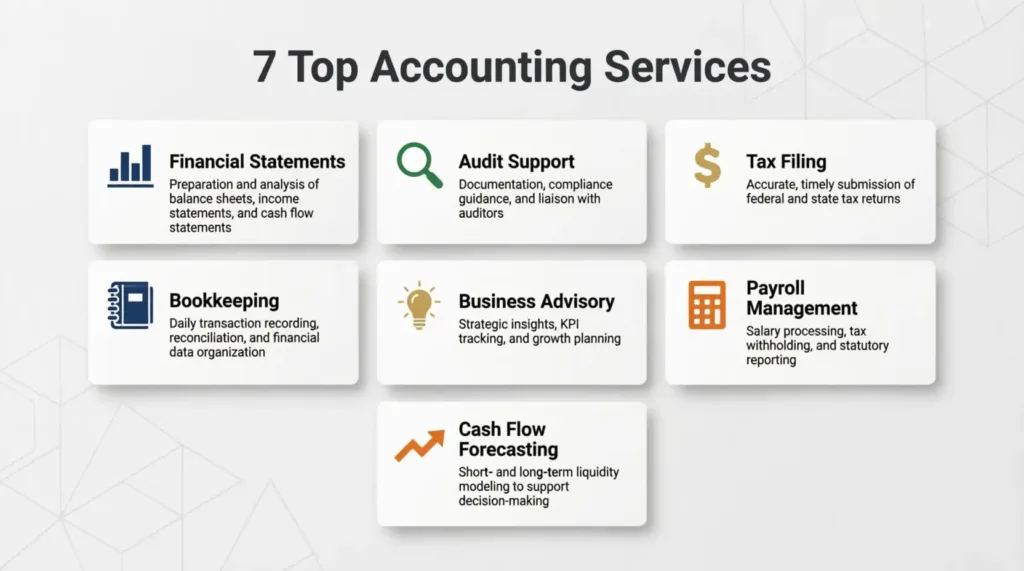
- Financial statement preparation: Accountants prepare the income statement, balance sheet, and cash flow statement. These financial statements are required for regulatory compliance, investor reporting, and loan applications.
- Tax filing and planning: Accountants complete and submit tax returns, calculate tax liabilities, and develop strategies to reduce the total tax burden legally.
- Audit support: Accountants prepare the documentation and reconciliations external auditors require, ensuring the audit process is efficient and findings are minimal.
- Bookkeeping: Accountants manage the recording of daily financial transactions, maintaining the chart of accounts and general ledger.
- Payroll management: Accountants process payroll, calculate deductions, and ensure payroll tax submissions are accurate and on time.
- Business advisory services: Accountants provide expert guidance on business structure, funding options, pricing strategy, cost reduction, and financial risk management.
- Cash flow forecasting: Accountants model future cash flow to help businesses anticipate shortfalls, plan expenditure, and maintain liquidity.
Advisory services are an increasingly important part of what accountants provide. Beyond compliance, accountants deliver expert guidance that directly supports business decisions. From expanding into new markets to evaluating whether to hire additional staff.
How much does an accountant make?
Accountants typically earn between £33,000 and £51,000 per year, with averages reported around £48,000–£51,000 depending on the source. Salaries vary widely by experience, qualifications, and location, with London and Big Four firms offering the highest pay
| Career Stage / Type | Typical Salary Range | Notes |
|---|---|---|
| Entry-level (1–3 years) | £22,000 – £36,800 | Graduate or trainee accountants starting out. |
| Mid-level (median) | £33,000 – £48,000 | The average across the UK, varies by sector. |
| Chartered Accountant (ACA, ACCA, CIMA) | £60,000 – £90,000+ | Higher salaries in London, finance, and Big Four firms. |
| Senior-level (8+ years) | £57,000 – £90,000+ | Experienced professionals, often in management roles. |
| Overall national average | £48,000 – £51,463 | Reported by industry surveys and salary databases. |
What Does an Accountant Do in the UK?
An accountant in the UK prepares financial statements and files tax returns with His Majesty’s Revenue and Customs (HMRC). Manages VAT (Value Added Tax) returns and ensures compliance with UK-specific financial laws and regulations. The core accounting function in the UK follows the same principles as international accounting but operates within a distinct regulatory framework.
UK accountants work under standards set by the Financial Reporting Council (FRC) and follow UK Generally Accepted Accounting Practice (UK GAAP) or IFRS for listed companies. UK accountants file annual accounts with Companies House for limited companies. Produce self-assessment tax returns for individuals and sole traders.
UK accountants hold professional qualifications from bodies including the Association of Chartered Certified Accountants (ACCA), the Institute of Chartered Accountants in England and Wales (ICAEW), and the Chartered Institute of Management Accountants (CIMA).
What Does an Accountant Do for a Business?
An accountant manages a business’s complete financial function, from recording transactions to producing reports, filing taxes, and advising on growth. The accountant ensures the business has accurate financial information at every stage of operation.
The accountant records all income and expenditure, tracks assets and liabilities, prepares financial statements for stakeholders, manages tax obligations, and provides strategic financial advice. Without an accountant, a business risks financial mismanagement, non-compliance penalties, and poor decision-making driven by inaccurate data.
What Services Does an Accountant Provide for Small Businesses?
An accountant provides small businesses with bookkeeping, tax filing, payroll processing, VAT management, cash flow forecasting, and business advisory services. These services of an accountant address the specific financial challenges small businesses face, regulatory complexity, and the need for clear financial data to secure funding.
Small businesses benefit from accountants who handle monthly bookkeeping. Ensuring financial records are current and reconciled. Accountants also prepare year-end financial statements. These are required for tax filings and may be requested by banks when a small business applies for a loan. Expert guidance on allowable business expenses reduces the tax burden legally and keeps more cash within the business.
What Role Does an Accountant Play in Company Growth?
An accountant supports company growth by providing accurate financial data and identifying cost-saving opportunities. Accountant improving cash flow management, and advising on funding strategies. Growth decisions, hiring, expanding premises, and entering new markets require reliable financial projections, and accountants produce those projections.
Revenue increases when businesses use accounting data to price products correctly, control overhead, and invest in high-return activities. Accountants develop financial models that show the projected impact of growth decisions before commitments are made. Reducing financial risk and improving the probability of sustainable expansion.
What Does a Tax Accountant Do for a Business?
A tax accountant manages every aspect of a business’s tax position, calculating tax liabilities, preparing and filing tax returns. Tax accountant developing strategies to reduce the total tax paid within legal limits.
A tax accountant’s work for a business includes 4 main areas. The tax accountant assesses the business structure to minimise tax exposure and prepares corporation tax returns. Tax Accountants respond to tax authority enquiries and represent businesses during audits.
What is the Difference Between an Accountant and a Tax Accountant?
The main difference between an accountant and a tax accountant lies in their scope of work and specialisation.
A general accountant handles the full range of financial functions, bookkeeping, financial reporting, and compliance. A tax accountant specialises exclusively in tax planning, tax filings, and tax compliance.
The 3 differences between an accountant and a tax accountant are listed below:
- Scope: A general accountant covers financial statements, audits, payroll, and advisory work. A tax accountant focuses solely on tax obligations, tax strategy, and tax law.
- Expertise: A tax accountant holds specialist knowledge of tax codes, deductions, credits, and jurisdiction-specific tax regulations that a general accountant may not maintain in depth.
- Usage: Businesses use general accountants year-round for day-to-day financial management. Tax accountants are engaged primarily during tax planning periods and ahead of filing deadlines.
What is the Difference between an Accountant and a Bookkeeper?
The main difference between an accountant and a bookkeeper is the level of responsibility and type of financial work they perform. A bookkeeper records daily financial transactions. An accountant analyses those records, prepares financial reports, and provides strategic financial advice.
Small businesses often use a bookkeeper for ongoing transaction recording and engage an accountant for year-end accounts and tax filings. This combination reduces costs while maintaining financial accuracy.
What Skills Are Needed to Be an Accountant?
An accountant requires 6 core skills: numerical accuracy, analytical thinking, and knowledge of accounting standards, technology proficiency, communication ability, and attention to detail.
The 6 skills needed to be an accountant are listed below:
- Numerical accuracy: Accountants identify errors in financial records, reconcile accounts, and calculate tax liabilities without making arithmetic mistakes.
- Analytical thinking: Accountants interpret financial data, identify trends, and produce actionable insights for business decision-making.
- Knowledge of accounting standards: Accountants apply GAAP, IFRS, or relevant national accounting principles correctly to all financial documents.
- Technology proficiency: Accountants use accounting software, such as QuickBooks, Xero, Sage, or enterprise systems, to process, store, and report financial data.
- Communication ability: Accountants explain complex financial information clearly to non-financial stakeholders, including business owners, investors, and managers.
- Attention to detail: Accountants review financial reports, tax filings, and reconciliations at a granular level to catch and correct errors before submission.
Do I Really Need an Accountant?
Yes, most businesses and self-employed individuals need an accountant. The complexity of tax laws and regulations, the volume of financial records to maintain, and the cost of errors make professional accounting support valuable for almost every business size.
A business with straightforward finances and simple tax obligations may manage with accounting software and a bookkeeper. A business with employees, VAT obligations, investment activity, or complex cost structures requires an accountant to ensure compliance and avoid costly mistakes. Fines for incorrect tax filings, missed deadlines, or inaccurate financial statements exceed the cost of professional accounting services in most cases.
When to Hire an Accountant?
Hire an accountant when the business registers for tax, takes on employees, reaches the VAT registration threshold, or applies for funding.
5 specific situations signal the right time to hire an accountant:
- Business registration: Accountants advise on the most tax-efficient business structure, sole trader, partnership, or limited company, before the business launches.
- First tax filing: Tax returns require accurate financial records and knowledge of allowable deductions. An accountant reduces errors and maximises legitimate tax savings.
- Taking on employees: Payroll tax, employer contributions, and employment law compliance require specialist handling that an accountant provides.
- Applying for a loan or investment: Lenders and investors require professionally prepared financial statements. An accountant ensures these documents meet the required standard.
- Business growth: Expanding into new markets, acquiring assets, or restructuring the business creates financial and tax complexity that requires accounting expertise.
Is Xact+ Accountant the Best Option for Your Business?
Yes, Xact+ Accountant is a strong option for businesses seeking comprehensive accounting services that combine financial statement preparation. Xact+ Accountant provides expert guidance across all key accounting functions, from bookkeeping and tax filings to strategic financial planning.
Xact+ Accountant serves businesses that need reliable accounting records, accurate financial reports, and proactive advisory services. Businesses that prioritise accuracy, compliance, and clear financial information benefit most from Xact+ Accountant.

About the Author: Ahmad Raza