Tax accounting is a subcategory of accounting focused on calculating taxable income and managing tax obligations in compliance with HMRC (His Majesty’s Revenue and Customs) regulations. Tax accounting deals exclusively with tax preparation and reporting, unlike general accounting, which examines overall financial health through the income statement, balance sheet, and cash flow statement.
Tax accounting UK practices cover a wide range of obligations, which involve VAT (Value Added Tax), corporation tax, and PAYE (Pay As You Earn). Effective HMRC taxation accounting ensures legal compliance, accurate financial reporting, improved cash flow, and reduced tax liability.
There are four main types of tax accounting. These are individual tax accounting, business tax accounting, corporate tax accounting, and nonprofit (tax-exempt) tax accounting. Examples range from a freelancer claiming deductions to a limited company managing corporation tax and VAT returns. Strong tax accounting UK practices provide financial clarity, minimise risk, and keep businesses fully compliant with HMRC regulations throughout the financial year.
What is Tax Accounting?
Tax accounting is a branch of accounting focused on the preparation, recording, and management of financial information strictly for tax purposes. It specifically calculates the amount of tax owed to the government by analysing income, allowable expenses, deductions, and any relevant tax credits. Tax accounting follows specific rules set by tax authorities, such as HMRC (His Majesty’s Revenue and Customs) in the UK. It applies to all entities, individuals, businesses, corporations, and tax-exempt organisations.
What is the importance of Tax accounting
Tax accounting is important because it makes sure that individuals and businesses comply with the tax laws imposed by the government. It helps avoid legal liabilities, fines, and penalties. Tax accounting also helps create accurate financial records, which support effective financial reporting and planning. This branch of accounting allows businesses to estimate their financial performance.
Good tax accounting supports smart business decisions, improves budget and resource allocation, and influences important choices like market entry and mergers. It also helps with strategic tax planning to legally reduce tax burdens and free up capital for future business growth. Risk-wise, timely filing of returns and accurate reporting reduce the chances of non-compliance and possible legal fines. Tax accounting helps businesses manage their finances by planning for tax payments and avoiding unexpected costs.
✓ Free initial consultation
How Tax Accounting Works?
Tax accounting is a specialised accounting method that focuses on accurately calculating what an individual or business owes in taxes. It works by focusing on two important areas, which include current-year liabilities and future-year liabilities. Current-year liabilities cover taxes owed for the current period, while future-year liabilities involve planning for upcoming tax obligations. All of this feeds into accurate financial reporting and ensures full compliance with tax laws and regulations.
What are the Types of Tax Accounting?
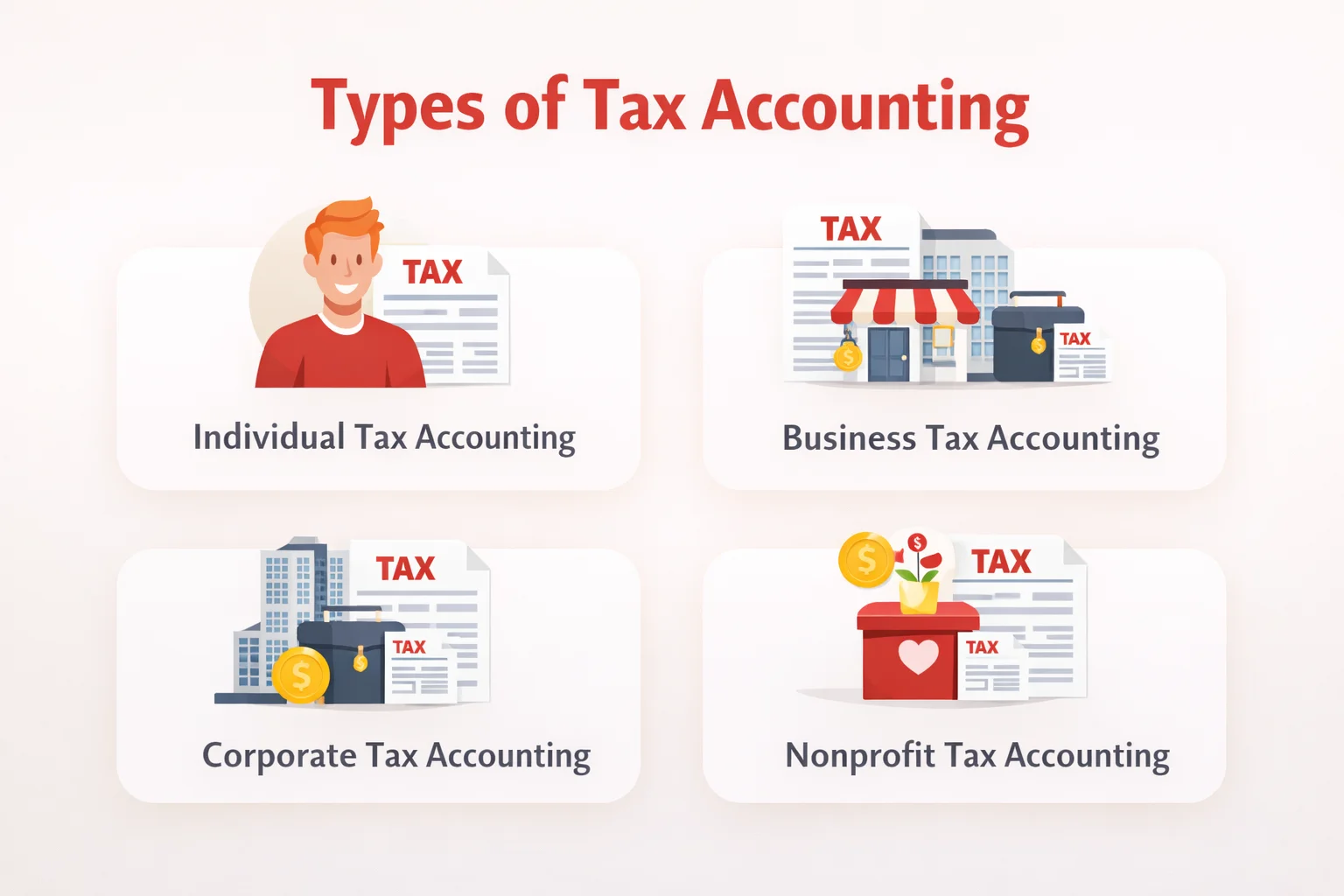
The types of tax accounting are individual tax accounting, business tax accounting, corporate tax accounting, and nonprofit (tax-exempt) tax accounting.
The types of tax accounting are outlined below.
- Individual tax accounting: This type of accounting applies to personal taxpayers and focuses on income from employment, investments, and other sources. It accounts for personal allowances, deductions, and credits, like pension contributions and charitable donations, to accurately calculate an individual’s tax liability.
- Business tax accounting: This type is used by sole traders, partnerships, and small to medium-sized businesses. It involves recording business income and expenses, managing VAT (Value-Added Tax) compliance, and handling PAYE (Pay As You Earn) contributions. It makes sure the business meets all its tax obligations throughout the financial year.
- Corporate tax accounting: Corporate tax accounting applies to larger companies and corporations. It deals with more complex tax structures, which involve corporation tax, deferred tax liabilities, and shareholder reporting. Corporations usually rely on dedicated tax accountants or specialist teams due to the scale and complexity involved.
- Nonprofit (tax-exempt) tax accounting: This type is designed for charities and nonprofit organisations that qualify for tax-exempt status. It tracks how funds, such as grants and donations, are received and used. Nonprofit tax accounting makes sure annual returns are filed correctly to maintain that tax-exempt status.
What are the Examples of Tax Accounting?
The examples of tax accounting include a freelancer claiming business deductions. An individual freelancer can use tax accounting to claim eligible deductions for home office expenses, travel, and business equipment. This eligibility may lower their overall tax liability.
Another example is of a small business managing expenses. A small retail business like ABC Stores uses tax accounting to track all sales, inventory costs, and eligible business deductions like marketing and utility expenses. The business records sales revenue at the time of purchase by following the accrual accounting method. This method gives a clear picture of revenue and expenses over time.
What Is the Main Purpose of Tax Accounting?
The main purpose of tax accounting is to determine the tax owed by taxpayers, whether businesses or individuals, according to tax code regulations. It ensures compliance with tax laws and tries to minimise tax liability by allowing tax accountants to help clients maximise savings without violating any laws. It keeps finances accurate, legal, and tax-efficient.
What does a tax accountant do?
A tax accountant is a financial professional who manages the entire tax process for individuals and businesses. Their core responsibilities include preparing and filing tax returns, calculating tax liabilities, identifying eligible deductions and credits, and maintaining full compliance with tax laws and regulations.
Who needs a tax accountant?
Anyone with a financial obligation to the government needs a tax accountant. This includes employed individuals, self-employed professionals, freelancers, small business owners, large corporations, partnerships, and non-profit organisations. Those with multiple income sources, complex investments, or significant assets particularly benefit from professional tax guidance. A tax accountant adds real value if taxes are involved.
What does it mean net of tax?
Net of tax means the amount remaining after all applicable taxes have been deducted. It describes the actual take-home value of income, profit, or a financial transaction once tax obligations have been removed. For example, if a business earns $100,000 and owes $20,000 in tax, the net of tax figure is $80,000, the true amount retained.
✓ Free initial consultation
What are the Common Tax Accounting Methods?
The common tax accounting methods are the cash method and the accrual method. There are other special methods and hybrid options, but those are not common and do not apply to most taxpayers. The cash method is the simplest method used by individuals and small businesses. Income is reported in the tax year it is received, and expenses are deducted in the tax year they are paid.
The accrual method reports income when it is earned, regardless of when payment is collected. This method deducts expenses when goods or services are received, rather than when they are paid. The hybrid method is a combination of the cash and accrual methods, where a business may apply different methods to different aspects of its finances. For example, using the cash method for income and the accrual method for expenses.
What are the principles of tax accounting?
The principles of tax accounting include consistency, accuracy, compliance, matching, and transparency. Consistency means using the same method year to year, and accuracy means making sure all income and expenses are correctly recorded. Compliance means conforming to tax laws and regulations. Matching is to align income with related expenses in the same period, and transparency is maintaining clear, honest, and well-documented financial records for reporting purposes.
What are the Benefits of Tax Accounting?
The benefits of tax accounting are legal compliance, reduced tax liability, better financial planning, improved cash flow management, accurate financial records, audit preparedness, and informed business decision-making.
The benefits of tax accounting are listed below.
- Legal compliance: Tax accounting makes sure individuals and businesses meet their legal obligations by following tax laws and regulations. Tax accounting helps businesses avoid penalties, fines, and possible legal action from tax authorities.
- Reduced tax liability: Tax accounting helps legally minimise the amount of tax owed by identifying eligible deductions, allowances, and tax credits. It saves money for both individuals and businesses.
- Better financial planning: Tax accounting provides a clear picture of income, expenses, and tax obligations. It helps with smarter budgeting decisions and more effective long-term financial planning throughout the year.
- Improved cash flow management: Tax accounting helps businesses effectively plan tax payments and anticipate future liabilities to prevent financial losses.
- Accurate financial records: Tax accounting demands organised recordkeeping for reliable tax filings and a clear financial overview.
- Audit preparedness: Organised tax records and accurate reporting confirm readiness for audits, minimising stress and investigation risks.
- Informed Business Decision-Making: Good tax accounting provides financial transparency that improves business decisions, like cost management and investment planning.
What is the difference between Tax Accounting and Financial Accounting?
Tax accounting and financial accounting differ in terms of purpose, governing rules, audience, scope, reporting period, treatment of income and expenses, flexibility, and mandatory requirements.
The difference between tax accounting and financial accounting is mentioned below.
- Purpose: Tax accounting focuses on calculating tax liabilities and ensuring compliance with tax laws. Financial accounting focuses on reporting overall financial performance to stakeholders.
- Governing rules: Tax accounting is governed by tax authorities such as HMRC. Financial accounting follows standard frameworks such as GAAP (Generally Accepted Accounting Principles) or IFRS (International Financial Reporting Standards).
- Audience: Tax accounting is prepared for tax authorities and government bodies, whereas financial accounting is prepared for investors, stakeholders, and management.
- Scope: Tax accounting deals specifically with taxable income, deductions, and liabilities. Financial accounting covers the full financial position of a business, which includes assets and equity.
- Reporting period: Tax accounting follows the tax year defined by law. Financial accounting usually follows the company’s own chosen fiscal or calendar year.
- Treatment of income and expenses: Tax accounting recognises income and expenses according to tax rules, which differ from how financial accounting records the same transactions under standard accounting principles.
- Flexibility: Tax accounting must strictly follow tax codes. Financial accounting allows some degree of professional judgement in how figures are presented.
- Mandatory requirements: Tax accounting is mandatory for all individuals and entities with a tax obligation. Financial accounting is required for registered companies and publicly listed businesses.
What is the difference Between Tax Avoidance and Tax Evasion?
Tax avoidance is the legal practice of arranging finances to minimise tax liabilities by using allowable deductions, credits, and exemptions within the boundaries of the law. Tax evasion is illegal, as it involves deliberately hiding income, falsifying records, or misrepresenting information to reduce tax obligations. Tax evasion results in serious penalties or criminal prosecution.
What is the difference between Tax Accounting and GAAP?
Tax accounting follows rules set by tax authorities to calculate taxable income and ensure legal compliance. GAAP (Generally Accepted Accounting Principles) provides a standardised structure for reporting a company’s overall financial performance to investors and stakeholders.
How much does a tax accountant cost?
The cost of a tax accountant in the UK depends on the complexity of the work and the business size. A standard self-assessment return generally ranges from £150 to £350. Fees for sole traders and individuals with multiple income streams commonly rise to £300 to £500. Average accountant prices for small businesses range from £150 to £500 per month. Limited companies can expect to pay between £800 and £5,000 or more annually, depending on location and service scope.
When to use a corporate tax accountant?
A corporate tax accountant is best used when a business faces complex tax obligations that are difficult to manage internally. This complexity includes managing corporation tax, VAT (Value-Added Tax) compliance, PAYE (Pay As You Earn), international tax matters, and mergers and acquisitions. More complex situations involve rapid business growth, internal audits, or when facing major changes to tax regulations that could impact the business financially.
How can you start a career in tax accounting?
To start a career in tax accounting, get a relevant degree in accounting, finance, or a related field. Pursue professional qualifications such as ACCA (Association of Chartered Certified Accountants), ACA (Associate Chartered Accountant), or CTA (Chartered Tax Adviser). Get practical experience through internships or entry-level roles at accounting firms. Building knowledge of tax laws and regulations is essential for long-term career progression.
How to Check if a Company is VAT Registered?
To check if a company is VAT registered, use HMRC’s online VAT registration checker at gov.uk. Simply enter the company’s VAT number to confirm its validity. Request the VAT registration number directly from the business, which must legally display it on all invoices and receipts.
How an Accountant Manages a Business Tax Account?
An accountant manages a business tax account by maintaining accurate financial records, tracking income and expenses, and calculating tax liabilities. The accountant can file returns on time, handle VAT submissions, PAYE obligations, and corporation tax returns. The accountant also provides strategic advice to reduce the business tax burden throughout the financial year.
✓ Free initial consultation

About the Author: Ahmad Raza