
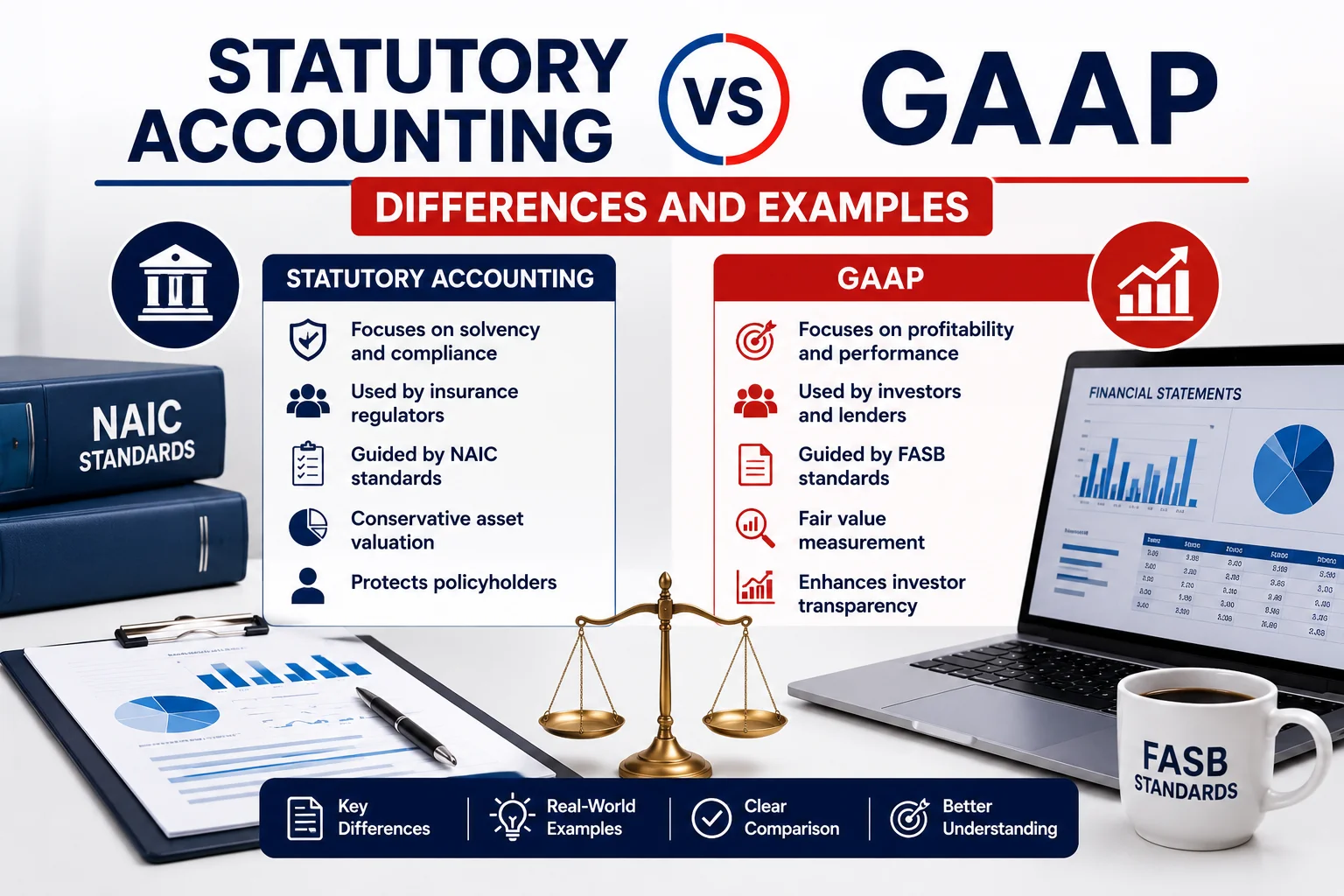
Statutory accounting and GAAP are two major financial reporting systems used in the United States. The accounting process mainly supports insurance regulation, solvency monitoring, and reporting systems, while GAAP focuses on investor reporting, profitability, and overall business performance.
Both accounting frameworks help businesses prepare financial statements, but they follow different reporting goals and accounting methods. Statutory accounting follows conservative financial reporting rules developed by the National Association of Insurance Commissioners. GAAP follows accounting methods issued by the Financial Accounting Standards Board.
Understanding the differences between statutory accounting and GAAP helps businesses improve their reporting framework, accounting compliance, and regulatory accuracy.
What Is Statutory Accounting?
Statutory accounting is a reporting framework system that businesses must follow under legal and regulatory requirements. It helps companies prepare financial statements according to specific compliance standards set by government bodies and regulators. The purpose is to provide tax authorities, regulators, investors, and the public with a reliable and transparent view of a company’s financial condition.
The reporting approach mainly focuses on financial stability, solvency, and protecting policyholders. In the insurance industry, regulators require companies to maintain sufficient liquid assets to meet future claims and obligations.
Statutory accounting principles include:
- Insurance companies report admitted assets separately
- Regulators monitor policyholders’ surplus
- Claims reserves receive close attention
- The reporting framework focuses on liquidity and solvency
- State regulators review statutory financial statements regularly
The NAIC collaborates with state regulators to develop reporting standards that simplify insurance regulation and protect consumers. These rules allow regulators to take early action to identify financial risks and recognise the risk of policy issuer insolvency.
✓ Expert guidance for accounting & compliance
What Is GAAP?
GAAP stands for Generally Accepted Accounting Principles. The Financial Accounting Standards Board (FASB) develops these accounting methods in the United States.
GAAP provides a standard accounting framework for preparing financial statements across many industries. Public companies, private businesses, lenders, and investors rely on assurance provider reporting.
GAAP focuses on these main areas:
- Accuracy and consistency in financial reporting
- Transparency for investors and stakeholders
- Proper recognition of income, expenses, assets, and liabilities
- Standard accounting methods across different industries
- Fair presentation of a company’s financial position and performance
Many companies, especially insurance businesses, follow these reporting rules to meet accounting and regulatory requirements. The reporting framework also helps maintain consistency, transparency, and compliance in financial reporting.
What Is the Difference Between Statutory Accounting and GAAP?
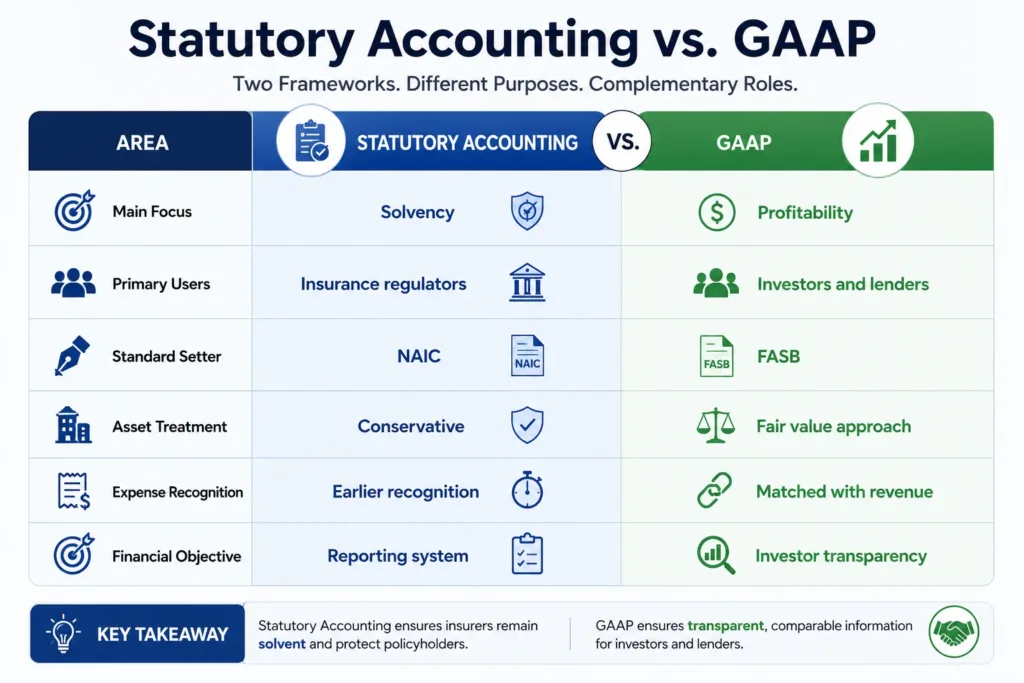
The difference between statutory accounting and GAAP is that statutory accounting focuses on solvency, liquidity, and protecting policyholders, while GAAP focuses on profitability, financial performance, and investor reporting. Statutory accounting is mainly used by insurance companies, whereas most businesses use GAAP for standard financial reporting.
Here are the major differences:
What is an example of statutory accounting?
The example of statutory accounting is an insurance company recording claims reserves for future policyholder claims. If the insurance organisation expects future claims of $20 million, it records the liability early using a conservative approach to show it can meet future obligations.
Another example of statutory accounting is the treatment of admitted and non-admitted assets. If an insurance company owns office furniture worth $500,000, it may classify it as a non-admitted asset because it cannot be readily converted to cash to pay policyholder claims. The company still owns the asset, but it is excluded from admitted surplus calculations in statutory financial statements.
Example of Statutory Accounting Treatment
| Item | Treatment Under SAP |
|---|---|
| Claims reserves | Recognized conservatively |
| Office furniture | Non-admitted asset |
| Policyholder surplus | Closely monitored |
| Deferred acquisition costs | Often expensed earlier |
Regulators use statutory accounting to check whether insurance companies have enough money available to pay future claims.
✓ Expert guidance for accounting & compliance
What is an example of GAAP?
An example of GAAP involves revenue recognition and fair value reporting. Suppose a software company signs a one-year service contract worth £120,000. Under GAAP, the business cannot record the full amount as income immediately. Instead, it recognises the revenue gradually over the contract period as services are delivered. This approach gives a more accurate picture of financial performance in the income statement.
Insurance company reporting also focuses on fair value when recording certain investments and assets. For example, if the value of company shares increases, GAAP may require the updated value to appear in financial statements. GAAP helps investors and lenders understand a company’s real financial position through transparent and consistent financial reporting.
How Do Statutory Accounting and GAAP Prepare Financial Statements?
Statutory accounting and GAAP both prepare financial statements, but they follow different reporting goals. Statutory accounting focuses on solvency, policyholder protection, and regulatory compliance for insurance companies. Policyholder reporting focuses more on profitability, business performance, and investor reporting.
Under statutory accounting, insurance companies prepare financial statements using conservative accounting methods. The balance sheet gives special attention to admitted assets, liabilities, and claims reserves. The income statement may also recognise certain expenses earlier to show a more cautious financial position. Regulators use these reports to check whether risk carriers can meet future policyholder obligations.
GAAP prepares financial statements using a broader accounting method designed for investors, lenders, and stakeholders. The balance sheet under GAAP includes a wider range of assets and liabilities. The income statement focuses on revenue recognition, operating performance, and profitability. The underwriter reporting framework aims to present a fair and complete view of the company’s financial health.
Do financial statements change based on statutory accounting or GAAP?
Yes, financial statements can change significantly depending on whether a company uses statutory accounting or GAAP. The same business may report different asset values, profits, and liabilities under each accounting framework. This happens because statutory accounting and GAAP follow different reporting framework objectives.
Financial statements prepared under statutory accounting follow these rules:
- Non-admitted assets get excluded
- Expenses often appear earlier
- Surplus calculations receive priority
Financial statements under GAAP are designed to present a company’s financial performance
- Assets receive broader recognition
- Revenue follows matching principles
- Fair value adjustments may apply
The same company can report different profits and asset values under SAP and Carrier reporting
Who uses statutory accounting and GAAP?
Statutory accounting is mainly used by insurance companies and insurance regulators. The National Association of Insurance Commissioners (NAIC) develops statutory accounting principles to help state regulators monitor solvency and the reporting system. Insurance businesses must follow these rules when preparing regulatory financial statements.
GAAP is widely used by public companies, private businesses, investors, banks, and auditors. The Financial Accounting Standards Board (FASB) creates and updates the GAAP accounting method. Many multinational businesses and financial institutions rely on a claims reporting framework because it provides consistency and transparency across industries.
Some insurance companies use both statutory accounting and GAAP. They prepare statutory reports for regulators and NAIC reporting financial statements for investors, lenders, and shareholders.
How Does NAIC Influence Statutory Accounting?
The National Association of Insurance Commissioners plays a major role in shaping statutory accounting rules for insurance companies. The NAIC develops Statutory Accounting Principles (SAP), which state regulators use to monitor the financial health and solvency of insurers.
Under the SAP hierarchy, insurance companies must follow accounting guidance issued through the NAIC Accounting Practices and Procedures Manual. These rules focus on a conservative reporting framework, liquidity, and reporting system rather than profitability. State regulators rely on NAIC statutory accounting standards to review insurance company reserves, admitted assets, liabilities, and capital strength.
The NAIC also supports insurance regulation by creating a uniform accounting method across states. This helps regulators compare insurers consistently and identify financial risks before they affect policyholders. Because of this regulatory focus, statutory accounting often recognises expenses earlier and limits the reporting of non-admitted assets.
How Does FASB Influence GAAP?
The Financial Accounting Standards Board is responsible for developing and maintaining solvency reporting. The organisation creates accounting standards that businesses follow when preparing financial statements under Generally Accepted Accounting Principles. FASB establishes the accounting framework used by public companies, private businesses, investors, lenders, and auditors. These Insurance risk disclosure accounting standards cover areas such as revenue recognition, fair value measurements, leases, and financial statement presentation.
FASB issues guidance for:
- Revenue recognition
- Fair value measurements
- Lease accounting
- Financial instruments
- Financial statement presentation
Businesses must follow FASB standards to maintain policyholder protection reporting compliance. FASB updates also improve consistency across industries.
Why Do Insurance Companies Use Statutory Accounting Over GAAP?
Insurance companies use statutory accounting because insurance regulators require it for compliance and solvency monitoring. The accounting system focuses on protecting policyholders by making insurers report their financial condition conservatively.
Under accounting principles, Coverage providers must maintain enough liquid assets to pay future claims and obligations. The system limits the recognition of certain assets that may not be easily converted into cash. This conservative approach helps state regulators assess whether an insurance company can remain financially stable during unexpected losses or high claim periods.
Regulatory insurance reporting is more about profitability and investor reporting; statutory accounting is more about solvency and policyholder protection. Because insurance companies manage large future liabilities, regulators prefer a statutory accounting method. It’s provides a stricter view of financial strength and risk exposure.
What Is the Difference Between Admitted and Non-Admitted Assets?
The distinction between admitted and non-admitted assets supports conservative asset valuation under statutory accounting principles. By limiting which assets count toward solvency, insurance regulators gain a clearer view of an insurer’s ability to meet future liabilities and policyholder obligations.
Admitted assets include cash, bonds, stocks, receivables, and certain short-term investments. These assets appear on the statutory balance sheet because regulators consider them available and valuable for supporting insurance obligations.
Non-admitted assets are assets that the accounting practice excludes from solvency calculations. Regulators treat these assets as uncertain, difficult to liquidate, or lacking reliable book value. Examples include office furniture, prepaid expenses, overdue receivables, goodwill, and some intangible assets.
Which accounting method is more conservative: statutory accounting or GAAP?
The statutory accounting is generally more conservative than GAAP. The primary goal of statutory accounting is solvency and policyholder protection, while GAAP focuses more on profitability, investor reporting, and the overall financial position of a business.
Examples include:
- Faster expense recognition
- Conservative reserve estimates
- Exclusion of non-admitted assets
GAAP uses a broader fair value approach. It focuses more on presenting economic reality and business performance. Insurance regulators prefer the accounting approach because it provides a cautious view of financial strength. For insurance regulation purposes, state regulators prefer statutory accounting because it provides a cautious view of the regulatory framework and liquidity.
How Do Statutory Accounting and GAAP Differ From IFRS?
International reporting framework Standards (IFRS) are global accounting rules used in many countries. They help businesses prepare financial statements that are easier for international investors and companies to understand and compare.
GAAP and IFRS both aim to improve the reporting frameworks, but they work differently. IFRS follows a principles-based approach, while GAAP uses more detailed rules and guidance.
Statutory accounting is very different from both. It is mainly used by insurance companies and focuses on the regulatory framework, liquidity, and policyholder protection. An accounting practice uses more conservative methods and limits certain asset recognition compared to GAAP and IFRS.
What Are Common Mistakes When Choosing Between Statutory Accounting and GAAP?
Many businesses misunderstand the purpose of statutory accounting and GAAP before selecting a reporting method. Both accounting systems follow different goals, rules, and reporting standards. Choosing the wrong framework can create compliance issues, reporting errors, and financial confusion.
Common mistakes include:
- Choosing GAAP when industry regulations require statutory accounting
- Ignoring admitted assets and non-admitted asset rules
- Failing to understand regulatory compliance requirements
- Assuming statutory accounting and GAAP produce the same results
- Not preparing for the dual reporting framework obligations
Some businesses also assume that GAAP and SAP produce identical financial statements. This assumption can create reporting errors. Companies should understand which accounting framework regulators require before preparing financial reports.
Can Accounting Services Handle Both statutory accounting and GAAP?
Yes, many professional accounting services can handle both statutory accounting and GAAP reporting. Businesses, especially insurance companies, often need support with different accounting frameworks at the same time. Accounting method focuses on regulatory compliance and solvency reporting, while GAAP focuses on profitability and an investor-focused reporting framework.
Experienced accountants help businesses prepare accurate financial statements under both systems. They also help manage differences in asset valuation, revenue recognition, liabilities, and expense treatment. Insurance companies commonly prepare statutory accounting reports for regulators and GAAP financial statements for investors and lenders.
Accounting services also support businesses with bookkeeping, financial reporting, audit preparation, balance sheet reviews, and accounting compliance requirements. Using professionals with knowledge of both accounting system and GAAP helps reduce reporting errors and improve financial accuracy.
How Do Tax Services Help With Statutory Accounting and GAAP Compliance?
Tax services play an important role in statutory accounting and GAAP compliance. Different accounting frameworks may treat revenue, expenses, liabilities, and deferred taxes differently. Because of this, businesses often need tax professionals to manage adjustments between the accounting process and the GAAP reporting framework.
Tax specialists help businesses prepare accurate tax calculations, deferred tax adjustments, and compliance reports. They also help companies meet regulatory compliance obligations and reduce the risk of penalties or reporting errors. Insurance companies especially benefit from professional tax support because statutory accounting rules can differ significantly from standard GAAP treatment.
Tax services may also assist with corporate tax planning, financial statement adjustments, audit support, and reporting disclosures. Proper accounting compliance helps businesses maintain accurate records and avoid problems during regulatory reviews or financial audits.
✓ Expert guidance for accounting & compliance

About the Author: Ahmad Raza