
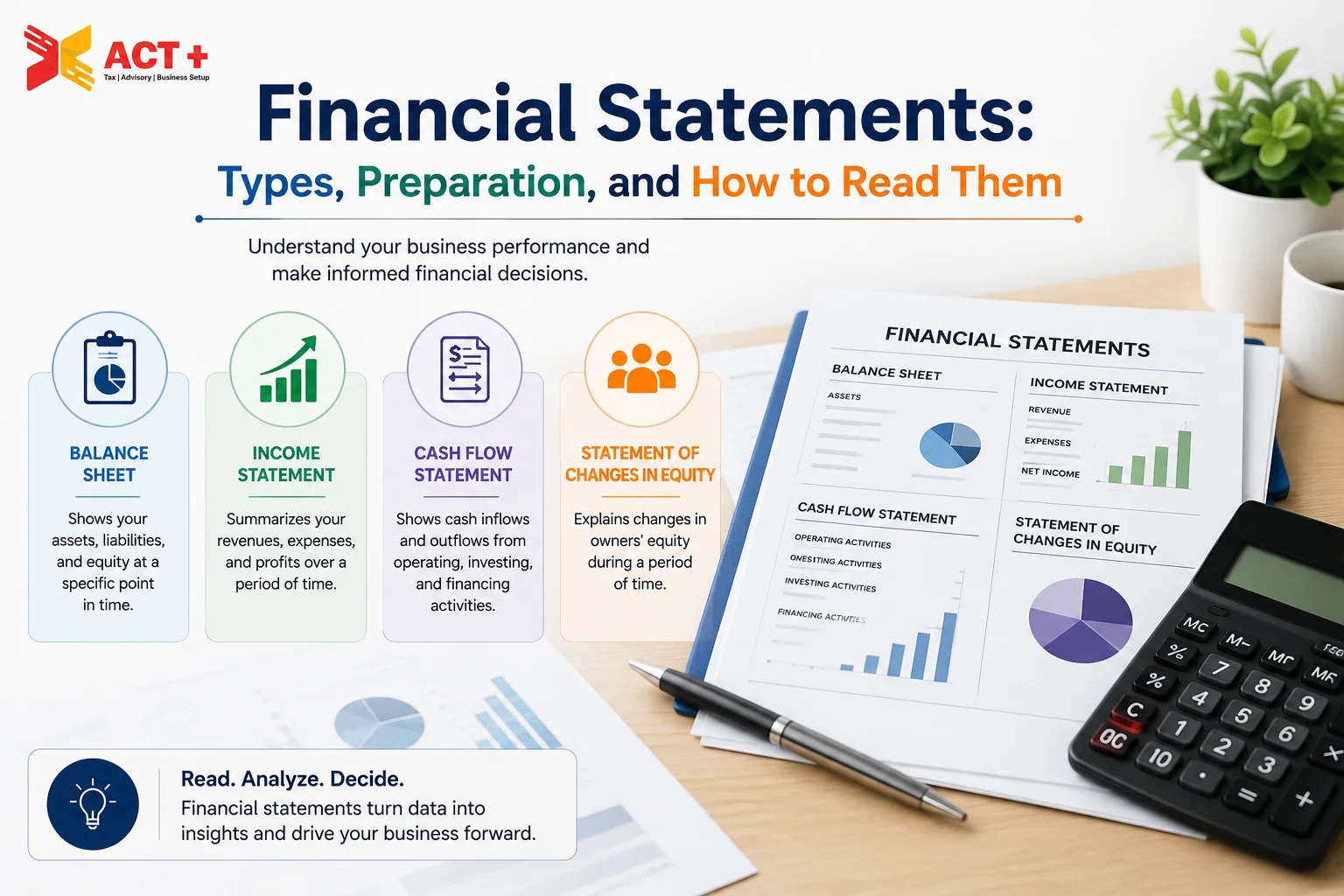
Financial statements are essential for anyone who owns, manages, invests in, or lends money to a business. These reports show how a company performs financially over a specific period. They summarise revenue, expenses, assets, liabilities, cash flow, and shareholders’ equity, helping users make informed decisions.
Every business, from a sole trader to a multinational company, relies on accurate financial reporting. Financial statements support business planning, tax reporting, funding applications, and regulatory compliance. They also provide a clear picture of a company’s financial health and long-term stability.
What Are Financial Statements?
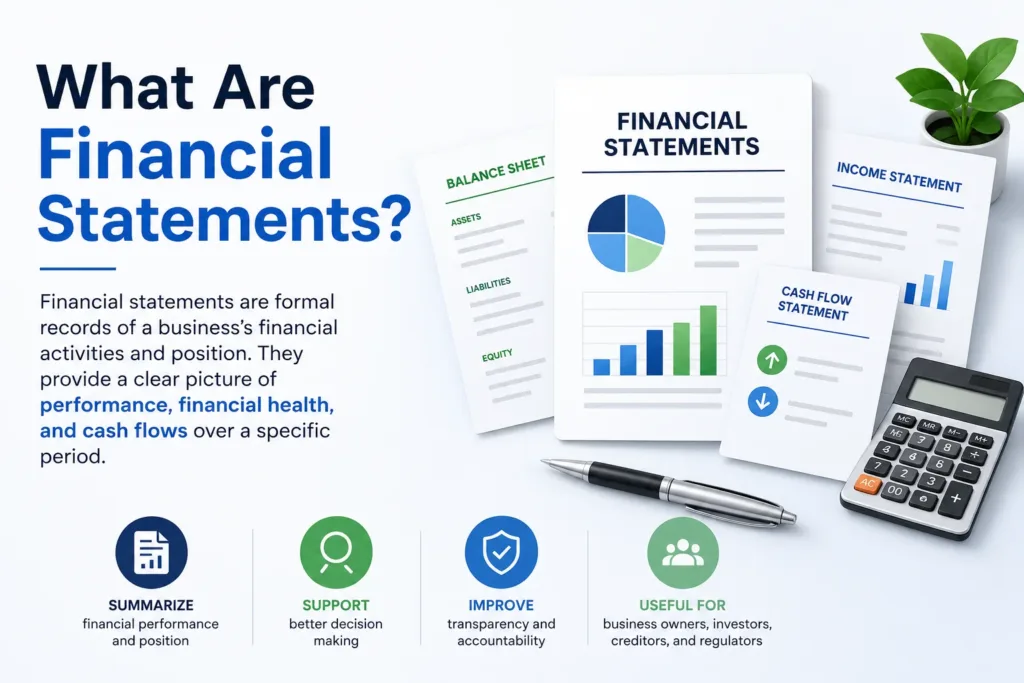
Financial statements are formal accounting reports that summarise a company’s financial position, performance, and cash movements during a specific accounting period. Businesses prepare these reports using information from their accounting records and bookkeeping systems. Financial statements provide a comprehensive overview of a business’s finances, making it easier to monitor growth, profitability, and financial risks. Most businesses prepare annual financial statements, while many also produce monthly or quarterly financial statements or reports for internal management.
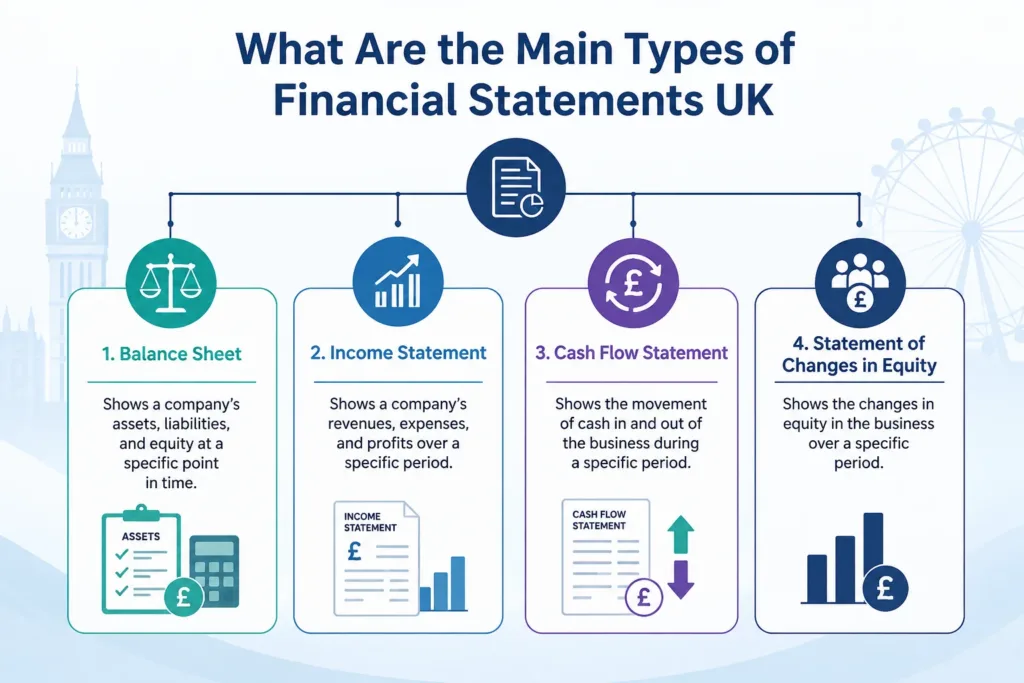
Financial statements typically include four primary reports:
- Balance Sheet
- Income Statement (Profit and Loss Statement)
- Cash Flow Statement
- Statement of Changes in Equity
Large companies also include Notes to the Accounts, which explain accounting policies, significant transactions, and important financial disclosures.
Need Help with Your Financial Statements?
Our qualified accountants can prepare, review, and file your financial statements accurately and on time.
Get Expert Help with Financial Statements →Why Are Financial Statements Important?
Financial statements help businesses measure financial performance, meet legal obligations, and make informed decisions. Without reliable financial reports, business owners may struggle to assess profitability, manage cash flow, control costs, or plan future investments.
Well-prepared financial statements allow a business to measure profits, monitor assets and liabilities, control operating expenses, and track cash movements. They also support budgeting, forecasting, and long-term financial planning.
Financial statements are also important for meeting tax reporting requirements and complying with accounting standards such as IFRS or GAAP. Accurate records can strengthen applications for business loans and help attract potential investors.
Reliable financial reporting builds confidence among investors, lenders, regulators, suppliers, and other stakeholders. It shows that the business maintains accurate records and manages its financial responsibilities properly.
Who Uses Financial Statements?
Financial statements are used by business owners, managers, investors, lenders, shareholders, auditors, suppliers, regulators, and tax authorities. They help users assess profitability, cash flow, financial stability, business performance, creditworthiness, compliance, and the company’s ability to meet future obligations and risks.
Common users include:
Each user focuses on different financial information depending on their objectives.
How Do Financial Statements Work?
Financial statements work by organising accounting data into structured reports. These reports summarise a company’s assets, liabilities, income, expenses, equity, and cash flow. Businesses prepare them regularly to measure performance, support decision-making, meet legal requirements, and clearly communicate financial health. Every financial transaction begins in the bookkeeping system. Transactions are then classified into accounts such as revenue, expenses, assets, or liabilities.
Reporting period, accountants reconcile the accounting records and prepare financial reports that comply with applicable accounting standards. Because each statement serves a different purpose, they work together to present a complete financial picture.
What Are the Main Types of Financial Statements?
Financial statements provide a clear, structured view of how a business is performing and what it owns, owes, earns, and spends. Each report focuses on a specific area, helping owners, investors, lenders, and managers make informed financial decisions with confidence.
These reports form the foundation of modern financial reporting.
1. Balance Sheet
A balance sheet shows what a business owns, what it owes, and the value belonging to its owners on a specific date. It is also called the Statement of Financial Position under IFRS.
The balance sheet contains three main sections:
- Assets
- Liabilities
- Shareholders’ Equity
The basic accounting equation remains:
Assets = Liabilities + Shareholders’ Equity
Examples of assets include:
- Cash
- Inventory
- Equipment
- Property
- Trade receivables
Examples of liabilities include:
- Bank loans
- Trade creditors
- Tax liabilities
- VAT payable
The four main financial statements provide a complete view of a company’s financial health. They help business owners, investors, lenders, and managers understand financial position, profitability, cash activity, and changes in equity before making important decisions.
2. Income Statement
An income statement shows whether a business made a profit or a loss during an accounting period. Many businesses refer to it as the Profit and Loss Statement (P&L).
The report summarises:
- Revenue
- Cost of sales
- Gross profit
- Operating expenses
- Operating income
- Finance costs
- Tax
- Net income
The calculation follows a logical sequence. Revenue minus direct costs equals gross profit. Gross profit minus operating expenses equals operating income. After deducting interest and tax, the business arrives at net income. The income statement allows management to identify profitable activities and areas requiring cost control.
3. Cash Flow Statement
A cash flow statement shows how cash enters and leaves a business during a reporting period. Profit does not always equal available cash. A profitable company can still experience cash shortages if customers pay late or significant investments occur. The statement contains three sections.
Operating Cash Flow
Operating activities include cash received from customers and cash paid for wages, suppliers, rent, utilities, and other day-to-day expenses.
Investing Cash Flow
Investing activities include purchasing equipment, selling property, or acquiring long-term investments.
Financing Cash Flow
Financing activities include bank loans, shareholder investments, dividend payments, and loan repayments. Strong cash management helps businesses remain financially stable, even during periods of slower sales.
4. Statement of Changes in Equity
The statement of changes in equity explains why shareholders’ equity increased or decreased during the accounting period.
It records movements such as the following:
- Net profit
- Net loss
- Dividend payments
- New share issues
- Share buybacks
- Retained profit
- Other comprehensive income
Investors often review this statement alongside the balance sheet to understand how management has used company profits.
How Do You Prepare Financial Statements?
Preparing financial statements involves collecting accurate accounting records, reconciling transactions, and producing reports that comply with applicable accounting standards. Accounting software automates much of the process, and accountants still perform reviews to ensure accuracy.
Most businesses follow these seven steps:
- Maintain accurate bookkeeping throughout the year.
- Record every financial transaction.
- Reconcile bank accounts and control accounts.
- Make adjusting entries for depreciation, accruals, and prepayments.
- Prepare the trial balance.
- Produce the financial statements.
- Review the reports for compliance with IFRS or GAAP.
Many businesses also prepare supporting notes to the accounts. These notes explain accounting policies, contingent liabilities, related-party transactions, and other significant financial information.
Professional accountants also check that figures agree across every statement. For example, net income from the income statement affects retained earnings within the statement of changes in equity and ultimately appears in shareholders’ equity on the balance sheet. A consistent preparation process improves accuracy, supports tax reporting, and provides reliable information for management decisions.

How Do You Read Financial Statements?
Read financial statements together rather than individually. Each report explains a different part of a company’s financial position. They provide a complete picture of business performance, profitability, liquidity, and long-term stability.
Use this order when reviewing company financial statements:
- Read the income statement to understand profitability.
- Review the balance sheet to assess financial position.
- Analyse the Cash Flow Statement to evaluate cash generation.
- Examine the Statement of Changes in Equity to understand movements in owners’ equity.
- Read the Notes to the Accounts for additional explanations.
Following this sequence helps you understand how profit affects cash flow and how both influence the company’s financial position.
Need Help with Your Financial Statements?
Our qualified accountants can prepare, review, and file your financial statements accurately and on time.
Get Expert Help with Financial Statements →What Is the Role of an Accountant in Financial Statements?
An accountant prepares, reviews, and interprets financial statements to ensure they are accurate, compliant, and useful for decision-making. Their role goes far beyond recording transactions, as they help businesses understand financial performance and meet statutory reporting requirements. Accountants maintain accurate bookkeeping records and reconcile financial data to identify errors or missing transactions. They prepare annual accounts and management accounts, giving business owners a clear view of profitability, cash flow, assets, liabilities, and overall financial health.
They also calculate tax liabilities and apply the correct financial reporting standards, such as IFRS or UK GAAP. This helps ensure that financial statements meet legal, professional, and regulatory requirements. Accountants use financial analysis to advise management, support audits, and improve regulatory compliance. Accurate financial reporting allows business owners to identify opportunities, control costs, make informed decisions, and reduce financial risk.
What Type of Accountant Prepares Financial Statements?
Financial statements may be prepared by different accounting professionals, depending on a business’s size, needs, and legal requirements. Each professional has a specific role, from recording daily transactions to reviewing reports and checking that financial information is accurate and reliable.
Common examples include:
| Accountant | Primary Responsibility |
|---|---|
| Bookkeeper | Records daily transactions |
| Management Accountant | Produces internal financial reports |
| Financial Accountant | Prepares statutory financial statements |
| Chartered Accountant | Reviews, prepares, and advises on financial reporting |
| Auditor | Independently verifies financial statements |
Small businesses often rely on one accountant, while larger organisations employ specialist accounting teams.
What Is the Format of Financial Statements?
Financial statements follow a structured format that complies with recognised accounting standards. Although layouts vary slightly between industries and jurisdictions, the information remains consistent.
A complete set of annual financial statements usually includes the following:
- Balance Sheet
- Income Statement
- Cash Flow Statement
- Statement of Changes in Equity
- Notes to the Accounts
Public companies prepare their reports using International Financial Reporting Standards (IFRS). Some private businesses prepare reports under UK GAAP, depending on eligibility. A consistent format allows investors, lenders, auditors, and regulators to compare businesses more easily.
What Are the Examples of Financial Statements?
Financial statements give a clear view of how a business is performing. Each report explains a different part of the company’s finances, such as assets, profit, cash movement, and owner equity. Together, they help readers understand the full financial position.
| Statement | Example Information Included |
|---|---|
| Balance Sheet | Cash, inventory, equipment, loans, shareholders' equity |
| Income Statement | Revenue, cost of sales, gross profit, expenses, net income |
| Cash Flow Statement | Operating, investing, and financing cash flow |
| Statement of Changes in Equity | Share capital, retained profit, dividends |
What Is a Statement of Financial Position?
A statement of financial position shows a company’s assets, liabilities, and equity at a specific date. The term is commonly used under IFRS. It provides an overview of what the business owns, what it owes, and the remaining value available to shareholders. Investors often review this report before assessing profitability because financial strength supports long-term growth.
Is a Statement of Financial Position the Same as a Balance Sheet?
Yes, a statement of financial position and a balance sheet refer to the same financial report. Both show a company’s assets, liabilities, and equity at a specific date. The difference is mainly in the terminology used.
- IFRS generally uses the term Statement of Financial Position.
- Many businesses and older accounting systems still use balance sheets.
Both reports contain identical information.
What Is an Income Statement?
An income statement shows that a business made a profit or loss during a specific reporting period. It explains how the company’s revenue changes after deducting the cost of sales, operating expenses, finance costs, and corporation tax.
A typical income statement includes revenue, cost of sales, gross profit, operating expenses, operating income, finance costs, corporation tax, and net income. Business owners can compare income statements from different periods to identify sales trends, control expenses, and improve profitability.
How Can You Analyse Financial Statements?
Financial statement analysis measures financial health using comparisons, trends, and financial ratios. Reading figures alone rarely provides enough insight. Analysis explains whether the business performs well compared with previous years, competitors, or industry averages.
The most common analysis methods include:
Compare Financial Performance Over Time
Comparing financial reports from several years helps business owners understand how the company is changing over time. They can review revenue growth, expense trends, profit margins, cash flow improvements, and changes in business debt.
This type of trend analysis highlights financial strengths and reveals potential problems early. It allows management to take timely action before small issues become serious financial challenges.
Calculate Financial Ratios
Financial ratios turn accounting data into useful performance indicators. They help business owners, investors, and lenders understand the financial position of a company more clearly. Liquidity ratios measure whether a business can pay its short-term debts. Profitability ratios show how efficiently the company generates profit, while debt ratios measure how much the business relies on borrowing.
The gross profit margin shows profitability before operating expenses are deducted. The net profit margin measures overall profitability after all expenses. The current ratio assesses short-term financial stability by comparing current assets with current liabilities. Lenders often review these ratios when assessing loan applications because they provide a clearer picture of financial performance, debt levels, and repayment ability.
Review Cash Flow
Strong cash flow often matters more than reported profit. A business may report healthy profits but struggle to pay suppliers because customers have not settled invoices.
Review:
- Operating cash flow
- Investing cash flow
- Financing cash flow
Consistent positive operating cash flow usually indicates a financially stable business.
Assess Business Assets and Liabilities
A careful review of the balance sheet helps business owners understand whether the company is becoming stronger or taking on unnecessary financial risk. By comparing key figures over time, management can identify warning signs, improve decisions, and maintain financial stability.
Review whether:
- Assets continue to grow.
- Liabilities remain manageable.
- Debt increases faster than revenue.
- Inventory levels remain appropriate.
- Receivables are collected promptly.
These indicators reveal how effectively management controls business finances.
Compare Against Industry Benchmarks
When a business compares its results with similar companies in the same industry. These comparisons provide a clearer picture of whether performance is strong, average, or below expectations.
For example:
- Retail businesses often operate with lower profit margins than software companies.
- Manufacturing companies usually own more fixed assets than consulting firms.
Industry comparisons provide context that individual financial reports cannot.
How Do You Read a Balance Sheet?
A balance sheet should be read by reviewing assets, liabilities, and shareholders’ equity together. Start with current assets, such as cash, inventory, and receivables, because they show whether the business can meet its short-term financial obligations.
Next, review long-term assets, including property, machinery, equipment, and investments. These assets show what the business owns and uses to support its long-term operations and growth.
After reviewing assets, examine the company’s liabilities. Pay attention to bank borrowing, trade creditors, tax liabilities, and lease obligations. High or rapidly increasing liabilities may indicate financial pressure.
What Is Retained Profit?
Retained profit represents accumulated earnings that remain in the business after paying dividends. Instead of distributing every pound earned to shareholders, businesses often retain part of their profits to:
- Expand operations
- Purchase equipment
- Repay loans
- Invest in new products
- Build cash reserves
Retained profit appears within shareholders’ equity on the balance sheet. A growing retained profit balance often indicates sustainable long-term business growth.
What Are Statutory Financial Statements?
Statutory financial statements are the annual financial reports that businesses prepare to meet legal reporting requirements. In the UK, limited companies must prepare statutory accounts under the Companies Act 2006. These accounts are usually filed with Companies House and submitted to HM Revenue & Customs (HMRC) as part of the company’s tax obligations.
A complete set of statutory financial statements generally includes:
- Balance Sheet (Statement of Financial Position)
- Income Statement (where required)
- Statement of Changes in Equity
- Cash Flow Statement (for qualifying companies)
- Notes to the Accounts
The exact reporting requirements depend on the company’s size. Micro-entities, small companies, and large companies follow different disclosure rules. Preparing accurate statutory financial statements helps businesses remain compliant and avoid penalties.
What Are Consolidated Financial Statements?
Consolidated financial statements combine the financial results of a parent company and its subsidiaries into a single set of reports. Instead of presenting each company separately, consolidated accounts show the financial position and performance of the entire group as one economic entity. These reports eliminate transactions between group companies to avoid double counting. Large corporate groups prepare consolidated financial statements to provide investors, lenders, and regulators with a clear view of the group’s overall financial health.
Do Financial Statements Need an Audit?
Not all financial statements require an audit. The audit requirement depends on the company’s size, legal structure, and applicable regulations. Many small private companies in the UK qualify for an audit exemption if they meet specific turnover, balance sheet, and employee thresholds.
Larger businesses and public companies often require an independent audit. An audit does not prepare the financial statements. Instead, an external auditor examines the accounting records and financial reports to determine whether they present a true and fair view of the company’s financial position. An audited set of financial statements provides greater confidence to shareholders, lenders, and investors.
What Financial Information Is Sent to Shareholders?
Shareholders need clear and reliable information to understand how a company is performing. These reports explain where the business stands financially, how management is using company resources, and whether the business is creating value, managing risks, and supporting future growth.
The information usually includes:
- Annual financial statements
- Directors’ Report
- Auditor’s Report (where applicable)
- Statement of Changes in Equity
- Notes to the Accounts
- Dividend information
Public companies often include additional commentary on business strategy, risks, and future outlook.This information allows shareholders to assess profitability, financial stability, and management performance before making investment decisions.
Are Financial Statements the Same Worldwide?
The purpose of financial statements remains consistent worldwide, but accounting standards and reporting requirements vary between countries.
Most countries follow one of two major accounting frameworks:
- International Financial Reporting Standards (IFRS)
- Generally Accepted Accounting Principles (GAAP)
IFRS is used in many countries, including the UK, the European Union, Australia, and Canada, for many reporting entities.GAAP is primarily used in the United States.
Although presentation rules differ slightly, both frameworks require businesses to report:
- Assets
- Liabilities
- Equity
- Revenue
- Expenses
- Cash flow
These common principles improve transparency and allow investors to compare businesses across international markets.
What Are the Limitations of Financial Statements?
Financial statements provide valuable information, but they do not capture every aspect of a business’s performance. Understanding these limitations helps users interpret financial reports more accurately.
Common limitations include:
Historical Information: Financial statements report past performance. They do not predict future results.
Estimates and Judgements: Some figures rely on professional estimates, such as depreciation, provisions, and impairment assessments.
Non-Financial Factors: Financial statements do not measure customer satisfaction, employee engagement, brand reputation, or market competition.
Timing Differences: Revenue and expenses may be recognised before or after cash changes hands, depending on accounting standards.
Inflation: Assets purchased years ago often appear at historical cost rather than current market value.
Because of these limitations, users should combine financial statement analysis with industry knowledge, market conditions, and management commentary.
What Are Common Mistakes in Financial Statements?
Accurate financial statements depend on complete accounting records, careful reviews, and consistent application of accounting standards. Even small errors can affect business decisions and regulatory compliance.
Common mistakes include:
- Recording revenue in the wrong accounting period.
- Omitting business expenses.
- Misclassifying assets and liabilities.
- Failing to reconcile bank accounts.
- Ignoring depreciation adjustments.
- Overlooking accruals and prepayments.
- Incorrectly calculating retained profit.
- Using outdated accounting standards.
- Missing supporting disclosures in the Notes to the Accounts.
- Failing to review financial reports before filing.
Businesses can reduce these risks by maintaining accurate bookkeeping throughout the year and having a qualified accountant review the financial statements before submission.
Need Help with Your Financial Statements?
Our qualified accountants can prepare, review, and file your financial statements accurately and on time.
Get Expert Help with Financial Statements →Frequently Asked Questions
Who is required to prepare financial statements in the UK?
Why are financial statements important for a business?
How often should financial statements be prepared?
What accounting standards are used for UK financial statements?
Can financial statements help attract investors?

About the Author: Ahmad Raza