
Financial management is the business function that deals with managing profits, controlling expenses, and handling cash and credit effectively. The objectives of financial management include profit maximisation, wealth maximisation, liquidity management, financial requirements planning, proper mobilisation of funds, and resource utilisation.
Some examples of financial management involve budgeting and financial planning, capital investment decisions, working capital management, debt and equity financing, and cash flow management. These examples explain how financial management operates across real-world business scenarios. Financial management makes sure organisations plan wisely, invest carefully, maintain liquidity, and keep funds moving in the right direction to remain financially stable and competitive.
There are types of financial management, such as capital budgeting, capital structure, working capital management, and revenue cycle management. Financial management’s functions include planning and forecasting, financial control and performance monitoring, acquiring funds, dividend decisions, and capital structure decisions. Other functions are investment of funds, cash and liquidity management, and managing surplus funds and profits.
What is Financial Management?
Financial management is the strategic practice of planning, organising, directing, and controlling the financial activities within an organisation. It involves applying general management principles to the financial resources of a business to guarantee stability and profitability.
How does financial management work?
Financial management works through a continuous cycle of planning, executing, monitoring, and adjusting financial decisions. It includes raising capital (debt or equity), investing wisely in profitable opportunities, managing cash flow for daily operations, and monitoring performance through financial reports. The main purpose is to make sure money is used effectively to maximise value while minimising financial risk.
✓ Free consultation • Trusted financial support
What are the Objectives of Financial Management?
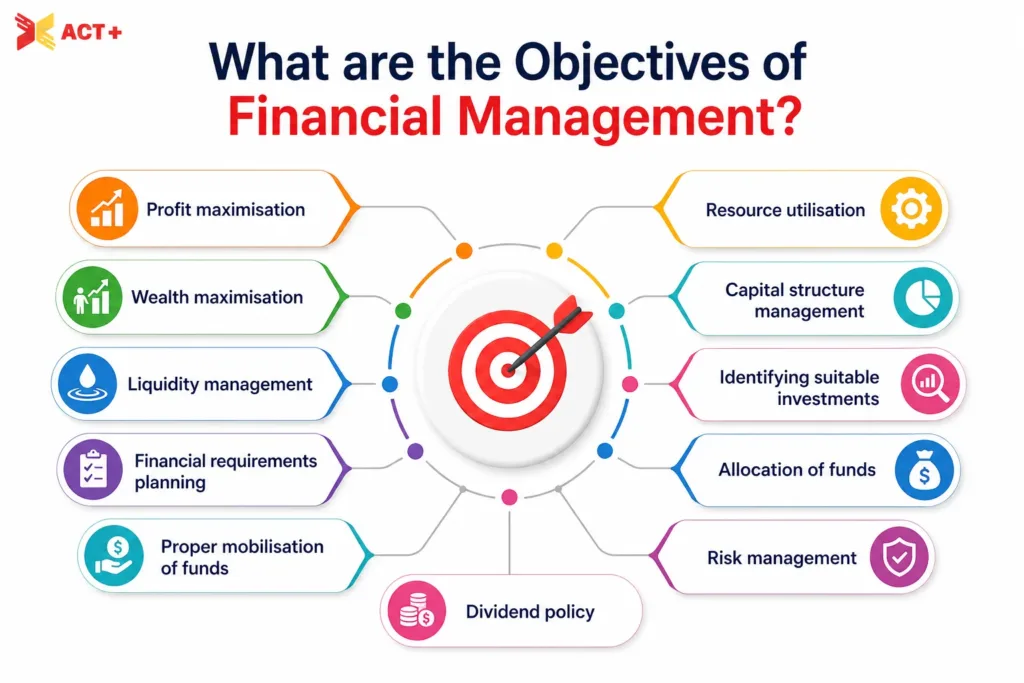
The objectives of financial management are profit maximisation, wealth maximisation, liquidity management, financial requirements planning, proper mobilisation of funds, and resource utilisation. Other objectives include capital structure management, identifying suitable investments, allocation of funds, risk management, and dividend policy.
Profit maximisation
Profit maximisation is the primary objective of financial management, as profitability allows a business to stay competitive, grow, and continue operating. It involves maximising the difference between revenues and expenses by either increasing income, reducing costs, or both.
This maximisation is achieved through strategies such as optimal pricing, effective production, investing in high-return projects, and improving operational performance. It is important to find the right balance between cutting costs too much and raising prices too much. Too much cost-cutting affects product quality, and too much pricing lowers demand, which impacts profits in the long run.
Wealth maximisation
Wealth maximisation focuses solely on short-term gains and disregards the time value of money. Wealth maximisation aims to increase the long-term market value of the business and its shareholders’ equity. It relies on cash flows rather than accounting profits and recognises that a pound received today is worth more than a pound received in the future. It also considers how dividend policy influences the market price of shares. Consistent and attractive dividends not only keep shareholders satisfied but also improve the company’s reputation and overall market standing.
Liquidity management
Liquidity management is an objective of financial management that ensures an organisation has enough cash and liquid assets to meet its short-term obligations and daily operational needs. It involves carefully monitoring and balancing cash inflows and outflows to maintain financial stability without holding excessive idle funds.
Financial managers use tools such as cash flow forecasting and liquidity ratios to assess and maintain an appropriate level of liquidity at all times. Insufficient liquidity exposes a business to financial limitations and liquidity risk. An overflow of cash, alternatively, leads to missed investment opportunities, so it is important to maintain the right balance between liquidity and profitability.
Financial requirements planning
Financial requirements planning involves accurately estimating the funding needs of a business across all areas. These areas include startup or expansion costs, working capital, operational expenses, capital expenditures, and contingency funds. Financial managers carefully assess these requirements by considering factors such as the scale of production, size of operations, number of employees, and technology needed.
The goal is to make sure that funds are available when needed so as to prevent both shortages that disrupt operations and excess funds that remain unproductive. Effective financial planning helps businesses prevent difficulties, maintain smooth operations, and establish a foundation for growth and strategic choices.
Proper mobilisation of funds
Proper mobilisation of funds is the process of raising financial resources to meet business needs. It involves identifying suitable sources such as equity, debt, or retained earnings and selecting the most cost-effective option after careful evaluation. Financial managers make sure that sufficient funds are available for operations, expansion, and unexpected situations. They also have to maintain a balance between risk and return. For instance, growing firms may rely more on equity, but established businesses prefer debt due to its lower cost. Effective mobilisation keeps the organisation running smoothly and confirms its long-term growth and financial stability.
Resource utilisation
Resource utilisation is the effective use of financial resources to achieve maximum productivity and profitability. Financial managers, after mobilising funds, focus on allocating them strategically across multiple assets such as shares and bonds. They also allocate them to other investment opportunities that meet the firm’s objectives and market conditions.
Financial managers use analytical tools like financial ratios, return on investment, cash flow forecasting, and cost-benefit analysis to monitor performance and reduce waste. Proper utilisation guarantees that resources are not underused or misallocated. This careful approach leads to reduced costs, increased accuracy, and improved long-term value for the business.
Capital structure management
Capital structure management means determining the ideal mix of equity and debt to finance a company’s operations and growth. Financial managers try to maintain a balance that minimises the overall cost of capital and keeps financial risk at a manageable level. This balance involves evaluating different financing options, including equity shares and debt instruments such as bonds or loans. Debt can provide a relatively lower-cost source of long-term funding, but too much reliance on it may increase the burden of interest obligations. A well-planned capital structure provides financial stability, improves the firm’s ability to handle economic fluctuations, and supports long-term growth.
Identifying suitable investments
Financial managers analyse market trends, evaluate opportunities, and select investments that offer optimal returns. These opportunities must comply with the organisation’s goals and risk threshold. Tax implications are also carefully considered, often in collaboration with tax planners, to maximise post-tax profits. Choosing to diversify across assets such as stocks, bonds, real estate, and commodities helps mitigate risk and confirms funds are working productively toward long-term business success.
Allocation of funds
Allocation of funds means making sure every department, project, and operation within an organisation is properly and sufficiently financed. Financial managers carefully analyse financial statements, historical data, and current market trends to determine where resources are most needed and will generate the greatest benefit.
A well-structured budget is then prepared to outline the optimal distribution of funds across the business. For instance, when launching a new product, more funds are directed toward marketing and production to maximise its chances of success. Effective allocation of funds ultimately provides operational productivity, supports strategic priorities, and supports the organisation’s capacity for growth and long-term success.
Risk management
Financial managers find and reduce threats to every business that affect its stability and profits. Some of these risks include market risk, operational risk, credit risk, legal risk, and liquidity risk. Strategies such as diversification, hedging, and contingency planning are employed to reduce the impact of these threats. Active risk management protects the business against unexpected challenges, helps with smooth operations, and builds long-term financial resilience.
Dividend policy
Dividend policy involves making strategic decisions about how a company’s profits are distributed among its shareholders, such as through dividends or share buybacks. Financial managers find a balance between rewarding shareholders with attractive returns and retaining sufficient earnings to fund future growth and operations. A well-defined dividend policy not only keeps shareholders satisfied but also improves investor confidence and the company’s overall market reputation.
What are the Examples of Financial Management?
Examples of financial management include budgeting and financial planning, capital investment decisions, working capital management, debt and equity financing, and cash flow management.
Budgeting and financial planning
A retail company prepares an annual budget forecasting revenues, expenses, and profits. This planning helps management allocate resources effectively, control costs, and confirm the business stays on track toward its financial goals.
Capital investment decisions
A manufacturing firm evaluates whether to purchase new machinery worth £500,000. Financial managers conduct a cost-benefit analysis and calculate the return on investment before approving the expenditure. They also have to make sure it adds long-term value.
Working capital management
A supermarket chain carefully manages its inventory levels during peak seasons. It makes sure enough stock is available without holding too much cash in reserve. This balance between inventory, receivables, and payables keeps daily operations running smoothly.
Debt and equity financing
A startup decides to raise capital by issuing shares to investors rather than taking a bank loan. The startup avoids high-interest payments and brings in experienced shareholders who add strategic value to the business.
Cash flow management
A small business closely monitors its monthly cash inflows and outflows. The business makes sure it always has sufficient liquidity to pay suppliers, employees, and overhead costs on time without relying on expensive short-term borrowing.
✓ Free consultation • Trusted financial support
What are the Types of Financial Management?
The types of financial management are capital budgeting, capital structure, working capital management, and revenue cycle management.
| Type | Focus | Goal |
|---|---|---|
| Capital Budgeting | Evaluating and selecting long-term investment opportunities | Make sure funds are committed to investments that generate maximum long-term value |
| Capital Structure | Determining the right mix of debt and equity financing | Minimise the cost of capital while maximising firm value |
| Working Capital Management | Managing short-term assets and liabilities | Maintain sufficient liquidity for smooth daily operations |
| Revenue Cycle Management | Monitoring the process of generating, tracking, and collecting revenue | Make sure predictive and consistent cash inflows |
Capital budgeting
Capital budgeting involves evaluating and selecting long-term investment opportunities that are worth pursuing with the organisation’s available funds. It helps financial managers decide whether to invest in projects, purchase assets, or expand operations by assessing their potential returns and risks. Common techniques used include net present value, internal rate of return, and payback period analysis. Effective capital budgeting confirms that funds are committed only to investments that generate meaningful long-term value for the business.
Capital structure
Capital structure is the mix of debt and equity financing a business uses to fund its operations and growth. Financial managers must carefully determine the right balance between borrowing and issuing shares to minimise the overall cost of capital while maximising firm value. Too much debt increases financial risk and interest obligations, and too much equity reduces shareholder value. A well-managed capital structure provides the financial foundation needed for long-term business operations and strategic expansion.
Working capital management
This type focuses on managing a company’s short-term assets and liabilities to maintain smooth daily operations. It involves managing cash, inventory, accounts receivable, and accounts payable to maintain sufficient liquidity without holding excessive idle funds. Poor working capital management leads to cash shortages, missed payments, and operational disruptions. Effective management in this area makes sure the business meets its short-term obligations while remaining financially stable.
Revenue cycle management
This type focuses on the entire process of generating, tracking, and collecting revenue from the point of sale to final payment. It makes sure that income is accurately recorded, invoices are quickly issued, and outstanding payments are correctly collected to maintain healthy cash flow. Financial managers monitor the revenue cycle closely to identify issues, reduce payment delays, and minimise revenue leakage. A well-managed revenue cycle improves the organisation’s financial position and supports consistent and predictable cash inflows.
What are the Financial Management Functions?
The financial management functions are planning and forecasting, financial control and performance monitoring, acquiring funds, dividend decisions, and capital structure decisions. Other functions include investment of funds, cash and liquidity management, and managing surplus funds and profits.
The financial management functions are discussed below.
- Planning and forecasting: This function involves estimating the capital requirements of the business and predicting future financial needs. It makes sure the organisation always has enough funds available without incurring excessive debt or financial risk.
- Financial control and performance monitoring: This function makes sure that the company is conforming to its budgets and meeting its financial targets. It involves using KPIs (Key Performance Indicators) and financial ratios to assess the organisation’s financial position.
- Acquiring funds: Acquiring funds is the process of sourcing capital. This function involves issuing shares (equity), taking out loans (debt), or looking for venture capital, depending on the company’s needs.
- Dividend decisions: This function determines how much of the profit should be given to shareholders and how much should be kept for future growth.
- Capital structure decisions: This function is the strategic mix of debt and equity used to finance the business. The goal is to minimise the cost of capital while maximising shareholder value.
- Investment of funds: Investment of funds is often known as capital budgeting. This function involves deciding which projects or assets to invest in to confirm the best possible ROI (Return on Investment).
- Cash and liquidity management: This function is the daily management of working capital. It makes sure the company has enough liquid cash to pay its bills, employees, and suppliers on time.
- Managing profits and surplus funds: This function makes decisions about what to do with extra money, such as debt repayment, acquisitions, and short-term investments.
What is the financial management cycle?
The financial management cycle is a continuous process used by organisations to manage their capital effectively. It is a recurring cycle that makes sure financial resources are planned, utilised, and monitored to meet long-term objectives.
What are the roles and responsibilities of financial management?
The roles and responsibilities of financial management are financial planning and forecasting, raising and allocating capital, cash flow management, cost control and budgeting, and risk management. There are also other responsibilities, such as financial reporting and analysis, tax planning and compliance, dividend decision-making, and investment management.
Why is financial management important?
Financial management is important because it makes sure an organisation uses its funds properly to achieve its goals and maintain stability. It supports informed decision-making, controls costs, manages risks, and maximises profitability. Businesses risk cash shortages, poor investment decisions, and long-term financial failure without effective financial management.
What is the scope of studying financial management?
The scope of studying financial management includes areas such as financial planning, capital budgeting, working capital management, capital structure, investment decisions, risk management, and dividend policy. It provides individuals with the knowledge and skills to make informed financial decisions, manage organisational resources effectively, and advance business growth across different industries and sectors.
What are the skills of financial management?
The skills of financial management are analytical competence for interpreting data and strategic planning for long-term growth. Professionals must master financial modelling, risk assessment, and budgeting for dealing with market fluctuations and optimising an organisation’s capital structure.
What is the difference between financial management and accounting?
Financial management focuses on accounting data to make strategic decisions regarding investment, financing, and dividend distribution. Accounting focuses on recording, classifying, and reporting past financial transactions to ensure accuracy and compliance. Financial management’s main goal is to maximise an organisation’s overall value and long-term stability.
What is the Difference Between Financial and Managerial Accounting?
Financial accounting reports an organisation’s past financial performance to external stakeholders such as investors and regulators, following standardised formats like GAAP or IFRS. Managerial accounting provides internal management with flexible, predictive financial and non-financial information to support daily decision-making and strategic planning.
Why study financial management?
Studying financial management gives you the analytical skills necessary to maximise organisational value and optimise resource allocation. It develops expertise in strategic decision-making, risk assessment, and capital structures. These skills are important for dealing with complicated economic situations, like running a small business that is growing or managing integrated modules in large-scale ERP systems.
✓ Free consultation • Trusted financial support

About the Author: Ahmad Raza