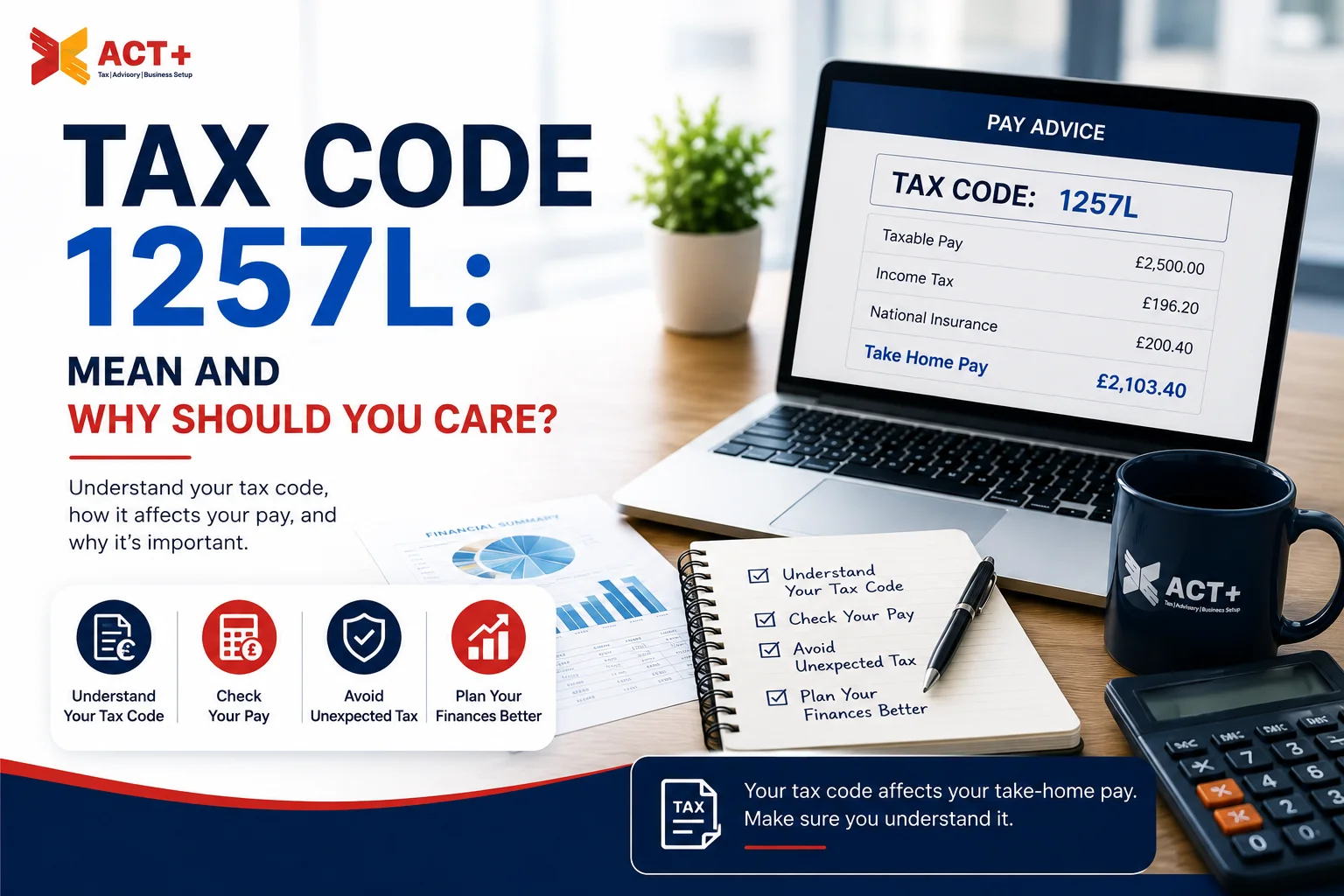
1257L tax code is the most common PAYE tax code used in the UK. It tells employers how much tax-free income an employee can receive before income tax applies. Most people with one job or one pension receive this code unless HMRC adjusts it for another reason.
Understanding your tax code is one of the easiest ways to check whether you are paying the right amount of income tax. If your tax code is incorrect, you could pay too much tax or too little tax. Both situations can create unnecessary problems later.
What does the tax code 1257L mean?
The tax code 1257L means you usually receive the standard Personal Allowance of £12,570 before paying income tax. It is the standard PAYE tax code 1257L used by HMRC for most employees and pensioners who have one source of income.
If you have searched for 257L meaning UK, tax code 1257L meaning, 1257L tax code meaning, what tax code is 1257L, or what does 1257L mean on payslip, they all refer to the same HMRC tax code. The code tells your employer how much tax-free income to apply through PAYE before deducting income tax.
Breakdown of “1257” and “L”
- 1257 – represents the standard Personal Allowance of £12,570. HMRC removes the final zero when creating a tax code.
- L – shows you qualify for the standard Personal Allowance without major adjustments.
For example:
- Personal Allowance: £12,570
- HMRC removes the last digit.
- The remaining figure becomes 1257.
- HMRC adds the letter L.
- Your tax code, 1257L, is created.
You may also see variations such as
- tax code C1257L
- S1257L
- 1257L cumulative
- 1257L M1
- 1257L W1
- 1257L W1M1Tax Code 1257L
- 1257L cumulative tax code
Although they contain the same base number, each version applies different PAYE rules depending on where you live or how HMRC calculates your tax. Many people also search for 1257L 0 tax code. This is not the standard HMRC code. A code showing “0T” or another adjustment usually means your Personal Allowance is not being applied in the normal way.
1257L tax code is the most common PAYE tax code used in the UK. It tells employers how much tax-free income an employee can receive before income tax applies. Most people with one job or one pension receive this code unless HMRC adjusts it for another reason.
Understanding your tax code is one of the easiest ways to check whether you are paying the right amount of income tax. If your tax code is incorrect, you could pay too much tax or too little tax. Both situations can create unnecessary problems later.
What does the tax code 1257L mean?
The tax code 1257L means you usually receive the standard Personal Allowance of £12,570 before paying income tax. It is the standard PAYE tax code 1257L used by HMRC for most employees and pensioners who have one source of income.
If you have searched for 257L meaning UK, tax code 1257L meaning, 1257L tax code meaning, what tax code is 1257L, or what does 1257L mean on payslip, they all refer to the same HMRC tax code. The code tells your employer how much tax-free income to apply through PAYE before deducting income tax.
Breakdown of “1257” and “L”
- 1257 – represents the standard Personal Allowance of £12,570. HMRC removes the final zero when creating a tax code.
- L – shows you qualify for the standard Personal Allowance without major adjustments.
For example:
- Personal Allowance: £12,570
- HMRC removes the last digit.
- The remaining figure becomes 1257.
- HMRC adds the letter L.
- Your tax code, 1257L, is created.
You may also see variations such as
- tax code C1257L
- S1257L
- 1257L cumulative
- 1257L M1
- 1257L W1
- 1257L W1M1Tax Code 1257L
- 1257L cumulative tax code
Although they contain the same base number, each version applies different PAYE rules depending on where you live or how HMRC calculates your tax. Many people also search for 1257L 0 tax code. This is not the standard HMRC code. A code showing “0T” or another adjustment usually means your Personal Allowance is not being applied in the normal way.
What is the UK personal allowance?
The UK Personal Allowance is the amount of income you can usually earn before paying income tax. For most taxpayers, the current allowance is £12,570 per tax year. This allowance forms the basis of the 1257L tax code. If your tax affairs are straightforward, HMRC normally applies this allowance automatically through PAYE.
The Personal Allowance generally applies to:
- Employees
- Pensioners
- People with one main employer
- Individuals with one pension provider
However, HMRC can reduce or increase your allowance if you:
- Receive taxable benefits.
- Have another source of income.
- Owe tax from previous years.
- Earn over the Personal Allowance reduction threshold.
- Claim certain tax reliefs.
Your tax code therefore reflects your individual tax position rather than simply your salary.
How much is the tax-free personal allowance?
The standard tax-free personal allowance is £12,570 per tax year for most UK taxpayers. This means you can usually earn up to £12,570 before Income Tax becomes payable. Earnings above this amount may fall into the Basic Rate, Higher Rate, or Additional Rate bands depending on your total income.
For example:
Many people search for 30k after tax when checking take-home pay. The exact amount depends on your tax code, National Insurance, pension deductions, student loan repayments, and any salary sacrifice arrangements.
Who Gets Tax Code 1257L?
Most employees and pensioners with one straightforward source of income receive the tax code 1257L. HMRC generally issues this code when a person has one employer or receives one pension and qualifies for the standard Personal Allowance.
The 1257L tax code is also common when an individual does not receive significant taxable benefits, and HMRC does not need to collect unpaid tax through PAYE. Most people in England, Wales, and Northern Ireland with simple tax circumstances and standard PAYE treatment will see 1257L on their payslip or pension statement.
Is 1257L the correct tax code?
The 1257L tax code is correct for many UK taxpayers, but it does not apply to everyone. Your correct tax code depends on your income, benefits, and individual tax circumstances.HMRC may issue a different tax code if you have more than one job, receive a company car or taxable medical benefits, receive the State Pension, or earn enough for your Personal Allowance to be reduced.
Your code may also change if you owe tax from previous years or receive rental income or other taxable income. If any of these circumstances apply, HMRC will adjust your tax code so the correct amount of income tax can be collected through PAYE.
How do I check if my tax code is correct?
Your tax code affects how much income tax is deducted from your salary or pension, so it is important to check that it is correct. A simple review of your records can help you spot mistakes early. Compare the details held by HMRC with your current income, job, benefits, and recent employment changes before taking action or contacting them directly.
You should review:
- Your payslip
- Your P60
- Your HMRC Personal Tax Account
- Any PAYE coding notices
- Your employment benefits
- Previous HMRC letters
If the information does not match your current situation, contact HMRC promptly. Correcting an incorrect tax code early can help prevent future tax underpayments or overpayments.
What are the Common UK Tax Codes?
HMRC issues different tax codes depending on a person’s income, allowances, benefits, and tax circumstances. Although 1257L is the most common code, it does not apply to everyone. Your code may change when you start a new job, receive taxable benefits, have more than one income source, or owe tax from a previous year.
Different tax codes allow HMRC to collect the correct amount of income tax through PAYE.
What does the tax code 1257L cumulative mean?
The 1257L cumulative tax code means HMRC calculates your Income Tax using your total earnings and the tax already paid since the beginning of the tax year. This is the standard calculation method used for most employees. It helps ensure that the correct amount of tax is deducted throughout the year, even when earnings or employment circumstances change.
A cumulative tax calculation:
- Reviews your total earnings since the start of the tax year
- Checks how much tax has already been deducted
- Adjusts future tax deductions where necessary
- Automatically corrects small tax overpayments or underpayments
Many people search for terms such as 1257L cumulative, 1257L cumul tax code, or simply 1257L cumul because this wording commonly appears on payslips and payroll records.
How to Check Your Tax Code?
You can check your tax code by reviewing your HMRC records, payslips, and personal tax account. Comparing these details helps you confirm whether HMRC is applying the correct Personal Allowance.
Follow these simple steps:
- Sign in to your HMRC Personal Tax Account.
- Review your current tax code.
- Compare it with your latest payslip.
- Check your P60 or P45 if you changed jobs.
- Review any company benefits or taxable expenses.
- Contact HMRC if the information looks incorrect.
You should also check your tax code whenever:
- You start a new job.
- You receive a pension.
- Your salary changes significantly.
- You receive taxable benefits.
- You have more than one employer.
- HMRC sends a new coding notice.
Regularly checking your UK tax code helps prevent unexpected tax bills.
What happens if my tax code is wrong?
An incorrect tax code can cause you to pay too much or too little income tax. HMRC will usually correct the issue once it receives updated information, although the adjustment may affect your future payslips and take-home pay.
A wrong tax code may lead to higher tax deductions, reduced net pay, underpaid tax being collected later, or a tax refund after HMRC reviews your records. HMRC may also issue a revised PAYE calculation to ensure the correct amount of tax is deducted.
Common reasons for an incorrect tax code include changing jobs, having more than one employment, receiving taxable company benefits, inaccurate information provided by an employer, or delays in HMRC updating its records.If you believe your 1257L tax code is incorrect, contact HMRC as soon as possible. Correcting the issue early can help prevent larger tax adjustments later in the tax year.
Is tax code 1257L getting a refund?
Having a 1257L tax code does not automatically mean that you are entitled to a tax refund. A refund is only due when you have paid more income tax than you actually owe. This can happen because of incorrect payroll deductions, changes in employment, or outdated information held by HMRC.
You may receive a tax refund if:
- Your employer deducted too much tax
- Your previous tax code was incorrect
- You stopped working partway through the tax year
- You overpaid income tax through PAYE
- HMRC recalculates your tax after receiving updated information
HMRC normally reviews PAYE records after the end of the tax year. If it identifies an overpayment, it may send the refund automatically or ask you to claim it through your HMRC Personal Tax Account. The 1257L tax code simply means that HMRC is applying the standard Personal Allowance to your income. It does not guarantee that you will receive a tax refund.
What is an emergency tax code?
An emergency tax code is a temporary code used by HMRC when it does not have enough information to work out your correct income tax. It is often applied when you start a new job or pension, and your latest PAYE details are unavailable. The code may result in tax being calculated separately for each pay period.
Emergency tax codes often appear when:
- You start a new job
- Your employer has not received your previous PAYE details
- You begin receiving a pension
- HMRC has not yet processed updated employment information
Common emergency tax codes include:
- 1257L W1
- 1257L M1
- 1257L W1M1
These codes calculate your tax using only the earnings from the current week or month. They do not consider your total earnings and tax paid since the beginning of the tax year. Many people search for terms such as 1257L M1, 1257L W1 tax code, and 1257L W1M1 because these codes commonly appear on payslips. These variations usually show that HMRC is using a temporary PAYE calculation. Once HMRC receives your complete employment and income information, it will normally replace the emergency code with the correct cumulative tax code.
Why has my tax code changed to 1257L?
This often happens after:
- Starting a new job.
- Updating your employment records.
- Correcting an earlier emergency tax code.
- Removing previous tax adjustments.
- Ending taxable employment benefits.
Receiving 1257L tax code usually means HMRC believes your circumstances now qualify for the standard allowance. Always read your HMRC coding notice carefully to understand why the change happened.
Why has my tax code changed from 1257L to 1157L?
HMRC may change your tax code to 1257L when its records show that you qualify for the standard Personal Allowance. This usually means that previous adjustments are no longer required or that HMRC has received updated information about your employment, income, or taxable benefits.
The change may happen after you start a new job, update your employment records, correct an earlier emergency tax code, remove previous tax adjustments, or stop receiving taxable employment benefits.
Receiving the 1257L tax code generally means HMRC believes you are entitled to the standard Personal Allowance. You should read your PAYE coding notice carefully to understand why the change was made and confirm that all the information is accurate.
Why has my tax code changed from 1257L to 1231L?
HMRC may issue the 1231L tax code when it reduces your standard Personal Allowance by a small amount. This usually means HMRC has included an adjustment for taxable benefits, previously unpaid tax, or updated PAYE information. Although 1231L is close to 1257L, it gives you a slightly lower amount of tax-free income.
This adjustment may reflect:
- Taxable employment benefits
- A small amount of unpaid tax from an earlier year
- Changes to benefits in kind
- Updated income or PAYE information
Always check your HMRC coding notice and compare it with your payslip and employment benefits. This will help you understand why your Personal Allowance has been reduced and whether the tax code is correct.
Which tax code is better, 1257L or 1263L?
Neither 1257L nor 1263L is automatically the better tax code. The correct code depends on your Personal Allowance, taxable benefits, unpaid tax, and other information held by HMRC. A higher tax code may reduce the Income Tax deducted from your pay, but it must accurately reflect your circumstances.
If HMRC has correctly issued the 1263L tax code, you may pay slightly less income tax because a larger part of your income is tax-free. A higher tax code does not always mean it is correct. The best tax code is the one that accurately reflects your income, allowances, benefits, and overall tax position.
What does tax code 1242L mean?
Tax code 1242L means HMRC has slightly reduced your Personal Allowance below the standard amount. This may happen when HMRC needs to collect tax on employment benefits, previous underpayments, or other taxable income through PAYE. As a result, a little more income tax may be deducted from your salary or pension.
HMRC may issue a 1242L because of:
- Taxable benefits.
- Unpaid tax from previous years.
- Adjustments to your PAYE record.
- Other taxable income.
The letter L still indicates that you qualify for the standard type of personal allowance. The reduced number reflects an adjustment made by HMRC. If you receive 1242L unexpectedly, review your coding notice and contact HMRC if anything appears incorrect.
Frequently Asked Questions
Is 1257L a good tax code for most employees?
Does 1257L mean I will get a tax refund?
Can 1257L change during the tax year?
Does 1257L apply if I have more than one job?
Can I have 1257L if I receive a pension?

About the Author: Ahmad Raza