
When someone dies and leaves behind property, savings, investments, or other valuable assets, the estate may need to be reported to HMRC before probate can be granted. In many cases, this involves completing the IHT400 form, which is the main inheritance tax form used for larger or more complex estates.
The inheritance tax form IHT400 helps HMRC calculate whether any Inheritance Tax (IHT) is due and provides detailed information about the deceased person’s estate. Executors, administrators, and personal representatives often rely on the IHT400 guide and IHT400 notes to understand what information must be included.
This guide explains what the IHT400 form is, when it is required, how to complete it, supporting schedules such as the IHT406 form and IHT423 form, how the IHT400 calculation works, and what happens after submission.
What is IHT400?
The IHT400 form is the main inheritance tax account used to report the value of a deceased person’s estate to HMRC.
Form IHT400 provides detailed information about the following:
- Property and land
- Bank accounts
- Investments and shares
- Business assets
- Gifts made before death
- Debts and liabilities
- Trust interests
- Foreign assets
HMRC uses the information provided in the inheritance tax form IHT400 to assess whether inheritance tax is payable and to verify the estate’s overall value.
Many executors download the IHT400 form PDF together with the official IHT400 guidance notes before starting the process. The IHT400 guide explains which supporting schedules must accompany the main form.
Common Supporting IHT Forms
The IHT400 form is often submitted alongside several supplementary schedules. Each schedule provides additional details about specific assets, gifts, liabilities, reliefs, or tax payments within the estate. The forms required will depend on the nature and value of the assets being reported.
The exact IHT400 forms needed will depend on the assets included in the estate and the information HMRC requires to calculate any inheritance tax liability.
When Is an IHT400 Required?
An IHT400 is required when an estate does not qualify as an excepted estate and must be fully reported to HMRC.
Common triggers include:
- The estate exceeds the available nil-rate band.
- An inheritance tax may be payable.
- The deceased owned foreign assets.
- The deceased made significant lifetime gifts.
- Business or agricultural relief is being claimed.
- Trust assets are involved.
- The estate contains complex assets or liabilities.
HMRC expects executors to complete the IHT400 form whenever detailed estate reporting is necessary.
When Do You Need to Use the IHT400 Form?
The IHT400 form is required when HMRC needs a detailed account of a deceased person’s estate. This usually applies to larger or more complex estates that cannot be reported using a simpler inheritance tax form.
Common situations include estates that exceed the available tax-free allowances, own multiple properties, or contain foreign property and overseas investments. The form may also be required where the deceased made significant gifts within seven years before death, held substantial investment portfolios, or owned business assets that qualify for business relief.
In some cases, the estate may involve agricultural property relief claims, complex family trust arrangements, or other assets that require additional information for HMRC. When completing the inheritance tax form IHT400, executors can use the IHT400 guidance notes to identify the correct supporting schedules and provide the necessary details for each type of asset.
What Information Is Needed for the IHT400 Form?
Before starting the IHT400 form, gather all relevant financial information about the estate. This usually includes details relating to property, savings, investments, liabilities, and gifts.
Property and Assets
Executors must report:
- Residential property
- Buy-to-let property
- Commercial property
- Land and development sites
- Overseas property
Property valuations should reflect the market value at the date of death.
Bank Accounts and Investments
Financial information often includes the following:
- Current accounts
- Savings accounts
- ISAs
- Premium Bonds
- Investment portfolios
- Stocks and shares
The IHT406 form is commonly used to report these assets.
Debts and Liabilities
Executors should include:
- Mortgages
- Loans
- Credit card balances
- Utility bills
- Funeral expenses
- Professional fees
Only allowable liabilities can reduce the estate value for IHT400 calculation purposes.
Gifts and Lifetime Transfers
Any gifts made before death may affect the inheritance tax calculation.
HMRC often requires details of:
- Cash gifts
- Property transfers
- Trust transfers
- Potentially exempt transfers
These are generally reported using supporting schedules alongside the IHT400.
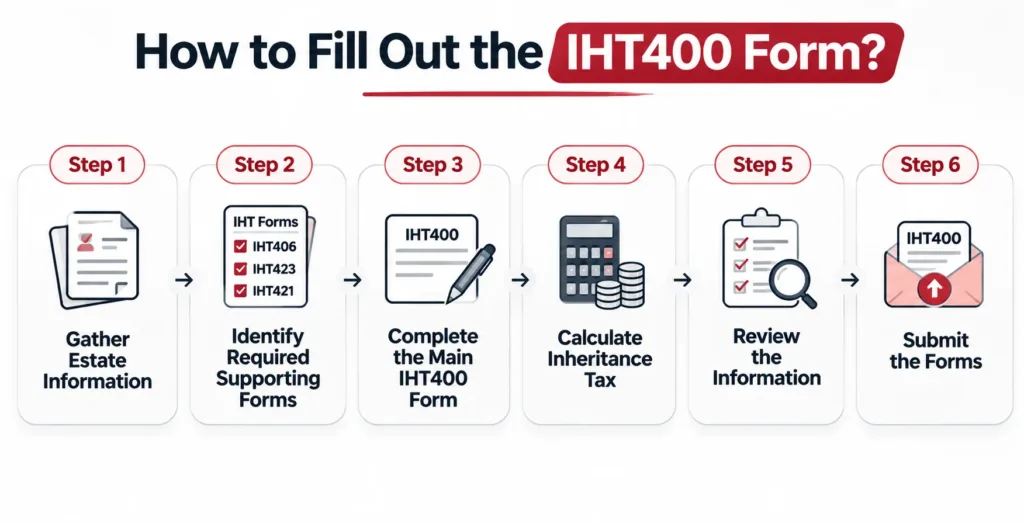
How to Fill Out the IHT400 Form?
Completing the IHT400 form can take time because every asset and liability must be reported accurately.
Step 1: Gather Estate Information
Collect this information:
- Death certificate
- Property valuations
- Bank statements
- Share certificates
- Pension information
- Loan statements
Step 2: Identify Required Supporting Forms
Review the IHT400 guidance notes to determine which schedules apply.
Common examples include:
- IHT406 form for savings and investments
- Form IHT406 for bank accounts
- IHT423 form for direct tax payments
- IHT421 form for UK probate applications
Step 3: Complete the Main IHT400 Form
Provide information about:
- The deceased
- Executors
- Estate value
- Relief claims
- Tax calculations
Step 4: Calculate Inheritance Tax
The IHT400 calculation considers:
- Gross estate value
- Allowable deductions
- Available reliefs
- Nil-rate bands
- Residence nil-rate band
Step 5: Review the Information
Double-check:
- Property values
- Bank balances
- Relief claims
- Tax calculations
Errors can delay probate and trigger HMRC inquiries.
Step 6: Submit the Forms
Send the completed inheritance tax form IHT400, along with all required schedules, to HMRC.
What Happens After I Submit the IHT400 Form?
After HMRC receives the IHT400 form, it reviews the estate information and tax calculation.
HMRC may:
- Accept the submission
- Request additional information
- Ask for supporting documents
- Query asset valuations
Once HMRC processes the application, it can issue the necessary probate information.
Do I Need to Complete IHT400 Before Applying for Probate?
Yes, in most cases. Where an estate requires the IHT400 form, executors normally submit the inheritance tax account before obtaining probate. HMRC processes the information and issues the relevant details required for the probate application. The IHT421 form plays an important role in this stage.
How to Submit the IHT400 Form?
The submission process involves several stages.
Step 1: Complete the Main Form
Fill in all required sections of the IHT400 form.
Step 2: Attach Supporting Schedules
Include relevant schedules such as:
- IHT406 form
- IHT423 form
- IHT405
- IHT411
- IHT417
Step 3: Calculate Any Tax Due
Complete the IHT400 calculation and determine whether tax is payable.
Step 4: Arrange Tax Payment
Where tax is due, payment may be made before probate.
The IHT423 form allows direct payment from certain bank accounts.
Step 5: Send Forms to HMRC
Submit the completed forms to HMRC using the address shown in the latest IHT400 guidance notes.
Step 6: Await HMRC processing
HMRC reviews the information and updates the probate process accordingly.
What Happens After the Submission of IHT400?
Once submitted, HMRC examines the estate information.
The department may:
- Verify valuations
- Review tax relief claims
- Check lifetime gifts
- Request clarification
If everything is correct, the estate administration can continue toward probate and final distribution.
What Is the Penalty for Filing HMRC IHT400 Late?
HMRC may impose penalties if required inheritance tax information is submitted late.
Possible consequences include:
- Financial penalties
- Interest charges
- Delays in probate
- Additional HMRC enquiries
The exact penalty depends on the circumstances and how late the submission is.
What Is an IHT400 Form Used For?
The IHT400 form provides HMRC with a complete account of a deceased person’s estate, including property, savings, investments, gifts, and other assets. HMRC uses the information to calculate any inheritance tax due, assess eligibility for available reliefs, verify the value of the estate, and support the probate process. Accurate completion of the inheritance tax form IHT400 is important because errors, missing information, or incorrect valuations can lead to delays in HMRC’s review and the administration of the estate.
Who Needs to Complete IHT400?
The responsibility usually falls on the following:
- Executors named in the will
- Administrators appointed by the court
- Personal representatives managing the estate
The individual completing the IHT400 must provide accurate information to HMRC.
How Long Does It Take to Complete IHT400?
The time required varies depending on the size and complexity of the estate.
Simple estates may take:
- 2 to 5 days to gather information
- 1 to 2 weeks to complete forms
More complex estates often take the following:
- Several weeks
- One to three months
Delays often occur while obtaining property valuations, investment statements, or foreign asset information.
Do I Need a Solicitor for IHT400?
No, a solicitor is not legally required. Many executors complete the IHT400 form themselves using the IHT400 guide and IHT400 guidance notes.
However, professional advice may help where the estate includes:
- Multiple properties
- Foreign assets
- Business interests
- Trusts
- Significant tax liabilities
Can I Complete the IHT400 Form Online?
Currently, most estates requiring an IHT400 must complete the form using the official HMRC paperwork and supporting schedules.
At present, full online submission options remain limited compared with simpler estate reporting processes. Always check the latest HMRC IHT400 guidance for current submission methods.
Do I Need to Fill in the Inheritance Tax Form?
If the estate falls within HMRC reporting requirements, yes.
Executors must complete either:
- The inheritance tax form IHT400, or
- Another estate reporting route permitted by HMRC
The correct form depends on the estate’s size and complexity.
Do HMRC check bank accounts for inheritance tax?
Yes. HMRC can verify information provided in the IHT400 forms by reviewing financial records and requesting information from banks, investment providers, and other institutions. This is why accurate reporting on the IHT406 form and related schedules is essential.
What Is the Difference Between IHT400 and IHT205?
If the estate contains substantial assets, foreign property, trusts, or tax liabilities, the IHT400 form is generally the correct option.
Do You Need Professional Help?
Need help completing the IHT400 form or handling inheritance tax and probate requirements? Xact+ Accountants can help you prepare tax forms, calculate liabilities and meet HMRC requirements.

About the Author: Ahmad Raza